
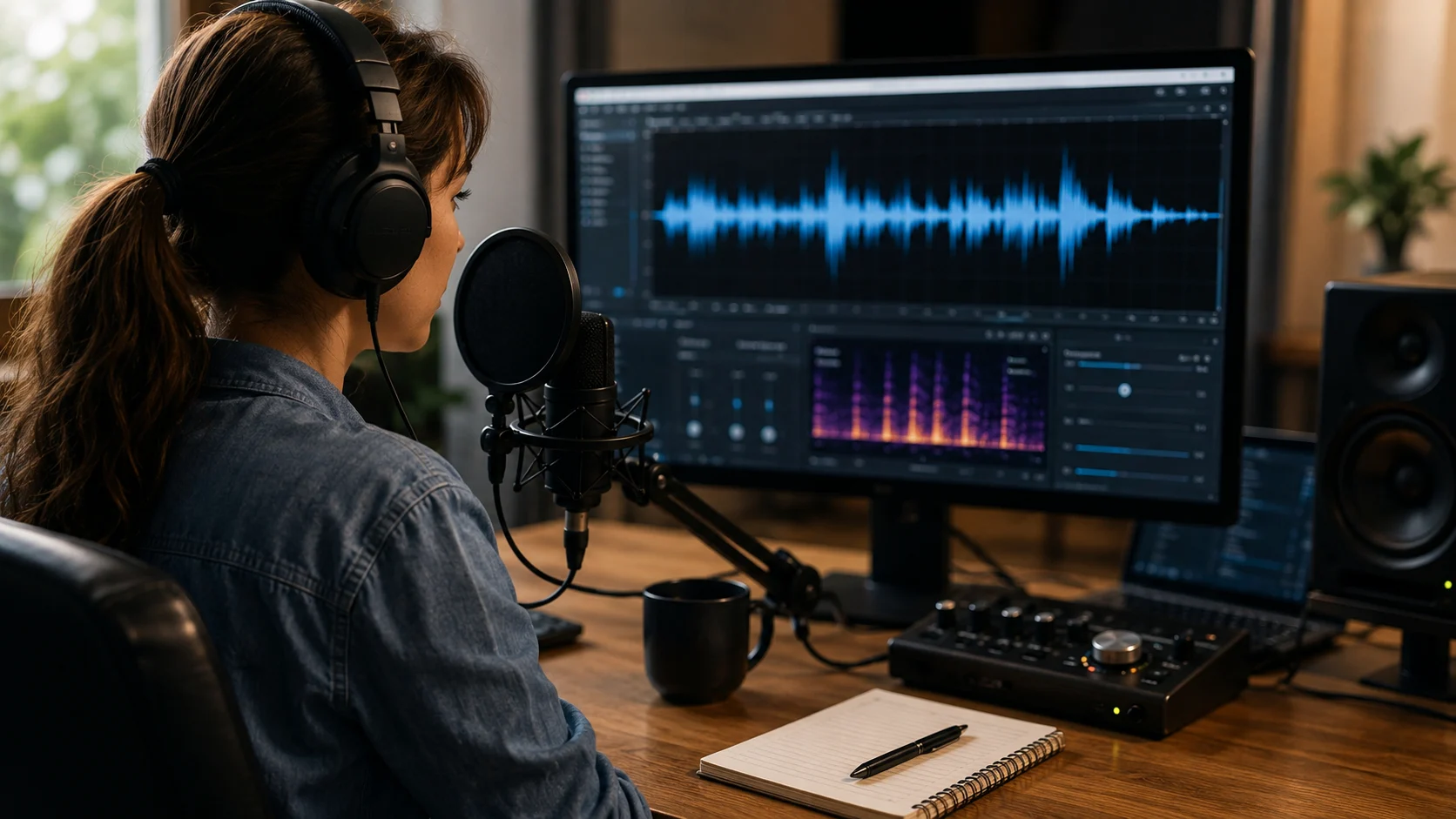
Synthetic speech has moved far beyond the robotic voices associated with early text-to-speech systems. Modern AI voice generator tools can produce expressive narration with varied pacing, intonation, and speaking styles.
These systems are used for audiobooks, accessibility, video narration, games, education, customer experiences, and application interfaces. The same realism that makes the technology useful also creates serious questions about consent and impersonation.
What Is an AI Voice Generator?
An AI voice generator converts text or another input into synthetic speech. Many products use neural text-to-speech models trained to reproduce the patterns of human speech.
The user typically enters text, chooses a voice, adjusts settings, and generates an audio file or real-time stream.
How Text Becomes Speech
A text-to-speech system must interpret pronunciation, sentence structure, punctuation, emphasis, and rhythm. It then generates acoustic representations and converts them into a waveform that can be played as audio.
Modern models can infer some emotional and stylistic cues from the text, although control differs between products.
Voice Libraries
Many services provide prebuilt voice libraries. Users can choose voices based on language, age-like qualities, style, pacing, or intended use.
This is often the simplest and safest option for general narration because the voices are offered specifically for synthetic speech use.
Voice Cloning
Some tools can create a synthetic voice from recorded samples of a person. This capability can support localization, accessibility, creative production, or preserving a consistent narrator.
It also creates obvious misuse risks. A cloned voice should only be created and used with appropriate consent and legal rights.
Real-Time Speech
Low-latency text-to-speech can power conversational assistants, games, accessibility tools, and live applications. In these situations, response speed matters almost as much as audio quality.
A highly expressive model that takes too long to generate may be unsuitable for an interactive voice agent.
Language and Accent Support
Voice models vary in language coverage and pronunciation quality. A multilingual model may speak many languages but perform better in some than others.
Test product names, local place names, abbreviations, numbers, and technical terminology before using a voice in production.
Choosing the Right Voice
A natural voice is not automatically appropriate for every project. Training content may benefit from clarity and moderate pacing. Fiction may need more expression. Accessibility may require predictable pronunciation and easy comprehension.
Listen to full paragraphs rather than short demo phrases because unnatural rhythm often becomes more noticeable in longer passages.
Editing and Regeneration
Good workflows let users regenerate a sentence without recreating an entire recording. Some tools allow control over pauses, pronunciation, stability, or style.
This can make AI narration much faster to revise than traditional recording when scripts change frequently.
Ethical Use and Disclosure
Synthetic speech can be used to impersonate real people, create fraudulent calls, or produce misleading media. Responsible use requires consent, security, and appropriate disclosure.
Organizations should establish clear rules for voice cloning and protect voice models from unauthorized access.
This is part of the broader responsible AI challenge around synthetic media.
Privacy
Voice recordings can be biometric and personally identifying. Users should understand how voice samples are stored and whether they can be deleted.
Businesses should also control who is allowed to create, use, or export cloned voices.
How to Compare AI Voice Tools
Evaluate naturalness, expressiveness, pronunciation, language coverage, latency, voice controls, cloning requirements, API support, editing workflow, commercial rights, privacy, and cost.
The best tool for a live voice assistant may be different from the best tool for an audiobook.
The Bottom Line
AI voice generators turn text into increasingly natural synthetic speech and can make narration, accessibility, localization, and interactive applications much easier to build.
Realistic speech is powerful, so it should be used with clear consent and safeguards. Choose a voice system for the actual workflow, verify pronunciation, and treat voice identity as sensitive information rather than just another design asset.
A Practical Checklist Before You Rely on Ai Voice Generators
Define the job first. Decide what success means before choosing a model or product. A system can look impressive in a demo while solving the wrong problem. Write down the expected output, the information it may use, the acceptable error rate, and which decisions still require a person.
Test representative examples. A useful first test is to generate a full paragraph containing names, numbers, abbreviations, emotion, and pauses instead of judging only a short demo sentence. Include normal cases and difficult edge cases. The goal is to learn where the system is dependable and where it needs stronger instructions, additional tools, or human review.
Verify important outputs. Do not confuse fluency with correctness. Check facts, calculations, citations, permissions, and important transformations against a reliable source. The more expensive or difficult an error would be to reverse, the stronger the verification process should be.
Review privacy and access. Understand what information is being sent to the system, where it is stored, and who can retrieve it later. Give connected AI tools only the permissions they need. Sensitive data should follow the same governance rules that apply elsewhere in the organization.
Measure value over time. Track time saved, correction rate, reliability, user satisfaction, and operational cost. A tool that feels fast during the first week may not create lasting value if people spend the same amount of time fixing its output.
Common Mistakes to Avoid
One common mistake is choosing technology before defining the workflow. Another is testing only ideal examples. Teams also tend to add automation without planning what happens when the model is uncertain, the data is missing, or a connected service fails.
The most important limitation to keep in mind is that realistic synthetic speech increases the risk of impersonation and requires strong consent and access controls. Build the workflow around that reality rather than assuming future model improvements will automatically solve it.
Frequently Asked Questions
Is AI voice generators always more accurate than a simpler approach?
No. AI is valuable when the task benefits from language understanding, pattern recognition, generation, or flexible decision support. A deterministic rule, database query, spreadsheet formula, or conventional software function can be better when the task is predictable and exact.
Should I pay for a AI voice generators product immediately?
Usually not. Start with a free tier, trial, or small pilot when one is available. Use it on real work and measure whether it saves time or improves quality. A paid plan becomes easier to justify when limits, collaboration, privacy, integrations, or higher-quality features solve a recurring problem.
What is the safest way to start using AI voice generators?
Begin with a narrow, reversible use case. Keep source material or original data available, review the output manually, and document the situations where the system fails. Expand automation only after the workflow performs consistently on representative examples and users know how to recover when it is wrong.