Not every AI request needs a powerful, expensive model. Correcting a short product description, extracting a date, summarizing a contract, and reasoning through a complex exception have different accuracy, latency, and privacy requirements. AI model routing is the practice of selecting a model or processing path for each request according to those requirements. Done well, it can improve the balance between quality, cost, and reliability. Done carelessly, it can introduce inconsistent outputs and hard-to-debug failures.
A routing system is more than a list of model names. It needs rules for understanding task difficulty, approved data handling, fallback behavior, quality measurement, and version changes. This guide focuses on decisions an application team can control rather than treating automatic routing as a magic optimization.
The basic architecture
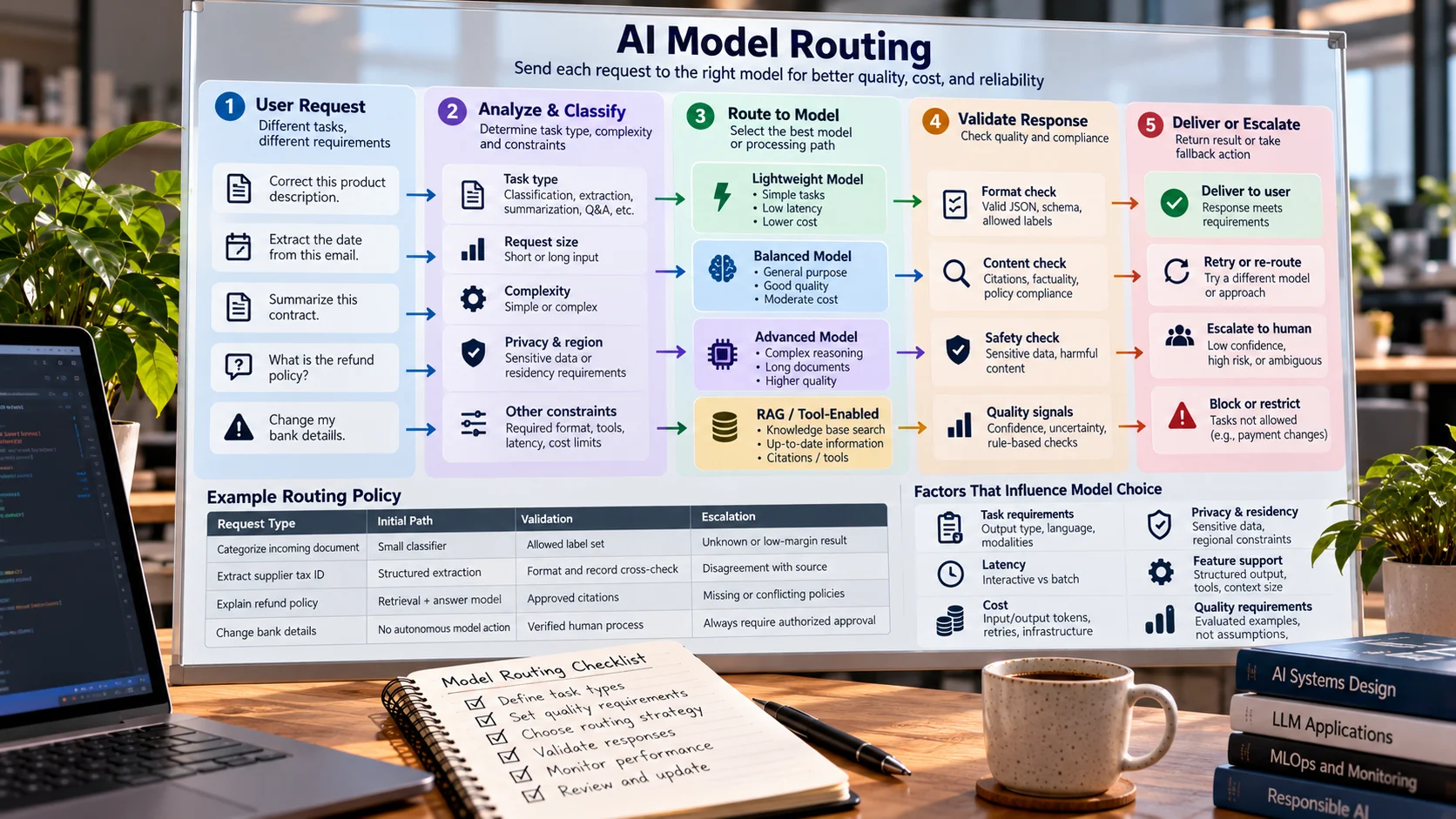
A user request reaches the application. Before sending it to a model, the application may classify its task type, inspect request size, identify privacy or regional constraints, estimate complexity, and select an approved model. After the model responds, the application validates the result and may retry, escalate, or request human review under defined conditions.
For example, a support workflow might direct simple intent classification to a lightweight model, knowledge-base answers to a retrieval-assisted model, and complex billing exceptions to a stronger model with stricter validation. The customer should not be exposed to unexplained quality differences. Routing is successful only if the overall workflow remains predictable and accountable.
A router can use fixed rules, a separate classifier, confidence or uncertainty indicators, learned quality predictors, or staged evaluation of intermediate responses. Each approach has different operational costs. Starting with straightforward, observable rules is often more practical for a small team than immediately deploying a learned router whose decisions are difficult to explain.
What should influence model choice?
Task requirements come first. A short classification output, a structured JSON object, a multilingual conversation, and analysis of a long document demand different capabilities. Define quality requirements using evaluated examples rather than assumptions that one model is always sufficient or that the biggest model is always better.
Latency matters for interactive interfaces. A customer waiting for a live response experiences delays differently from a nightly reporting job. Cost depends on input and output token volume, inference pricing, retries, cache behavior, and operational overhead. Privacy and residency can exclude some providers or routing paths even when they appear attractive on speed or price.
Consider also feature support. Some models support particular structured-output modes, tool calls, context sizes, or modalities; others do not. A fallback must preserve the application contract. Routing a JSON-schema task to a model that cannot reliably follow the schema can break downstream systems despite apparently successful generation.
Static rules versus intelligent routing
Static routing is explicit: “If the task is sentiment classification and the input is shorter than a defined bound, use approved Model A; otherwise use Model B.” It is easy to audit and change, but task complexity is not always visible from length or keywords. A short sentence may contain a difficult legal ambiguity, while a lengthy document may only need a straightforward extraction.
A learned router may predict which model is likely to achieve acceptable quality for a particular prompt. Amazon Bedrock’s documented intelligent prompt routing is an example of provider-managed selection between supported models within a defined family, with stated support and limitations that can change over time. Such services should be evaluated against the organization’s own task distribution instead of assuming the provider’s aggregate improvement applies universally.
A cascade is another option. Start with a lower-cost model, check the response against a known requirement, and escalate difficult cases. This can work when a validator has meaningful evidence—for example, a schema check or a comparison against authoritative records. A fluent model’s self-declared confidence is a weak escalation signal unless it has been calibrated and tested for the task.
A worked routing policy for document requests
Imagine an internal assistant handling three request types: document classification, extracting fields from supplier forms, and answering policy questions. A sensible initial policy might use a lightweight classifier for categories, a schema-capable extraction model for fields, and retrieval-backed generation for policy questions. High-risk or ambiguous cases route to manual review.
Request Initial path Validation Escalation
Categorize incoming document Small classifier Allowed label set Unknown or low-margin result
Extract supplier tax ID Structured extraction Format and record cross-check Disagreement with source
Explain refund policy Retrieval + answer model Approved citations Missing or conflicting policies
Change bank details No autonomous model action Verified human process Always require authorized approval
This is an illustrative workflow, not a recommendation that AI approve changes to payment information. It demonstrates an essential principle: some tasks should route away from autonomous AI, regardless of what a powerful model can technically generate.
Defining quality before optimizing costs
Before routing, create a representative evaluation set. Include common, difficult, multilingual, long-input, low-context, and adversarially phrased requests where relevant. For extraction, measure exact field correctness and missing-field behavior. For knowledge answers, evaluate supported claims and citation relevance. For classification, inspect confusion among high-cost categories. Record latency and cost per resolved task, including retries.
Test each candidate model on the same cases, then simulate routing decisions. Compare the routed system against a strong single-model baseline. A router may appear economical because it sends most traffic to a cheap model but spend the savings on retries or human correction. Count those downstream costs and errors rather than only raw token spending.
Define a quality floor for each class of task. If the system violates that floor in a meaningful subgroup, savings are not a sufficient justification. Customers experience the weakest failure cases, not just averages.
Reliability and fallback design
Provider outages, rate limits, timeouts, and version changes will occur. Routing policy should distinguish temporary infrastructure failures from semantic failures. A timeout may justify retrying through an approved alternate path with idempotency controls. An unsupported-language answer may require a different capability or human escalation. Automatically trying five models in sequence without bounded retries can amplify cost and turn one outage into an application-wide problem.
Fallbacks should be compatible with the expected schema, content policy, authorization rules, and region restrictions. If no approved alternative exists, return a clear degraded-service message rather than silently sending private data to a prohibited provider. The system should log which model was selected, which policy version was used, and why a fallback occurred, without retaining unnecessary sensitive content.
Routing decisions themselves can fail. A classifier may mislabel a risky request as simple, or an optimization threshold may become stale after models are updated. Audit samples regularly and allow operators to disable or override routing rules safely.
A simple, transparent routing function
This pseudocode uses a small set of rules. Production systems need authentication, provider-specific adapters, robust error handling, and tested validation.
def choose_path(request):
if request.contains_restricted_data:
return “approved_private_path”
if request.requires_payment_action:
return “human_approval”
if request.task == “classification” and request.length < 1500:
return "small_classifier"
if request.task == "policy_question":
return "retrieval_answer"
return "general_approved_model"
The function is deliberately conservative. It makes the data-handling decision before considering price. It also illustrates why routing should not be driven by prompt wording alone: trusted application metadata, task contracts, and verified permissions are better inputs than a customer's claim that their request is harmless.
The risk of uneven user experience
If two users ask similar questions and receive inconsistent levels of accuracy, routing may damage trust. Differences can arise from threshold boundaries, fluctuating model availability, language support, or context truncation. Track consistency across near-duplicate requests and make sure policies do not systematically disadvantage particular languages or customer segments.
Customer-facing applications may benefit from routing transparency at an appropriate level: for example, describing that answers are generated with AI and that complex cases may receive additional review. Exposing raw provider names is not always necessary, but making unsupported guarantees of identical responses is unwise. Monitoring should connect response quality with the chosen model and route.
A/B tests of routing strategies should compare genuine outcomes under controlled conditions. Do not send high-stakes requests to a weaker model simply to obtain optimization data. Maintain opt-in, governance, and evaluation practices appropriate to the application.
Version management and observability
Treat routing rules like software releases. Each request log can store non-sensitive metadata about task category, policy version, model version, input/output token counts, latency, validation outcome, fallback event, and final disposition. This allows teams to investigate a rise in corrections after an update. Model pricing and capability descriptions change, so maintain a controlled registry rather than hardcoding assumptions forever.
Run evaluation suites when adding or removing a model. A better model for English summaries may not improve numeric extraction or multilingual support. Evaluate the route's decision boundaries, not just individual models. Consider a shadow-test phase where proposed route decisions are recorded but the actual production response still uses the existing trusted path.
The related ByteScope article on small language models explains why smaller systems can be useful for constrained tasks. Our discussion of AI inference provides context for the runtime and latency trade-offs behind model selection.
Common traps in cost optimization
A popular mistake is optimizing price per million tokens instead of cost per successful task. If a cheap model requires repeated calls and extensive editing, it may be more expensive overall. Another mistake is assuming prompt length perfectly predicts difficulty. A third is treating model updates as interchangeable versions; output schemas, refusal behavior, and reasoning style can change in ways that invalidate historical routing thresholds.
Be careful about caching. Reusing a previous response may save cost for generic questions but can be wrong for time-sensitive account data. Invalidate caches according to source freshness and permission boundaries. Similarly, batching and asynchronous jobs can reduce overhead for suitable workloads but are not substitutes for a reliable interactive fallback policy.
Routing long and multilingual inputs
Task complexity cannot be estimated from token count alone. A 5,000-word memo may require extracting one date, while a ten-word legal question may involve a subtle conflict between definitions. Build evaluation strata based on the type of reasoning, ambiguity, modality, and source-grounding requirement rather than only input length.
Multilingual routing needs additional caution. One candidate model may perform well on English customer-support messages but misunderstand a regional language or code-switching. If a router uses English-centric complexity labels, it may systematically send difficult non-English requests to an unsuitable low-cost path. Measure routing accuracy and downstream quality separately for the languages actually used by customers.
Testing a model-router rollback
Before enabling learned routing for all traffic, preserve a stable single-model fallback and test the ability to return to it quickly. A rollback must preserve response schemas and data-handling obligations. Record model and router versions so a failure can be reproduced. If a proposed path sends confidential information to a new provider, require explicit approval rather than assuming that emergency fallback can relax privacy policy.
During a pilot, compare the new router's outcomes against the baseline using the same representative requests. Investigate cases where the router saved a small amount but missed a critical fact. This analysis often reveals that routing policy needs task-specific exclusions, not merely a different global threshold.
Avoid confusing routing accuracy with answer quality
An AI router can correctly predict that a request is short or inexpensive and still select a model that gives a poor answer. The relevant outcome is whether the chosen route satisfies the user's actual task and service constraints. Create a labeled collection of requests covering routine summaries, complex analysis, sensitive information, tool use, and ambiguous instructions. For each route, record the selected model, task success, failure type, latency, and actual cost. If an ostensibly cheaper model creates enough corrections or escalations, its initial price advantage may disappear. Include a fallback that detects unsupported capabilities such as missing tools or document context. Routing should also preserve privacy requirements: a request cannot move to an otherwise attractive provider if the organization has not approved that destination for its data. A good router is an accountable decision policy, not simply a classifier that produces model names.
A cost-quality experiment with a fixed review budget
Suppose a team evaluates 300 representative support requests using a strong baseline model and a proposed routed system. Human reviewers judge whether each response solves the customer's problem, identify unsupported claims, and record time spent correcting failures. The team then calculates cost per accepted answer, not just cost per generation.
A routed setup that saves 35% in token charges but requires twice as many escalations may not be an improvement. Conversely, routing routine requests to a smaller model while preserving the strongest model for complex cases may produce real savings without reducing quality. Because the sample is finite, report uncertainty and inspect high-cost error types rather than claiming universal superiority from one trial.
Frequently asked questions
Do I need several AI providers to use model routing?
No. Routing can select among models from one provider or even among different task-specific processing paths. The key idea is choosing an appropriate capability according to requirements.
Can a router guarantee the best model every time?
No. Routing decisions are estimates informed by rules or predictors. Some difficult requests look simple, and model behavior is probabilistic. Evaluate errors and maintain safe fallback mechanisms.
Should users be allowed to choose a model directly?
Sometimes. Expert users may benefit from explicit selection, while everyday workflows often need a consistent managed experience. User control should not override privacy, compliance, or authorization restrictions.
Conclusion
Effective AI model routing starts with clearly defined tasks, quality floors, and non-negotiable data-handling rules. Only then should teams optimize latency and cost. Compare routed decisions against a strong baseline, log the route as part of every result, and treat fallback behavior as a core product feature. The goal is not to use the cheapest model as often as possible; it is to deliver dependable outcomes with an appropriate amount of computing and oversight.
References
Amazon Bedrock: Intelligent prompt routing
NIST AI Risk Management Framework