
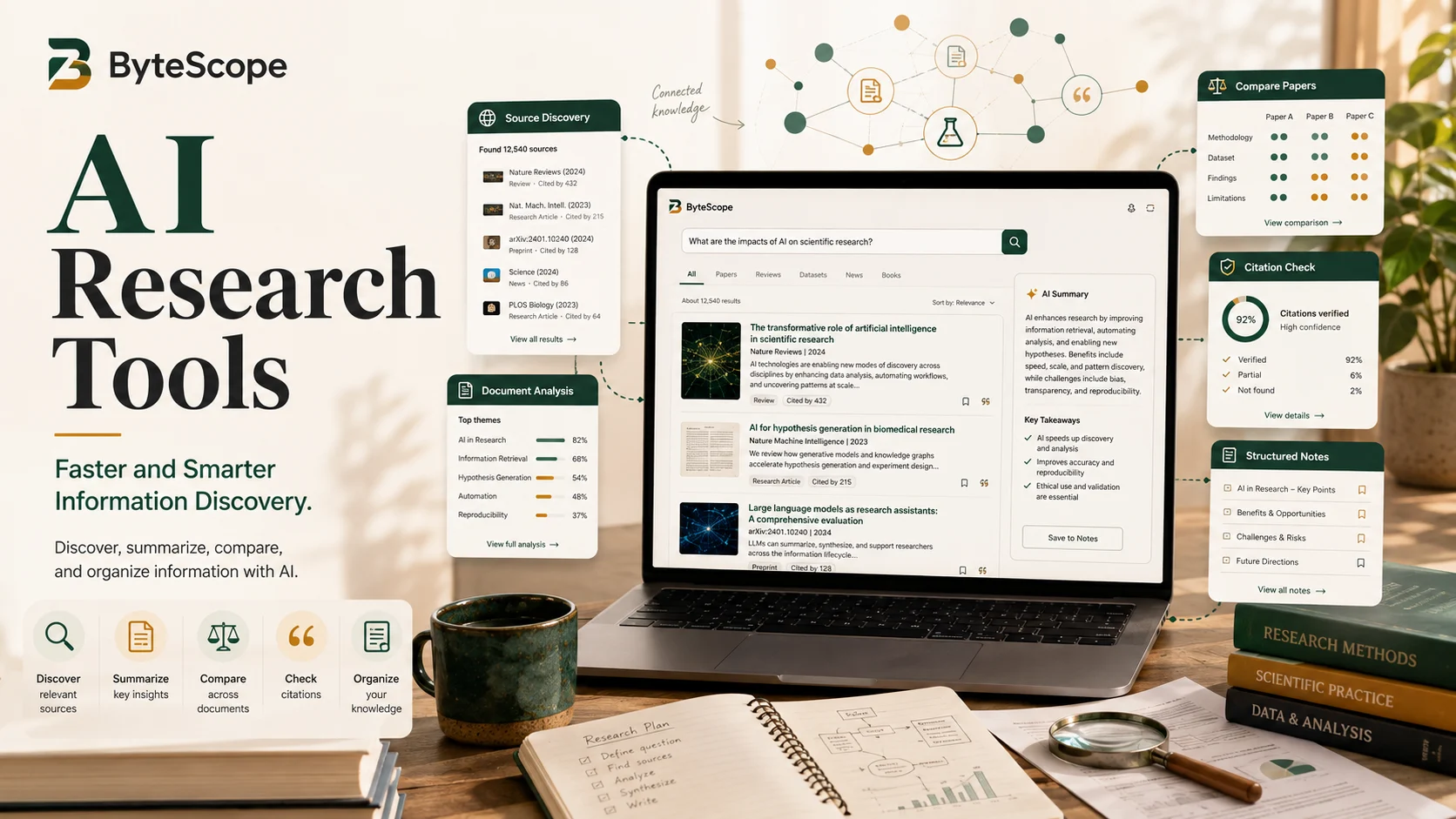
Finding information is easy; finding the right information is harder. A single search can return thousands of pages, many repeating the same claims, relying on outdated sources, or presenting conflicting conclusions. Researchers, students, journalists, and professionals often spend more time sorting results than understanding them. AI research tools can reduce that friction by helping users discover sources, summarize documents, compare ideas, and organize findings. Their value is not that they replace research, but that they make information discovery faster and more structured.
What Are AI Research Tools?
AI research tools use artificial intelligence and language models to support searching, summarizing, extracting key ideas, comparing sources, and organizing information. Traditional search engines are excellent at locating pages across the web, while AI-powered research tools can add another layer by interpreting a question and helping users work with what they find. The two approaches are complementary rather than interchangeable. Search is often best for broad discovery and direct access to sources, while AI can help users make sense of larger collections of material.
Why Information Discovery Has Become More Difficult
The modern research problem is rarely a lack of information. It is deciding which information is relevant, credible, current, and worth reading in full. Duplicate articles, low-quality summaries, outdated pages, technical papers, and competing viewpoints can make even a simple topic time-consuming to investigate. This is especially difficult when a user is unfamiliar with the subject and does not yet know which terminology or sources matter. AI research tools can help narrow the field, but they work best when they guide attention rather than make final judgments.
How AI Research Tools Support Discovery and Understanding
One of the strongest uses of AI in research is filtering. A research assistant can identify recurring themes, extract important concepts from long documents, or summarize a report before the user decides whether it deserves deeper reading. It can also compare documents and highlight where they agree or differ, which is useful when a topic has conflicting evidence. For complex material, AI can translate technical language into simpler explanations, helping beginners build enough context to approach the original source with more confidence.
The same tools can improve organization by grouping findings, creating structured notes, and connecting related ideas. That is useful in long projects, but users should still check whether important context or contradictory evidence disappeared during summarization.
Finding and Evaluating Reliable Sources
Source discovery is one of the most practical areas for AI research tools. They can help users locate academic papers, reports, documentation, articles, and other material relevant to a research question. However, finding a source is not the same as establishing that it is reliable. A strong workflow still requires checking the original publication, author or institution, publication date, methodology when relevant, and whether the source actually supports the claim being made.
This matters because AI systems can sometimes produce incorrect or fabricated citations. A reference that looks convincing may point to the wrong document, misstate an author, or fail to exist. Citations should therefore be treated as leads that must be verified, not as automatic proof. When a topic may influence an academic conclusion, business decision, health choice, or public claim, the original source deserves direct review.
Different Types of AI Research Tools
AI research tools generally fall into overlapping categories. AI search and discovery tools focus on locating information and presenting source-linked answers, while academic research tools are designed around scientific papers and literature. Document-analysis tools help users work with PDFs, reports, and long text, while knowledge or note-taking systems focus on organizing material across a project. General AI assistants can support brainstorming, explanation, comparison, and summarization across many topics.
The right category depends on the job. A student starting a literature review may need academic search and citation support, while a journalist comparing reports may benefit more from document analysis. A business analyst could prioritize fast comparison and structured notes, while a content creator might mainly need topic exploration and source discovery. Choosing by use case is usually more useful than choosing whichever product has the longest feature list.
What to Look for in an AI Research Tool
The most important qualities are source transparency, accuracy, context handling, and fit with the user’s workflow. A tool is more useful when it clearly shows where information comes from and makes it easy to open the original source. Support for long documents, citations, notes, or multiple files can matter for deeper research, while ease of use may matter more for quick discovery. Privacy also deserves attention when users upload confidential reports, unpublished research, internal business documents, or personal data.
Cost should be judged by value rather than price alone. Before committing, test the same research task in several tools and compare source quality, accuracy, clarity, and how much verification is still required afterward.
Limitations and a Better Research Workflow
AI research tools can hallucinate facts, misread documents, miss context, rely on biased sources, or summarize an argument too aggressively. They may also surface outdated material or make two sources appear more consistent than they really are. Overreliance on summaries creates another problem because users can lose nuance that matters in research. These limitations mean that AI should accelerate research, not become the final authority.
A practical workflow is to use AI to discover and explore a topic, verify important claims in original sources, compare competing evidence, organize findings, and finally synthesize the information using human judgment. The verification stage is the critical safeguard. AI can reduce the time spent navigating information, but the user remains responsible for deciding what is credible, relevant, and appropriate to use.
The Future of AI-Powered Research
AI-powered research is likely to become more integrated with search, document management, productivity software, and professional knowledge systems. The most useful progress may not be simply faster answers, but better ways to connect related sources, surface contradictions, and help people work across large collections of information. For students, researchers, journalists, analysts, and other knowledge workers, that could make complex research more manageable without removing the need for expertise.
Conclusion
AI research tools can make information discovery faster by helping users search, summarize, compare, and organize material that would otherwise require significant manual effort. Their strongest role is as research assistants that reduce friction and help people decide where to focus their attention. They are not automatic sources of truth, and their outputs still need to be checked against reliable original material.
Good research continues to depend on source quality, context, verification, critical thinking, and human judgment. Used with those principles in place, AI can make the process more efficient without weakening its standards. The real advantage is not simply finding more information in less time, but creating a clearer path from discovery to understanding.