
Machine learning often works behind the scenes of services people use every day. A music app suggests songs based on listening habits, an email service filters spam, and an online store recommends products that seem relevant. These systems are not following a fixed rule for every possible situation. Instead, they rely on patterns learned from data. That raises a simple question: how do computers learn to make these decisions? The answer lies in Machine Learning, one of the most important approaches used in modern Artificial Intelligence.
What Is Machine Learning?
Machine Learning is a method within Artificial Intelligence that allows computers to learn patterns from data and use those patterns to make predictions, classifications, recommendations, or decisions. In traditional programming, a developer usually writes explicit rules that tell a computer what to do. In Machine Learning, the system is given examples and an algorithm that helps it discover useful relationships in the data. The computer is not learning in the human sense; it is adjusting mathematical parameters so that its outputs become more accurate.
How Machine Learning Works
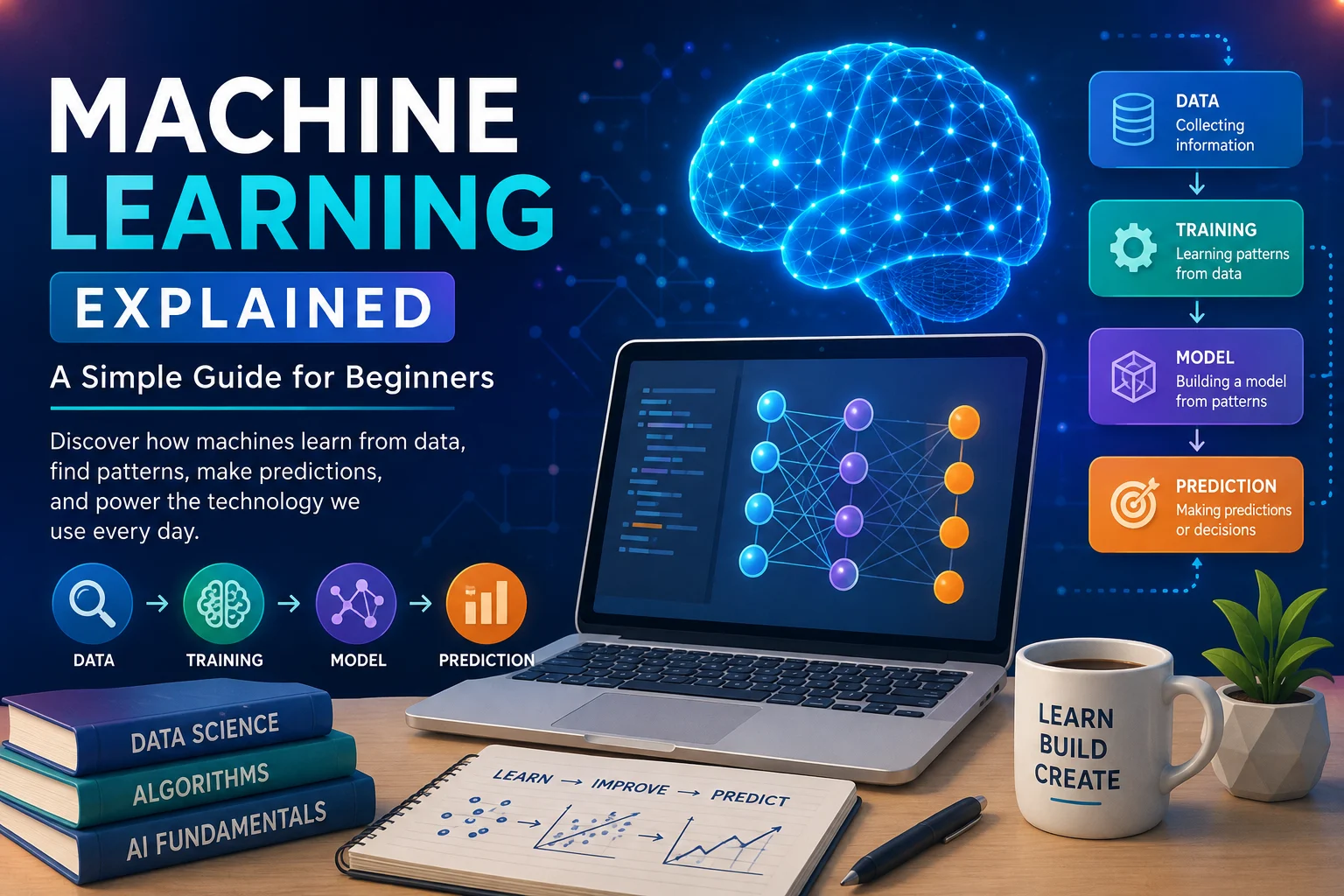
The basic process can be understood as data, training, model, prediction, and evaluation. First, the system receives data that represents the problem it needs to solve. During training, an algorithm analyzes that data and adjusts the model to capture useful patterns. Once training is complete, the model can process new data it has never seen before and generate an output. Its performance is then evaluated to see how well those predictions match the expected result.
Imagine a spam filter. The training data might contain emails labeled as either spam or not spam. The algorithm studies differences between the two groups, and the resulting model learns which combinations of signals are useful. When a new email arrives, the model applies what it learned and estimates whether the message is likely to be spam.
Why Data Matters
Data is the foundation of most Machine Learning systems because the model can only learn from the examples it receives. Training data may include numbers, text, images, audio, transaction records, or other information. Some datasets also include labels, which are known answers attached to examples. Features are the measurable characteristics the system uses, such as words in an email or color patterns in an image.
The quality of the data matters as much as the quantity. If examples are inaccurate, unbalanced, or too limited, the model may learn misleading patterns. A system trained mostly on one type of situation may perform poorly when it encounters something different. Poor data can clearly limit what the model can learn.
What Is a Machine Learning Model?
A Machine Learning model is the result of the training process. It can be thought of as a learned set of relationships that turns new input into a prediction or other output. The training data is used to build the model, but the model is what gets applied later when new information appears. For example, after a model has been trained to recognize handwritten digits, it can receive a new image and estimate which number it represents by applying patterns learned during training.
The Main Types of Machine Learning
Supervised learning uses examples with known labels or target values. A model might learn from emails already marked as spam, or from houses where both property details and sale prices are known. The goal is to learn a relationship that can be applied to new cases. This approach is common when there is a clear answer the model is expected to predict.
Unsupervised learning works differently because the data does not come with a predefined target. Instead, the system searches for structure, similarities, or groups within the data. A business might use this approach to identify groups of customers with similar behavior. Reinforcement learning uses feedback in the form of rewards or penalties, allowing a system to improve its actions over time. It is often associated with game playing, robotics, and decision-making problems.
How Machine Learning Learns From Mistakes
Training is an iterative process rather than a single moment when the computer becomes accurate. The model makes predictions, measures how far those predictions are from the desired result, and adjusts its internal parameters. Repeating this cycle can gradually improve performance. An algorithm is simply a method used to process data and solve a problem; in Machine Learning, algorithms combine with training data and repeated adjustment to produce a useful model.
Machine Learning and Artificial Intelligence
Artificial Intelligence is the broader field concerned with building systems that perform tasks associated with intelligent behavior, while Machine Learning is one important way to build those systems. Not every AI system must rely on Machine Learning, but many modern applications do. Recommendation engines, image recognition, speech processing, fraud detection, and many generative AI systems depend heavily on Machine Learning methods.
Real-World Uses and Limitations
Machine Learning is used in search engines to rank results, in streaming platforms to recommend content, and in banking to detect unusual transactions. It also supports speech recognition, product recommendations, image analysis, cybersecurity tools, and parts of healthcare and transportation systems. In each case, the model is designed for a specific task and depends on the data, training process, and decisions made by the people who build it.
These systems can still make mistakes. Poor-quality or biased data may lead to poor predictions, while changing real-world conditions can make previously useful patterns less reliable. Overfitting is another problem, where a model learns the training data too closely and struggles with new examples. Machine Learning also lacks human judgment, and sensitive applications can raise privacy, fairness, security, and accountability concerns.
The Future of Machine Learning
Machine Learning will likely become more deeply integrated into software, automation, research, business, healthcare, education, and robotics. Progress will come from better models, better data practices, and stronger integration with everyday tools. At the same time, improvements in capability will need to be balanced with reliability, transparency, privacy, and responsible use.
Understanding the basics does not require advanced programming or mathematics. Those skills become more important for anyone who wants to build Machine Learning systems, but beginners can first focus on the core idea: data is used to train a model, and the model uses learned patterns to make predictions about new information.
Conclusion
Machine Learning is one of the central technologies behind modern Artificial Intelligence. It works by using data and algorithms to discover patterns, training a model from those patterns, and applying that model to new inputs. Supervised, unsupervised, and reinforcement learning provide different ways for systems to learn depending on the problem and the type of feedback available.
Its power comes from the ability to process large amounts of data and find relationships that would be difficult to express as fixed rules. Its limitations come from the same source: models depend heavily on the data and assumptions used during training. For beginners, understanding this balance is the best way to see Machine Learning realistically—as a powerful pattern-learning technology that can support useful decisions without thinking or understanding the world like a human.