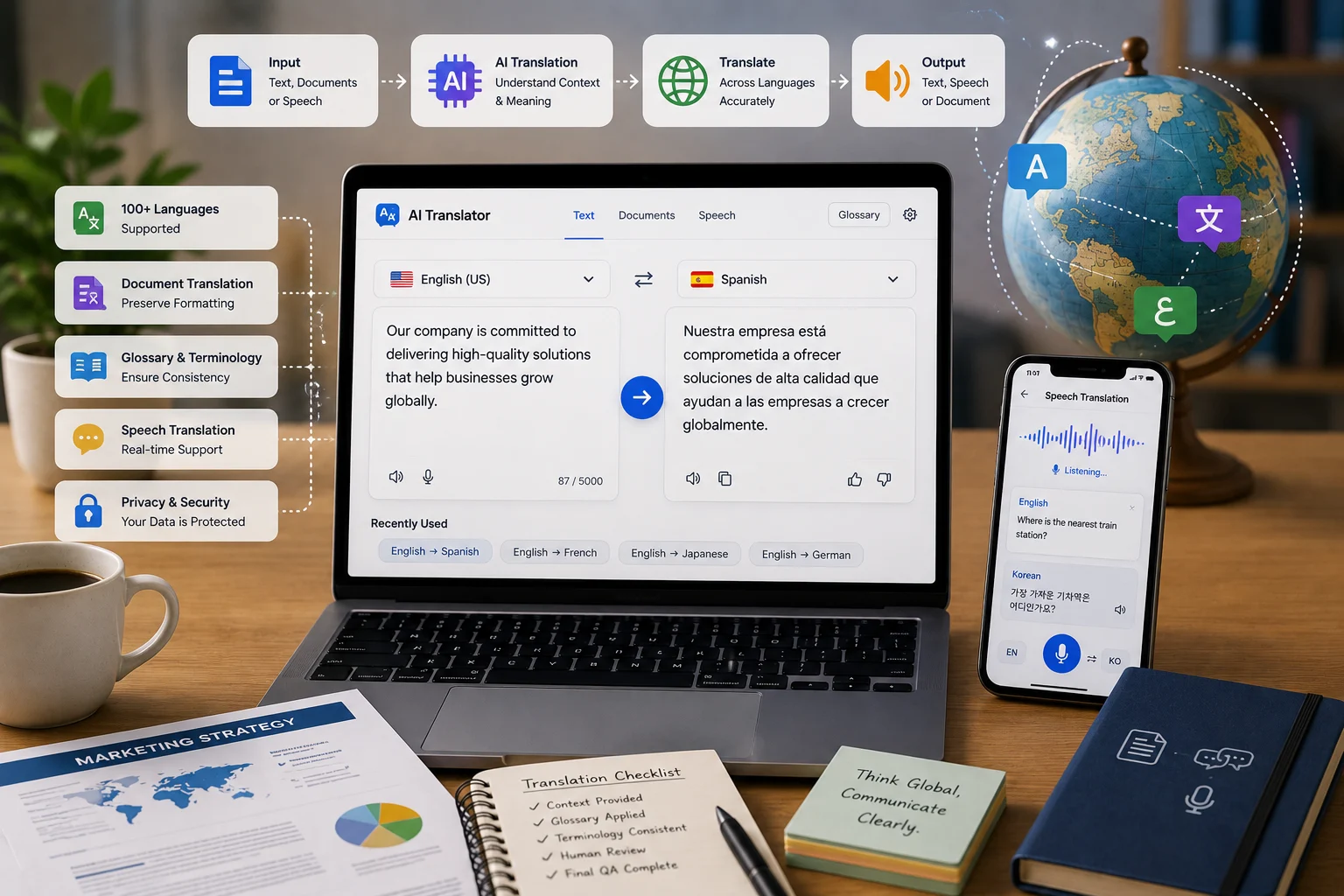
Online translation has existed for years, but modern AI translation tools can work with more context, preserve document formatting, adapt terminology, and increasingly support live speech. This makes multilingual communication faster for individuals, teams, and global businesses.
Translation remains a difficult language task. A sentence can have several valid translations depending on tone, industry, audience, and cultural context. AI can accelerate the work, but important communication may still need human review.
How AI Translation Works
Modern translation systems use neural networks trained on multilingual data. Instead of replacing each word independently, the model considers the sentence and surrounding context to generate a target-language version.
This allows better handling of grammar, idioms, word order, and meaning than simple dictionary substitution.
Text Translation
For everyday use, text translation is the simplest workflow: paste a passage, choose a target language, and receive a translated version.
The best results come from clear source writing. Ambiguous sentences, unexplained abbreviations, and inconsistent terminology make translation harder for both AI and human translators.
Document Translation
Business users often need complete Word, PDF, or presentation files translated without rebuilding the layout. Some tools can translate documents while preserving formatting and visual structure.
DeepL, for example, supports text, document, and speech-oriented translation workflows and provides business features such as glossary controls.
Glossaries and Terminology
Consistent terminology matters in technical, legal, medical, and brand communication. A glossary tells the system how specific terms should be translated.
This can prevent a product name or specialized phrase from being translated differently across hundreds of documents.
AI Translation for Speech
Real-time speech translation combines several AI tasks: speech recognition, translation, and often text-to-speech or caption generation.
Each stage can introduce errors. Background noise may affect the transcript before translation even begins.
For important meetings, participants should confirm critical numbers, names, decisions, and obligations.
Translation vs. Writing Assistance
Sometimes the goal is not literal translation but localization. Marketing copy may need a different tone or phrasing for another market.
An AI writing system can adapt style after translation, but users should clearly distinguish between “translate accurately” and “rewrite naturally for this audience.” Those are different tasks.
Context Makes a Difference
A single sentence can be ambiguous when removed from its document. Providing the surrounding paragraph, document type, target audience, and desired tone can improve the output.
This is a practical application of prompt engineering: give the system enough information to interpret the intended meaning.
When Human Review Is Important
Legal agreements, medical information, safety instructions, immigration documents, financial disclosures, and public-facing brand copy can carry high consequences.
In those cases, professional review may be necessary even when AI produces a fluent translation.
Privacy and Confidential Documents
Before uploading contracts, customer data, internal strategy, or personal records, review the provider’s data handling and enterprise privacy options.
Organizations may need controls for retention, regional processing, access, and whether submitted content is used to improve services.
How to Compare Translation Tools
Test the languages and content types you actually use. Compare terminology accuracy, tone, document formatting, speech support, glossary features, integrations, privacy, editing workflow, and cost.
Do not rely only on a generic claim that one tool is “most accurate.” Translation quality depends on the language pair and domain.
The Bottom Line
AI translation tools make multilingual communication faster by translating text, documents, and increasingly speech while considering more context than older rule-based systems.
They are powerful productivity tools, but fluent output can still contain subtle meaning errors. Use glossaries, provide context, and involve qualified human reviewers when the consequences of a mistranslation are significant.
A Practical Checklist Before You Rely on Ai Translation Tools
Define the job first. Decide what success means before choosing a model or product. A system can look impressive in a demo while solving the wrong problem. Write down the expected output, the information it may use, the acceptable error rate, and which decisions still require a person.
Test representative examples. A useful first test is to test your real language pair with product names, technical terms, formal writing, and ambiguous sentences. Include normal cases and difficult edge cases. The goal is to learn where the system is dependable and where it needs stronger instructions, additional tools, or human review.
Verify important outputs. Do not confuse fluency with correctness. Check facts, calculations, citations, permissions, and important transformations against a reliable source. The more expensive or difficult an error would be to reverse, the stronger the verification process should be.
Review privacy and access. Understand what information is being sent to the system, where it is stored, and who can retrieve it later. Give connected AI tools only the permissions they need. Sensitive data should follow the same governance rules that apply elsewhere in the organization.
Measure value over time. Track time saved, correction rate, reliability, user satisfaction, and operational cost. A tool that feels fast during the first week may not create lasting value if people spend the same amount of time fixing its output.
Common Mistakes to Avoid
One common mistake is choosing technology before defining the workflow. Another is testing only ideal examples. Teams also tend to add automation without planning what happens when the model is uncertain, the data is missing, or a connected service fails.
The most important limitation to keep in mind is that a grammatically fluent translation can still be wrong in tone, legal meaning, or domain terminology. Build the workflow around that reality rather than assuming future model improvements will automatically solve it.
Frequently Asked Questions
Is AI translation tools always more accurate than a simpler approach?
No. AI is valuable when the task benefits from language understanding, pattern recognition, generation, or flexible decision support. A deterministic rule, database query, spreadsheet formula, or conventional software function can be better when the task is predictable and exact.
Should I pay for a AI translation tools product immediately?
Usually not. Start with a free tier, trial, or small pilot when one is available. Use it on real work and measure whether it saves time or improves quality. A paid plan becomes easier to justify when limits, collaboration, privacy, integrations, or higher-quality features solve a recurring problem.
What is the safest way to start using AI translation tools?
Begin with a narrow, reversible use case. Keep source material or original data available, review the output manually, and document the situations where the system fails. Expand automation only after the workflow performs consistently on representative examples and users know how to recover when it is wrong.