
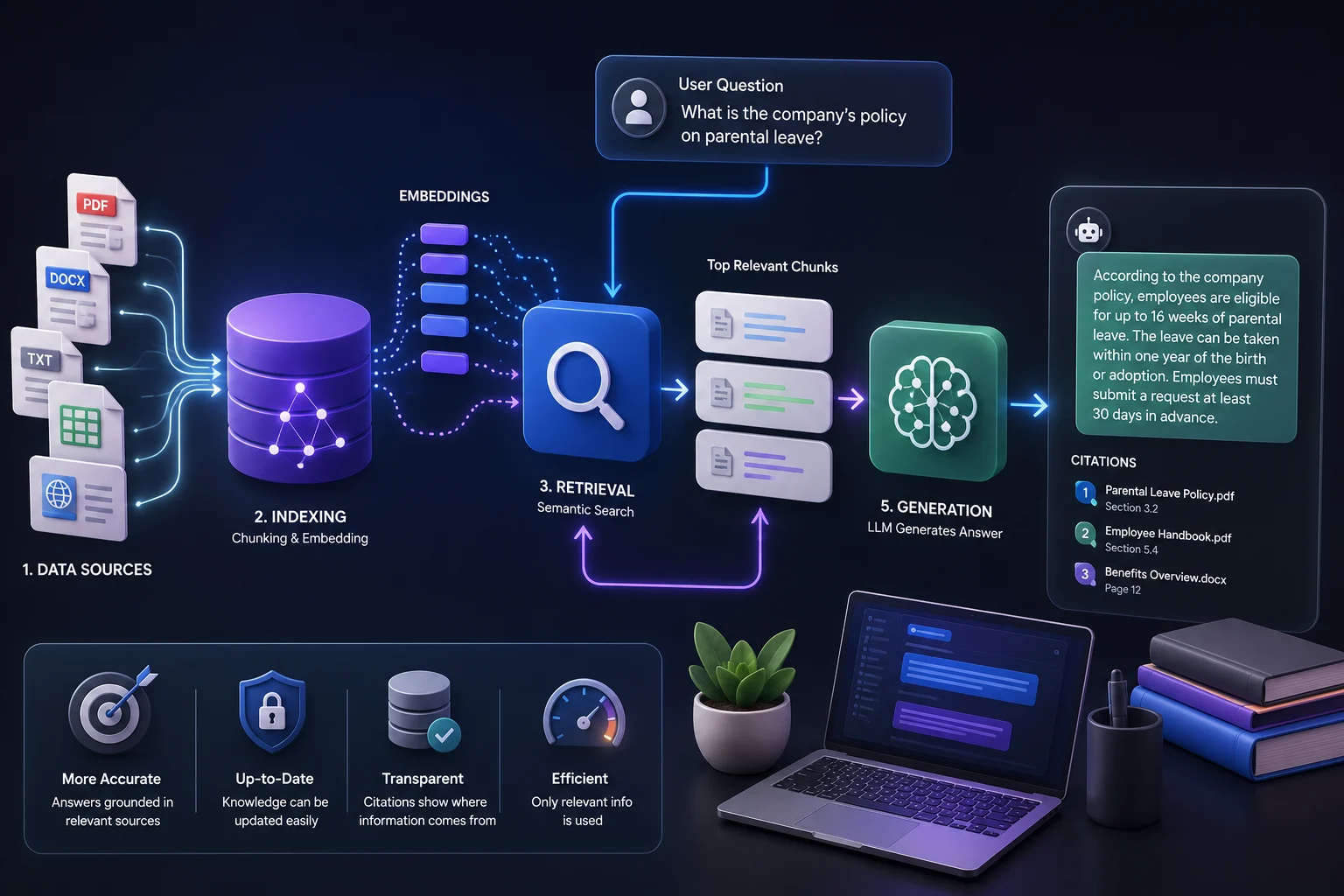
A language model knows patterns learned during training, but many useful questions depend on information that is private, recent, specialized, or too large to place in every prompt. Retrieval-Augmented Generation, usually shortened to RAG, is a common way to connect a generative AI model with external knowledge.
Instead of asking the model to rely only on its internal training, a RAG system first searches a collection of documents for relevant information. The selected material is then added to the model’s context before it generates an answer.
What Problem Does RAG Solve?
Imagine a company wants an AI assistant to answer questions about internal policies. Training a new language model from scratch would be expensive and unnecessary. Pasting the entire policy library into every prompt would also be inefficient.
RAG provides a middle path. The documents remain in an external knowledge store. When a user asks a question, the system retrieves the passages that appear most relevant and sends only those passages to the model.
This approach can make answers more grounded in a known source and easier to update when the underlying information changes.
The Basic RAG Workflow
A simple RAG system usually has two major phases: preparing the knowledge base and answering a query.
During preparation, documents are collected, cleaned, and divided into manageable chunks. Each chunk is often converted into an embedding, a numerical representation that helps the system compare meaning.
When a user asks a question, the query is also represented numerically. The retrieval system searches for document chunks that are semantically similar or otherwise relevant. Those chunks are placed into the model’s context window, and the model generates a response using the retrieved information.
Why Embeddings Are Common in RAG
Traditional keyword search works well when the exact terms are known. Semantic search can be more flexible because it tries to find related meaning even when the wording differs.
For example, a user asking about “time off for a new child” might need a document titled “parental leave policy.” Embeddings can help connect those concepts even though the wording is not identical.
Many real systems combine semantic search with keyword search, metadata filters, reranking, or business rules rather than relying on a single retrieval method.
RAG Does Not Retrain the Model
This is one of the most important distinctions. RAG changes the information supplied to the model at answer time. It does not normally change the model’s weights.
Fine-tuning, by contrast, modifies model behavior using training examples. Fine-tuning can teach style, format, or task patterns, while RAG is often better for knowledge that must be updated or cited.
The two techniques can also be combined.
Common RAG Use Cases
RAG is useful for company knowledge assistants, customer support, research tools, document Q&A, policy search, technical documentation, and specialized knowledge bases.
It can also support AI agents that need to consult reference material before taking an action. Instead of asking an agent to memorize every procedure, the application can retrieve the procedure that applies to the current task.
Why RAG Can Reduce Hallucinations
Giving a model relevant source material can reduce the need to guess. It also allows applications to show citations or references so the user can inspect the evidence behind an answer.
However, RAG does not eliminate AI hallucinations. The retrieval system can select the wrong document, the source itself can be outdated, or the model can still misinterpret the retrieved text.
A trustworthy RAG workflow therefore needs both good retrieval and careful answer generation.
Chunking Matters More Than It Sounds
Documents are often split into chunks before indexing. If chunks are too small, important context may be separated. If they are too large, retrieval can return lots of irrelevant information and consume more context.
Good chunking depends on the content. A legal policy may need section-aware boundaries. Product documentation may work better when headings and code examples stay together. Meeting transcripts may benefit from speaker and time information.
Reranking and Filtering
The first retrieval step often returns several candidates. A reranker can then score those candidates more carefully and place the most relevant passages first.
Metadata filters can also restrict the search. A system might retrieve only documents from a particular department, product version, region, language, or date range.
These controls improve relevance and help prevent the model from receiving information that should not apply to the user.
RAG Security and Permissions
Connecting AI to private knowledge introduces access-control risks. A retrieval system must respect user permissions. An employee should not receive a confidential document simply because the vector search considers it semantically relevant.
Organizations should also monitor what data is indexed, how it is updated, and whether sensitive information is sent to external model providers.
How to Evaluate a RAG System
Do not evaluate only the final writing quality. Check whether the system retrieved the right evidence, whether the answer is supported by that evidence, whether citations point to the correct passage, and whether the system knows when the source does not contain an answer.
A polished response with weak retrieval is still unreliable.
The Bottom Line
Retrieval-Augmented Generation connects a generative model with external knowledge. The system searches for relevant information, places selected material into the model’s context, and generates an answer grounded in that material.
RAG is valuable because knowledge can be updated without retraining the entire model and because answers can be tied to inspectable sources. Its quality still depends on document preparation, retrieval accuracy, permissions, and verification.
A Practical Checklist Before You Rely on Rag
Define the job first. Decide what success means before choosing a model or product. A system can look impressive in a demo while solving the wrong problem. Write down the expected output, the information it may use, the acceptable error rate, and which decisions still require a person.
Test representative examples. A useful first test is to ask a question whose answer exists in a controlled document set, then verify both the retrieved passage and the final generated answer. Include normal cases and difficult edge cases. The goal is to learn where the system is dependable and where it needs stronger instructions, additional tools, or human review.
Verify important outputs. Do not confuse fluency with correctness. Check facts, calculations, citations, permissions, and important transformations against a reliable source. The more expensive or difficult an error would be to reverse, the stronger the verification process should be.
Review privacy and access. Understand what information is being sent to the system, where it is stored, and who can retrieve it later. Give connected AI tools only the permissions they need. Sensitive data should follow the same governance rules that apply elsewhere in the organization.
Measure value over time. Track time saved, correction rate, reliability, user satisfaction, and operational cost. A tool that feels fast during the first week may not create lasting value if people spend the same amount of time fixing its output.
Common Mistakes to Avoid
One common mistake is choosing technology before defining the workflow. Another is testing only ideal examples. Teams also tend to add automation without planning what happens when the model is uncertain, the data is missing, or a connected service fails.
The most important limitation to keep in mind is that bad retrieval produces bad grounding even when the final response sounds polished. Build the workflow around that reality rather than assuming future model improvements will automatically solve it.
Frequently Asked Questions
Is RAG always more accurate than a simpler approach?
No. AI is valuable when the task benefits from language understanding, pattern recognition, generation, or flexible decision support. A deterministic rule, database query, spreadsheet formula, or conventional software function can be better when the task is predictable and exact.
Do I need to understand the mathematics behind RAG?
No. A conceptual understanding is enough for most users and product decisions. Mathematics becomes more important when you are implementing, optimizing, or researching RAG at a technical level. Start with the purpose, inputs, outputs, tradeoffs, and failure modes before going deeper into equations.
What is the safest way to start using RAG?
Begin with a narrow, reversible use case. Keep source material or original data available, review the output manually, and document the situations where the system fails. Expand automation only after the workflow performs consistently on representative examples and users know how to recover when it is wrong.