
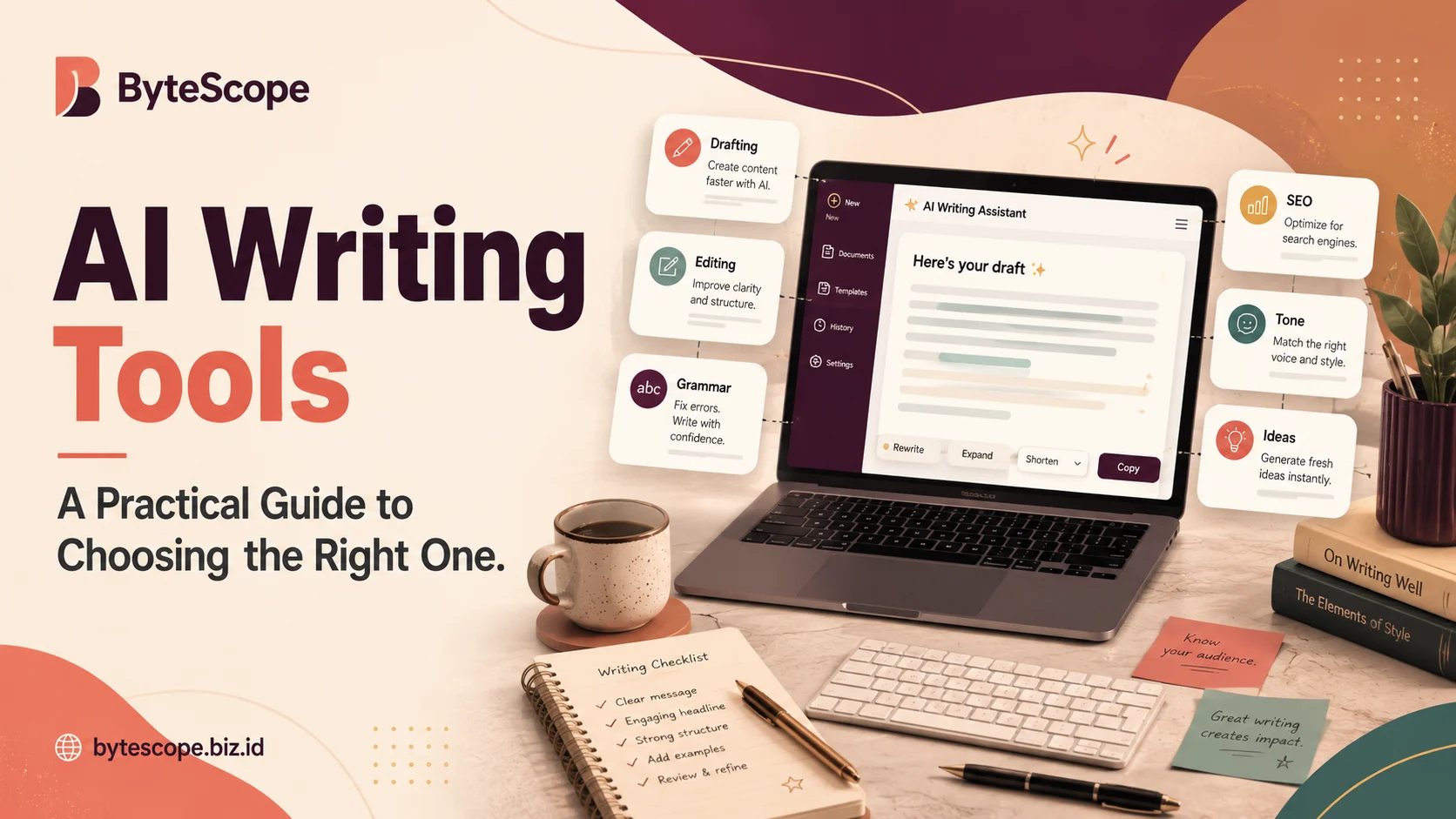
Choosing an AI writing tool can feel harder than using one. Many products promise faster drafting, better grammar, stronger SEO, clearer emails, or more persuasive marketing copy, yet those capabilities often overlap. A tool that works well for a blogger may feel limiting to a marketer, while a student may care more about clarity and research support than campaign templates. The useful approach is to identify the kind of writing you do, the control you need, and how much editing you are willing to perform afterward.
What Are AI Writing Tools?
AI writing tools use artificial intelligence, often language models, to help people generate, edit, rewrite, organize, or improve text. Some are broad assistants that can handle many tasks, from brainstorming to drafting emails, while others are designed for narrower purposes such as grammar correction, SEO optimization, or marketing copy. Their usefulness depends on how well the tool fits a specific workflow. A strong tool should move writing forward without forcing the user to rebuild every output from the beginning.
Start With Your Writing Goal
Before comparing features, define the job you want the tool to perform. A blogger may need help with outlines, drafts, and rewriting, while an SEO writer may care about keyword integration and content structure. A marketer may prioritize short-form copy, variations, and tone control, whereas a business professional may want concise emails and reports. Students and academic writers have different concerns, including clarity, source awareness, and academic integrity. Creative writers may value brainstorming and stylistic flexibility. Once the writing goal is clear, many unsuitable options can be eliminated immediately.
Key Features Worth Evaluating
Output quality should be the first consideration because an AI writing assistant is useful only when its suggestions are relevant, coherent, and reasonably close to the desired style. Tone control also matters, especially for users who write for different audiences. A good tool should handle enough context to remember instructions, maintain consistency, and avoid contradicting earlier parts of a document. Editing features can matter as much as generation because rewriting, shortening, expanding, and clarifying text are common parts of real writing workflows.
Privacy, language support, and integrations deserve attention too. A tool that works inside a preferred editor or browser can reduce friction, while one that requires constant copying and pasting may become inconvenient. For professional or confidential work, users should understand how the service handles submitted content. Pricing should be considered alongside time saved, output quality, and the amount of editing still required rather than treated as the only deciding factor.
Different Types of AI Writing Tools
General-purpose AI assistants are the most flexible category. They can help with brainstorming, drafting, rewriting, summarizing, idea development, and basic research support across many situations. Specialized writing tools, by contrast, focus on particular jobs such as marketing copy, grammar improvement, business communication, or long-form content. Their narrower focus can be useful when the same type of task appears repeatedly.
AI-powered editing tools are better suited to writers who already create their own drafts but want help improving grammar, tone, readability, or sentence structure. SEO-focused tools add another layer by helping writers think about search intent, content organization, and keyword usage. These categories often overlap, so the important question is not what a product calls itself, but whether its strongest capabilities match the user’s actual work.
How to Compare AI Writing Tools
Comparing tools by feature count alone can be misleading. A better test is to give several tools the same real-world task and compare the results. Look at how well each one follows instructions, preserves tone, handles context, and produces usable text without excessive editing. Consistency matters too; a tool that occasionally creates excellent copy but often needs major correction may be less useful than one that produces reliably solid drafts.
Workflow compatibility is another practical test. Consider how quickly you can move from idea to draft to final edit, whether collaboration is easy, and whether the tool fits naturally with existing software. The best comparison is usually hands-on because a feature list cannot show how much editing effort a particular writing style will require. Testing with your own material also reveals whether the tool understands your usual prompts and formats.
Free vs Paid AI Writing Tools
Free AI writing tools can be sufficient for occasional use, experimentation, and simple tasks. They are useful for learning how prompts work and discovering which features actually matter. Paid plans may offer higher usage limits, additional models, advanced editing options, integrations, or specialized workflows, but those extras are only valuable when they solve a real problem. The better question is not whether a paid tool has more features, but whether those features save enough time or improve enough work to justify the cost.
Common Mistakes and the Need for Human Editing
Popularity is a weak reason to choose an AI writing tool. Users also make mistakes when they focus on feature quantity, ignore privacy, or expect every generated draft to be ready for publication. AI output often needs fact-checking, tone adjustments, stronger examples, and original insight, so the time required for editing should be part of the comparison. A tool that produces fast but generic text may offer less value than one that creates a stronger starting point with fewer corrections.
AI writing tools work best as assistants rather than replacements for writers. They can accelerate drafting and improve structure, but they do not automatically know which claims are accurate, which examples are appropriate, or what perspective will make a piece distinctive. Human editing is still needed to verify facts, review sources, refine tone, remove repetition, and add experience or judgment that the model cannot supply. This is especially important for professional, academic, financial, medical, or other high-stakes content.
How to Choose the Right AI Writing Tool
The right AI writing tool is the one that fits the work you do most often. General-purpose assistants suit flexible writing and brainstorming, editing tools are better for polishing existing drafts, and SEO-oriented platforms may suit writers focused on search visibility. Marketing and business users may benefit from specialized workflows, while academic users should prioritize clarity, source awareness, and responsible use. Before committing, test a few options with the same task and compare output quality, accuracy, tone, consistency, editing effort, ease of use, privacy, and cost. Hands-on comparison is often more revealing than a long feature list.
Conclusion
Choosing among AI writing tools is ultimately a workflow decision, not a popularity contest. The strongest option is the one that produces useful output for your specific content, requires a reasonable amount of editing, fits your preferred tools, respects your privacy needs, and delivers enough value for its cost. AI can make writing faster and more flexible, but it does not remove the need for judgment, originality, or careful revision. Used well, an AI writing assistant should strengthen the writing process while leaving the writer in control of the final result.