
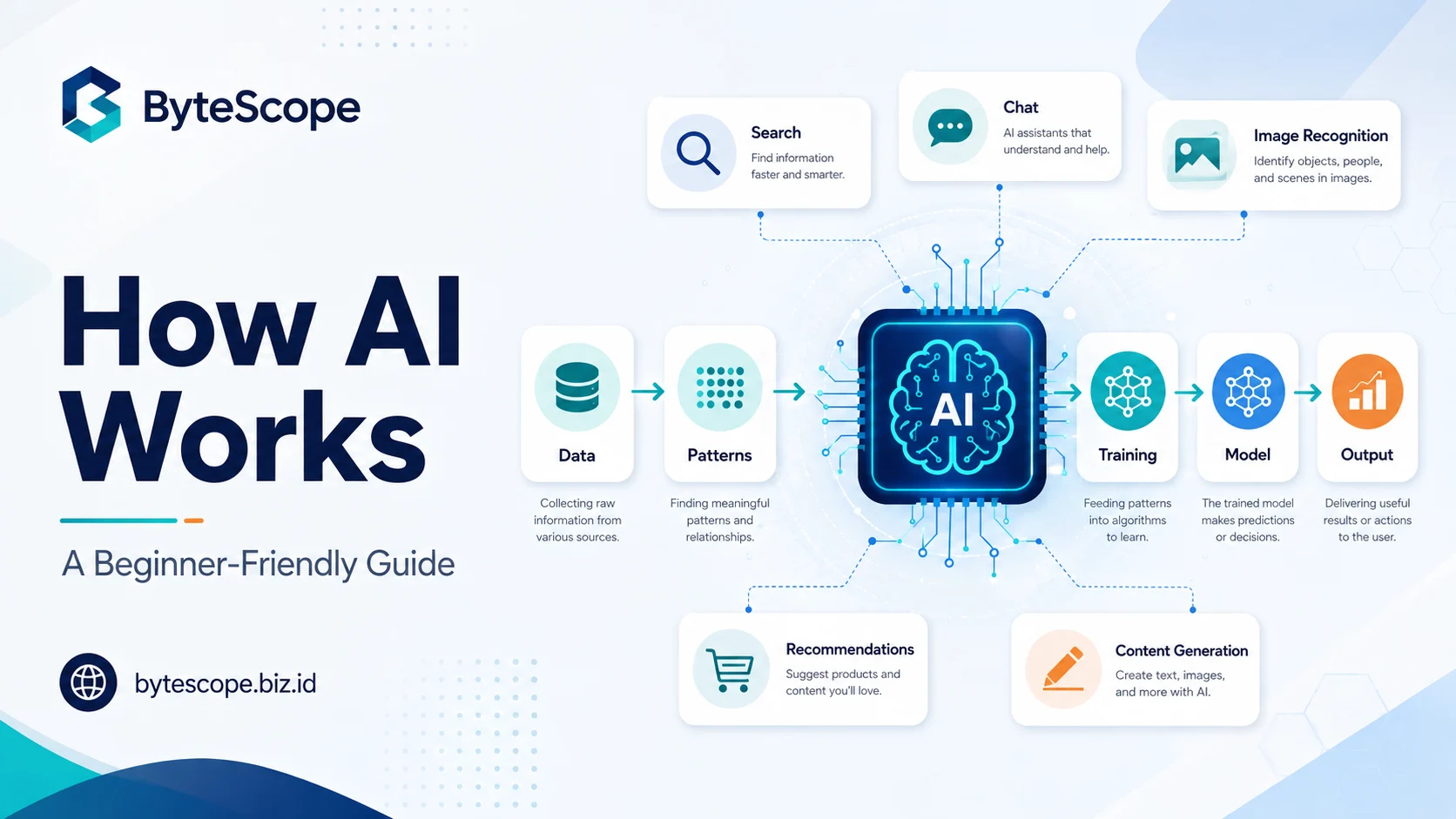
Artificial intelligence often appears to work like magic. A search engine seems to know what you mean, a streaming service suggests something you might enjoy, and a chatbot can respond in seconds. Behind those experiences, however, there is no hidden digital mind thinking like a person. Most modern AI systems work by processing data, identifying patterns, and using those patterns to make predictions or generate outputs. Understanding that process makes AI much less mysterious and helps explain both its strengths and its limits.
What Artificial Intelligence Actually Does
Artificial intelligence is a broad field focused on building computer systems that can perform tasks that normally require human-like abilities, such as recognizing images, understanding language, making predictions, solving problems, or generating content. AI does not need consciousness or emotions to do this. A system can identify a face in a photo or recommend a product without “knowing” the person in a human sense. It uses learned relationships in data to produce a useful result.
How Artificial Intelligence Learns from Data
Many AI systems begin with data, which might include photographs, written text, audio recordings, transaction records, or sensor readings. During training, the system searches for patterns that connect inputs with useful outcomes. An image model, for example, may learn that certain shapes, textures, and colors often appear in pictures of cats. This movement from data to patterns is central to understanding how artificial intelligence works.
This process is commonly called machine learning. Instead of programmers writing every possible rule by hand, a machine-learning system adjusts itself by studying examples. It makes a prediction, compares that prediction with the expected result, measures the error, and changes internal settings to reduce similar errors. Repeating the process many times helps the system improve and build a model that can handle new input.
Machine Learning, Neural Networks, and Training
Neural networks are a type of machine-learning model made of layers that transform information step by step. Early layers may detect simple patterns, while later layers combine them into more complex features. In image recognition, early processing might notice edges and shapes, while deeper processing can help distinguish objects. In language systems, layers can learn relationships between words, phrases, grammar, and context.
Training a neural network means adjusting many internal parameters so the model becomes better at its task. The system processes examples, produces predictions, receives an error signal, and updates those settings. The goal is to learn patterns that work beyond the training examples rather than simply memorizing them. Once training is complete, the resulting system is called an AI model.
What an AI Model Does After Training
An AI model is the trained system that takes new input and produces an output. The input could be a photo, a sentence, a financial record, or a prompt typed into a chatbot. The model processes that input using patterns learned during training, then returns a prediction, classification, recommendation, or generated response.
How Generative AI Produces Content
Generative AI uses learned patterns to create new content rather than only classify or predict. A large language model learns statistical relationships in language from large collections of text. When a user enters a prompt, the model generates a response by predicting suitable pieces of text based on the context it receives. It does not simply retrieve one fixed answer from a hidden list. Instead, it constructs output from patterns learned during training.
The same broad idea applies to other media. Image models learn visual relationships and use prompts to guide the creation of pictures, while other systems can generate audio, video, or software code. The quality of the result depends on the model, its training, the input, and the task.
Why AI Sometimes Makes Mistakes
AI can produce impressive results, but it is not automatically correct. A model may have learned from incomplete, biased, outdated, or low-quality data, and it can struggle with ambiguous input or unfamiliar situations. Generative systems may also produce statements that sound confident even when they are inaccurate, a problem commonly called hallucination. This happens because the model is designed to generate plausible output, not to guarantee truth in every case. Human verification remains important, especially when AI is used for health, finance, education, law, or research.
How Artificial Intelligence Is Used in Real Life
Artificial intelligence already supports many ordinary digital services. Search engines use AI to interpret queries, recommendation systems suggest videos or products, and banks use automated models to help detect unusual transactions. In education, AI can support tutoring and feedback, while businesses use it for customer service, forecasting, and document processing. Healthcare organizations may use AI to assist with image analysis or administrative tasks, although professional oversight remains essential in clinical settings. These examples show that AI is not one single technology but a collection of systems designed for different purposes.
Is Artificial Intelligence Really Intelligent?
AI can outperform people at specific tasks, yet that does not mean it thinks or understands the world in the same way humans do. A model can process huge amounts of information quickly, but it does not automatically possess common sense, lived experience, emotions, values, or human judgment. Its apparent intelligence comes from computation and learned patterns. That distinction matters because fluent language or accurate predictions can make a system seem more capable than it really is.
The Limits and Future of Artificial Intelligence
AI has real limitations. Accuracy can vary, bias can be reproduced from training data, privacy can be affected when sensitive information is processed, and systems can be misused. AI also depends heavily on human choices about data, design, testing, and deployment. Responsible use therefore requires security, transparency, oversight, and clear limits on where automation should be trusted. These issues do not make AI useless; they show why technical capability and human judgment need to work together.
AI is likely to become more deeply integrated into software, education, business, research, and creative work. The important change may not be that machines replace people completely, but that more tasks are completed through collaboration between humans and AI systems. People who understand how AI works will be better prepared to judge its outputs, use it effectively, and recognize when human expertise is still necessary.
Conclusion
How Artificial Intelligence works can be summarized as a flow from data to patterns, from patterns to training, and from training to a model that produces outputs from new inputs. Machine learning allows systems to discover relationships in data, while neural networks provide one powerful way to process complex information. Generative AI extends the same general idea into content creation, producing text, images, audio, video, and code from learned patterns.
The technology is powerful because it can detect and use patterns at a scale humans cannot easily match, but it remains dependent on data, design, and human oversight. Its outputs can still be wrong, biased, or incomplete, and its apparent intelligence should not be confused with human understanding. For beginners, learning the basic process behind AI is the best foundation for using it with more confidence, better judgment, and greater responsibility.