
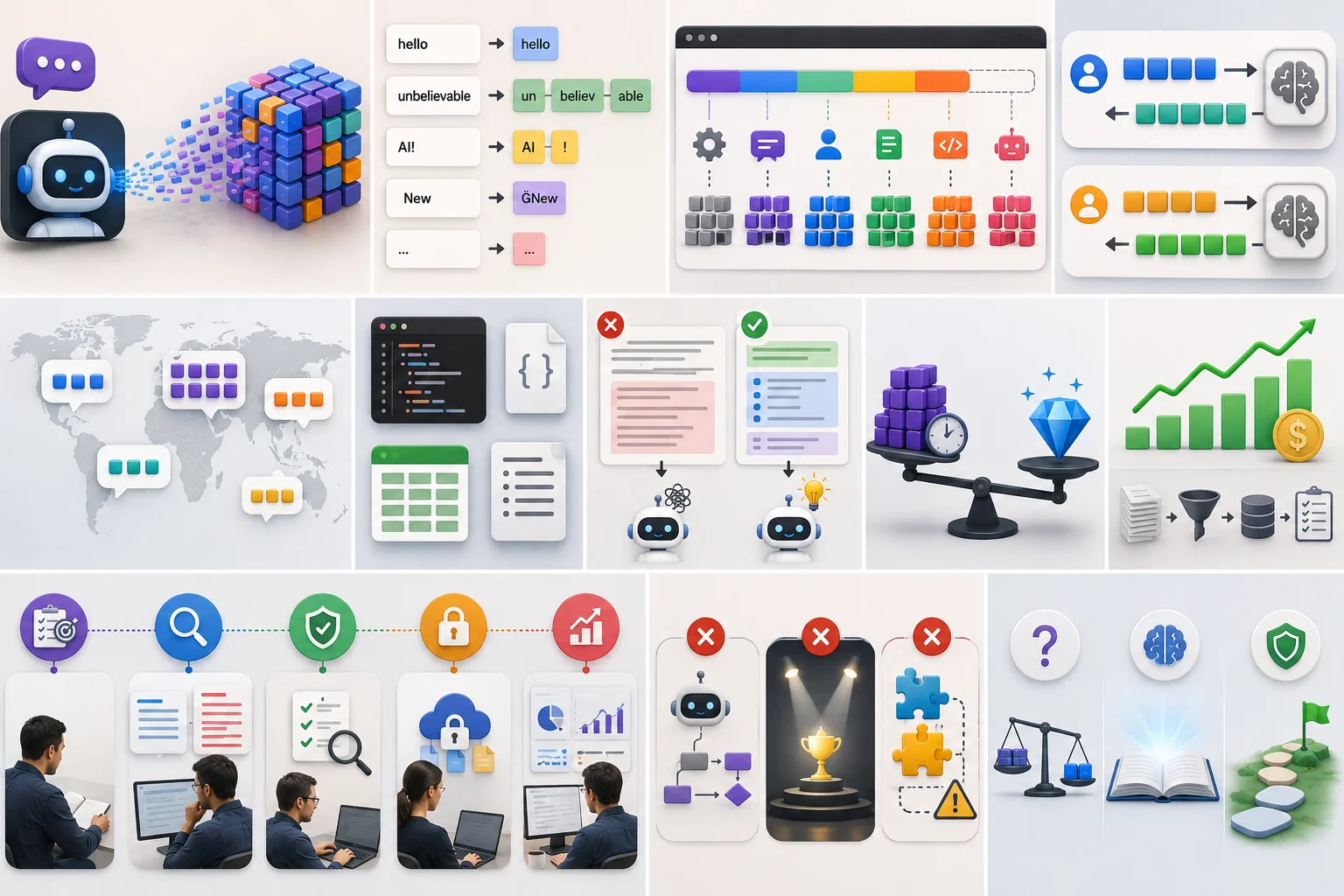
When people use an AI chatbot, they usually think in words, sentences, and paragraphs. A language model does not process text in exactly the same way. It works with smaller numerical units commonly called tokens.
Understanding tokens helps explain several things that otherwise seem arbitrary: why a model has a context limit, why long documents consume more capacity, why API usage is often measured by text volume, and why one short-looking phrase may use more model input than another.
What Is a Token?
A token is a unit of text that a language model processes. Depending on the tokenizer and the language, a token may represent a whole word, part of a word, punctuation, whitespace patterns, or another text fragment.
For example, a common word may be represented by one token while a rare or complex word may be split into several pieces. The exact split is determined by the tokenizer used by the model.
This means that “token” and “word” are not interchangeable. Two passages with the same number of words can have different token counts.
Why Models Use Tokens Instead of Whole Words
Using a fixed vocabulary of token pieces gives a model a practical way to represent enormous amounts of language. If every possible word, name, spelling variation, and invented term required its own entry, the vocabulary would become difficult to manage.
Subword-style tokenization lets a model build unfamiliar words from smaller pieces. It also helps the same system work across many writing patterns and languages, although token efficiency can vary between languages.
Once text is tokenized, each token is converted into a numerical representation the neural network can process.
Tokens and the Context Window
One of the most important reasons to understand tokens is the context window. A model can only consider a limited amount of information at one time, and that capacity is usually expressed in tokens.
The context may include the system instructions, conversation history, user message, uploaded text, tool results, and the model’s generated response. All of those pieces compete for space.
This is why very long conversations can eventually lose earlier details or require older information to be compressed. Our separate guide to AI context windows explores that issue in more detail.
Input Tokens and Output Tokens
AI services often distinguish between input and output tokens. Input tokens are the text or structured content sent to the model. Output tokens are the model’s generated response.
This distinction matters for developers because API pricing and limits may treat input and output differently. It also matters for performance: asking for very long responses can increase latency and resource use.
Consumer chat interfaces usually hide most of these details, but the same underlying constraints still exist.
Why Token Counts Differ Across Languages
Tokenizers are built from patterns in training data and vocabulary design. As a result, some languages or writing systems may be represented more compactly than others.
A sentence in one language can require a different number of tokens than an equivalent sentence in another language. Even punctuation, capitalization, code, and unusual formatting can change the total.
This is one reason developers should measure actual token usage instead of assuming a fixed “one token equals one word” formula.
Tokens in Programming and Structured Data
Code is also tokenized. Variable names, punctuation, indentation patterns, operators, and strings all consume context. A large source file can therefore use a substantial number of tokens even if it does not look long on screen.
The same applies to JSON, tables represented as text, logs, and machine-generated documents. Repetitive formatting can consume context without adding much useful meaning.
For coding workflows, this is relevant when using AI coding tools on large repositories.
How Tokens Affect Prompt Design
Efficient prompts are not necessarily the shortest possible prompts. The goal is to spend context on information that helps the model complete the task.
Useful instructions, examples, and source material can improve an answer even though they increase token usage. Unnecessary repetition, giant blocks of irrelevant text, and duplicated context usually do not.
This is one reason good prompt engineering focuses on clarity and relevance rather than simply adding more words.
Do More Tokens Mean a Better Answer?
No. A longer prompt can provide valuable context, but it can also distract the model. A longer response may contain more detail, but it can also become repetitive or introduce more opportunities for mistakes.
Quality depends on task definition, model capability, relevant context, and verification. Token count is a resource measurement, not a quality score.
Tokens and AI Cost
For API users, token usage commonly affects cost because providers measure how much input a model processes and how much output it generates. Exact rates vary by model and change over time, so developers should always check the provider’s current pricing documentation.
Teams working at scale often reduce unnecessary token use through shorter prompts, retrieval systems that send only relevant documents, caching, summarization, and choosing smaller models for simple tasks.
The Bottom Line
Tokens are the units language models use to process text. They may correspond to words, word pieces, punctuation, or other text fragments. Token counts influence how much information fits inside a context window and can affect API cost and response length.
You do not need to count tokens manually for everyday AI use. But understanding the concept makes model limits much easier to understand and helps explain why careful context management matters in larger AI workflows.
A Practical Checklist Before You Rely on Ai Tokens
Define the job first. Decide what success means before choosing a model or product. A system can look impressive in a demo while solving the wrong problem. Write down the expected output, the information it may use, the acceptable error rate, and which decisions still require a person.
Test representative examples. A useful first test is to compare a short plain-language prompt with a long prompt containing duplicated context and notice how much unnecessary material is being sent. Include normal cases and difficult edge cases. The goal is to learn where the system is dependable and where it needs stronger instructions, additional tools, or human review.
Verify important outputs. Do not confuse fluency with correctness. Check facts, calculations, citations, permissions, and important transformations against a reliable source. The more expensive or difficult an error would be to reverse, the stronger the verification process should be.
Review privacy and access. Understand what information is being sent to the system, where it is stored, and who can retrieve it later. Give connected AI tools only the permissions they need. Sensitive data should follow the same governance rules that apply elsewhere in the organization.
Measure value over time. Track time saved, correction rate, reliability, user satisfaction, and operational cost. A tool that feels fast during the first week may not create lasting value if people spend the same amount of time fixing its output.
Common Mistakes to Avoid
One common mistake is choosing technology before defining the workflow. Another is testing only ideal examples. Teams also tend to add automation without planning what happens when the model is uncertain, the data is missing, or a connected service fails.
The most important limitation to keep in mind is that token counts are model-specific and should not be treated as a universal word-count formula. Build the workflow around that reality rather than assuming future model improvements will automatically solve it.
Frequently Asked Questions
Is AI tokens always more accurate than a simpler approach?
No. AI is valuable when the task benefits from language understanding, pattern recognition, generation, or flexible decision support. A deterministic rule, database query, spreadsheet formula, or conventional software function can be better when the task is predictable and exact.
Do I need to understand the mathematics behind AI tokens?
No. A conceptual understanding is enough for most users and product decisions. Mathematics becomes more important when you are implementing, optimizing, or researching AI tokens at a technical level. Start with the purpose, inputs, outputs, tradeoffs, and failure modes before going deeper into equations.
What is the safest way to start using AI tokens?
Begin with a narrow, reversible use case. Keep source material or original data available, review the output manually, and document the situations where the system fails. Expand automation only after the workflow performs consistently on representative examples and users know how to recover when it is wrong.