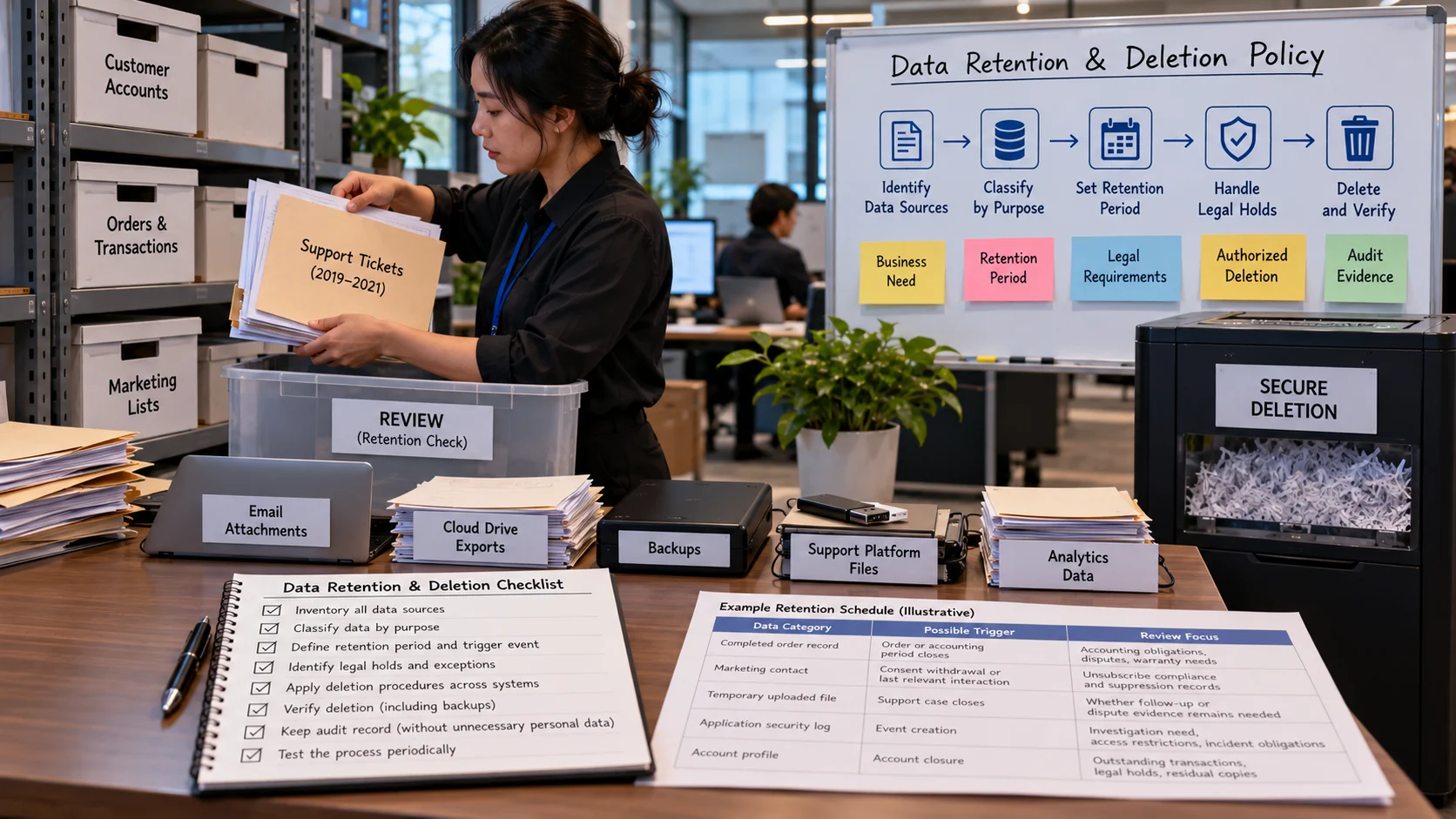
A subscription business discovers old support attachments and former employee exports still stored across email, cloud drives, and a ticketing platform. A data retention and deletion policy defines why business information is kept, how long categories remain necessary, and how authorized deletion or legal holds are handled across systems and backups. This is a lifecycle-policy guide with concrete operational steps, not a broad discussion of privacy as an innovation principle. Quantitative examples below are hypothetical and should be adapted to the reader’s actual data.
Key Takeaways
A retention policy defines why data is kept, for how long, who owns it, and how disposal is verified.
Backups, exports, ticket attachments, and analytics copies belong in the inventory, not only the primary database.
Deletion requests and retention exceptions require documented handling appropriate to applicable laws and obligations.
Create deletion procedures that work across connected systems, include archival copies, and can be reapplied after a restore.
Audit proof of disposal without retaining unnecessary sensitive information in the audit trail, and periodically test that these controls still work after a platform or retention-policy change.
Why Data Retention Needs a Written Policy
Digital businesses accumulate information through orders, customer accounts, website analytics, support tickets, marketing lists, backups, and employee systems. Keeping everything indefinitely can increase cost, security exposure, and legal risk. Deleting everything quickly can also cause problems when records must be retained for legitimate operational, contractual, or legal reasons. A data retention and deletion policy explains what information is kept, why, for how long, and how it is disposed of when no longer needed.
There is no universal retention period for every business and country. Requirements depend on data category, processing purpose, local law, contractual obligations, dispute risks, and other factors. An example schedule can illustrate how to document decisions, but cannot replace the legal assessment needed for a real organization.
Inventory the Data Before Setting Deadlines
Begin by identifying where personal and business data lives. Look beyond the primary customer database: email attachments, exported spreadsheets, third-party support tools, cloud backups, meeting transcripts, log files, analytics platforms, and employee devices can all hold copies. Record the data category, source, purpose, system owner, access permissions, and current deletion capabilities.
Classify information by purpose rather than storing everything under the broad label “customer data.” An order record needed for tax and accounting may have a different justification from a marketing preference, abandoned-cart event, temporary support attachment, or outdated device identifier. Combining them into one retention rule can lead to keeping too much information or deleting something that must remain available.
Also distinguish operational records from derived data. An aggregate report may not identify individuals if properly constructed, while a supposedly anonymous extract can still contain unique combinations that reveal someone. Review whether derived datasets and AI training inputs retain personal information or traceable identifiers.
Key Questions for Each Category
Why is the information needed? Identify a real purpose such as fulfilling an order, maintaining a warranty, responding to a complaint, meeting accounting obligations, or honoring communication preferences. “We may use it someday” is generally not a sufficient rationale for indefinite personal-data retention.
When does the clock begin? Retention may run from collection, last transaction, account closure, contract termination, or the end of a required reporting period. Define the event precisely so systems can calculate deletion dates consistently.
What could pause deletion? Legitimate legal holds, active disputes, investigations, or regulatory requirements may require preservation. Such exceptions should be documented, time-limited where appropriate, and authorized by responsible people.
How will deletion be verified? Removing a record from the visible interface does not necessarily erase backups, caches, exports, and integrated systems. The policy must describe practical deletion methods and residual retention that cannot immediately be eliminated.
Illustrative Retention Schedule Structure
A useful policy table may include columns for data category, purpose, triggering event, retention period, legal basis or requirement, owner, deletion action, and exceptions. The periods below are intentionally not prescribed: each organization must determine appropriate periods for its jurisdiction and circumstances.
Data category Possible trigger Review focus
Completed order record Order or accounting period closes Accounting obligations, disputes, warranty needs
Marketing contact Consent withdrawal or last relevant interaction Unsubscribe compliance and suppression records
Temporary uploaded file Support case closes Whether follow-up or dispute evidence remains needed
Application security log Event creation Investigation need, access restrictions, incident obligations
Account profile Account closure Outstanding transactions, legal holds, residual copies
A suppression record is sometimes needed to avoid contacting someone who opted out. Deleting every trace of an opt-out without designing another control can cause the marketing system to re-add the person on the next import. Retention design must consider such functional dependencies.
A Step-by-Step Policy Implementation
Create the system inventory. Locate databases, SaaS tools, backups, file shares, and integrations containing relevant information.
Assign accountable owners. Someone must approve each category’s purpose and period and respond when requirements change.
Determine lawful requirements. Consult applicable laws, contracts, industry rules, and qualified advisers when needed. Avoid copying another company’s schedule as though it is binding.
Document triggers and exceptions. Specify how retention begins, ends, and is suspended by a legitimate hold.
Map deletion capabilities. Determine whether each system supports record-level erasure, scheduled cleanup, deletion APIs, or only account-wide termination.
Build controlled deletion workflows. Use job logs, approval steps for high-impact operations, and safe retries for partial failures.
Test with representative records. Verify that deletion reaches relevant downstream systems and does not remove records that must remain under authorized holds.
Train staff and review periodically. Teach employees how to report personal-data requests, preserve evidence, and avoid uncontrolled exports.
Document the policy in language business teams understand. A technical script that purges database rows cannot replace a clear rule about when and why those rows should be removed.
Deletion in Backups and Distributed Systems
Backups complicate erasure because they are designed to preserve historical states. A business may not be able to selectively remove one record from an immutable backup without compromising integrity. Applicable legal requirements and technical capabilities determine how to manage this, potentially including constrained backup access, defined backup expiration, and controls against reintroducing erased records during restoration.
Plan restoration tests. If a backup is restored into production, previously completed deletion requests may need to be re-applied before the system resumes ordinary use. Maintain appropriate deletion event records or another controlled mechanism to prevent resurrecting removed profiles. These records should themselves be minimal and protected.
Distributed integrations create similar challenges. A customer account may be deleted from a CRM while details remain in helpdesk exports, analytics tools, and spreadsheets downloaded months earlier. System ownership and vendor contracts should clarify the deletion responsibilities of each party. Do not promise instant total erasure unless the organization can actually perform it.
AI Systems and Data Retention
Generative AI workflows create additional storage locations: prompts, uploaded documents, model outputs, chat histories, evaluation examples, logs, embeddings, and vector databases. Their retention behavior may differ from the primary application. A deletion request may require removing source documents, derivative indexes, and retained conversation content according to the system’s architecture and applicable obligations.
Deleting a source file does not automatically prove that every derivative or model parameter no longer reflects it. Avoid overstating what a “delete” button guarantees. Review the vendor’s current data handling terms and the organization’s actual integrations. Where sensitive information is unnecessary for AI assistance, minimize it before processing.
Monitoring Compliance and Effectiveness
Useful measures include the share of data categories with documented schedules, deletion jobs completed on time, unresolved exceptions, expired records still accessible, and time to handle valid data requests. Review a sample of records near expiry and test that relevant systems apply the correct trigger. An impressive number of deleted records does not prove the right records were deleted.
Investigate both under-deletion and over-deletion. Keeping information too long can increase exposure, while removing records prematurely can undermine legitimate obligations and business continuity. Audit logs should document decisions, not create permanent hidden copies of personal data without a justified purpose.
Make the Policy Sustainable
Start with a small number of high-impact categories rather than promising immediate perfection across every system. A customer database, support attachments, and website logs may offer a sensible first scope. Choose owners, write the rules, test deletion, and expand to complex integrations and archives.
Review the schedule when products, laws, data flows, or vendors change. Employee training should emphasize that exporting a dataset to a personal spreadsheet does not exempt it from retention controls. Procurement should consider whether a new software service can implement deletion and preserve necessary audit evidence before the business adopts it widely.
A retention policy succeeds when staff know which information is necessary, how long it belongs in each system, and how to remove it responsibly. The result is not simply less stored data; it is a better documented, more accountable information lifecycle.
An illustrative data retention schedule
Information class Business purpose Example review trigger Disposal control
Unfinished newsletter signups Complete opt-in process Signup abandoned Delete according to approved policy
Support tickets Respond and document resolution Ticket closed Review justified retention period
Accounting records Meet tax and legal duties End of fiscal period Confirm jurisdiction-specific schedule
System access logs Detect abuse and investigate incidents Security review cycle Controlled deletion and backup expiry
This is a planning illustration, not legal advice or a universal retention timetable. Real durations depend on applicable law, contracts, active litigation holds, tax rules, and the purpose of processing. A policy must also address production copies, archives, backups, derived features, and third-party vendors. Deleting a database row without considering searchable exports and backups can leave the supposedly removed record accessible.
What the example teaches. Old support attachments remain in a former supplier’s storage after a ticketing-system change. The company maps retention triggers, copies, backups, and processor obligations. It documents which records need preservation for legal reasons and tests deletion rather than assuming an archive setting removes everything.
Handling a Customer Request to Delete Information
When a person requests deletion, the organization should identify the requester appropriately, determine which records the request covers, and assess whether lawful exceptions require any data to be retained. The response should not promise erasure of information that the organization is legally obligated to preserve, nor should it retain material indefinitely without a justified purpose. Keep records of the decision and action at the minimum level needed to demonstrate compliance.
A practical workflow identifies records in the primary account system, connected support services, marketing lists, analytics environments, and relevant archives. The team should determine which systems support automatic deletion and which require manual intervention or vendor assistance. When deletion cannot occur immediately in a restricted backup, document the available safeguards and applicable requirements rather than assuming hidden copies are irrelevant.
Review Schedules Against Actual System Behavior
A policy can be written perfectly while the underlying systems continue to retain expired data. Periodic testing should select records that have passed their retention trigger and verify expected behavior. Confirm that scheduled jobs complete, exceptions are authorized, and deleted records are not recreated by nightly imports. A sudden rise in deletion failures may indicate an API change, permissions problem, or obsolete integration.
When a service provider changes, include retention and deletion capabilities in procurement review. It is easier to establish deletion rights and technical interfaces before signing a contract than after years of accumulated records have become difficult to export or erase.
Deletion Is a Process Across Copies and Backups
Deleting a record from the primary application may not remove it from analytics exports, support attachments, archived files, or backups. Build a data inventory that records each authorized copy and defines when routine backup rotation removes expired data. Some backups cannot reasonably support selective immediate deletion; organizations should establish lawful, documented controls for retention periods, restoration, and the reapplication of deletion requests after a restore.
A retention schedule should also specify exceptions such as active disputes or legally required records, without using vague “keep everything for safety” defaults. Assign an owner to review expired records, verify that deletions completed where technically feasible, and keep a minimal audit trail of the action rather than retaining the very sensitive data the policy intended to remove.
Frequently Asked Questions
How long should customer records be kept?
There is no universal period. Retention depends on purpose, applicable law, contracts, and genuine operational needs; obtain jurisdiction-specific advice for regulated data.
Is archiving the same as deleting?
No. Archived data remains stored and potentially discoverable. Deletion requires an authorized process that accounts for live systems and relevant copies.
Can backups be exempt from deletion?
Backups may follow distinct technical schedules, but they should have documented safeguards, expiry periods, and restoration procedures that respect deletion obligations.
What should a deletion log contain?
Enough to show category, authorization, completion time, exceptions, and systems covered without unnecessarily retaining the sensitive information meant to be removed.
Further Reading on ByteScope
Responsible AI Guide
Innovation Debt
Sources and Further Reading
ICO: Storage Limitation Principle — UK ICO regulatory guidance; check your jurisdiction.
NIST: Privacy Framework — NIST primary material for frameworks and evaluation methods.