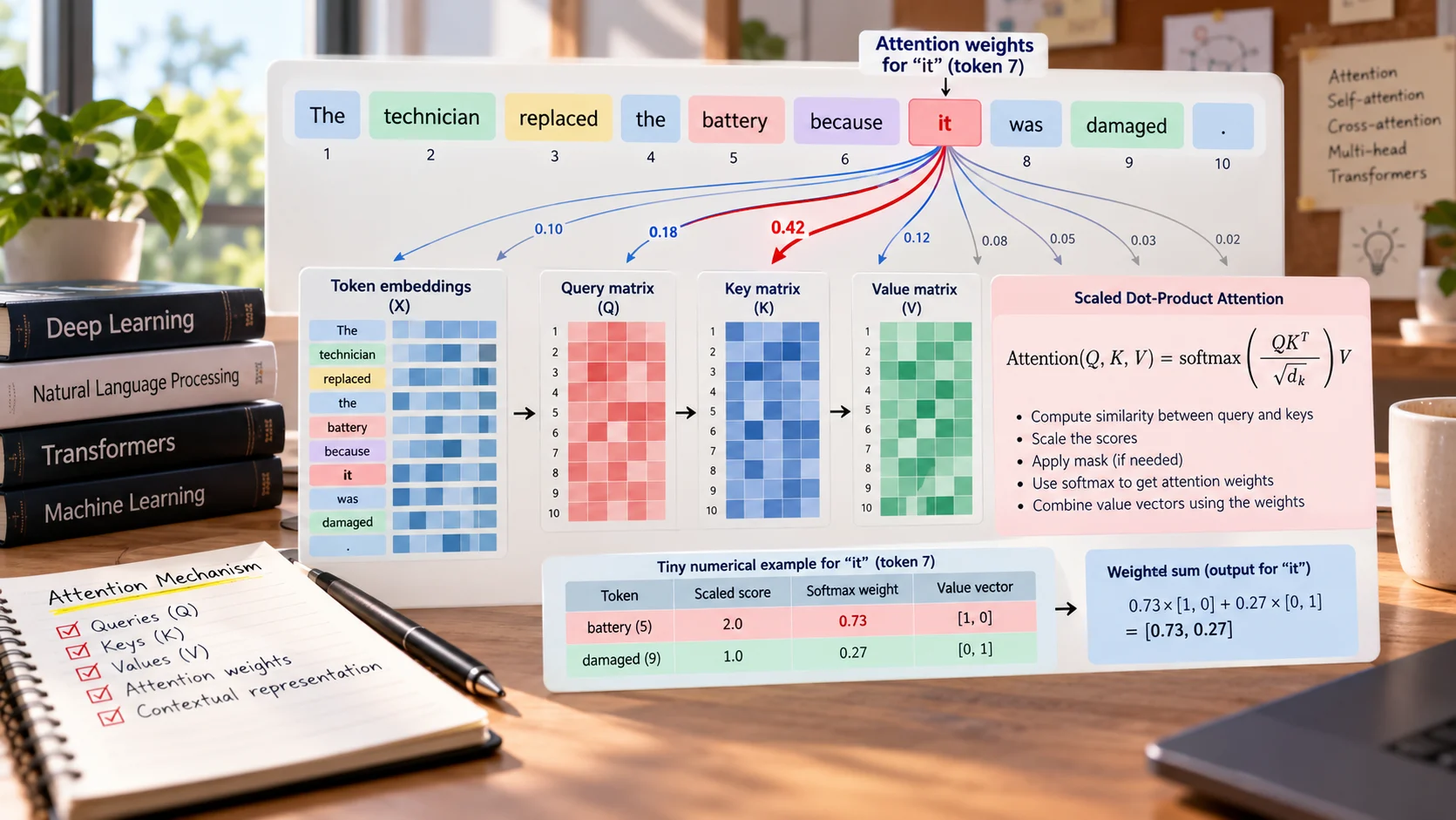
When a language model processes “The technician replaced the battery because it was damaged,” the word “it” is not meaningful in isolation. Understanding the sentence involves relationships among distant words, grammatical roles, and context. Attention mechanisms help neural networks compute contextual representations by allowing elements of a sequence to weigh information from other elements. They are a central part of the Transformer architecture, although they should not be confused with human awareness or comprehension.
Attention sounds abstract because it is usually introduced with matrices and formulas. Its basic purpose is practical: instead of representing each word only through its local neighbors, a model can combine information from relevant positions across a sequence. Different heads, layers, and token representations make the process powerful, though the same mechanism also introduces computational costs and interpretability limits.
The problem attention was designed to address
Earlier approaches to sequence modeling often processed text sequentially. Recurrent networks could pass information from one step to the next, but long-range relationships were challenging to learn efficiently, and sequential computation restricted parallelism. Attention mechanisms existed in earlier neural systems, yet the 2017 paper Attention Is All You Need proposed an architecture relying on attention rather than recurrence or convolution for sequence transduction.
A Transformer does not need to read every token one at a time with a recurrent hidden state. During training, its architecture can process many token representations in parallel, subject to masking and implementation details. This changed the practical economics of training large sequence models. It did not make language understanding automatic or eliminate limitations associated with data, optimization, or context length.
A useful way to think about attention is as a method of constructing a token’s representation from other token representations. For each position, the model learns which information may matter for the current computation. These relationships are numbers computed from vectors, not verbal rules consciously selected by the model.
Queries, keys, and values without mysticism
In standard scaled dot-product attention, each token representation is transformed into three vectors: a query, a key, and a value. The query describes the information sought by one position. Keys allow other positions to be compared against that query. Values carry the information that will be combined into the output.
For a given token, calculate similarity scores between its query and available keys. Scale the scores to control their magnitude, apply masking when necessary, and use softmax to obtain weights that sum to one over the allowed positions. Combine value vectors using those weights. The result becomes a contextualized representation for that position.
The familiar formula is:
[\operatorname{Attention}(Q,K,V)=\operatorname{softmax}(QK^T/\sqrt{d_k})V]
Here, Q, K, and V are matrices of query, key, and value vectors. The square root of key dimension d_k helps keep dot-product scores from growing excessively as vector dimensionality increases. This equation describes a common attention operation; practical implementations include further details such as masks, multiple heads, and numerical optimizations.
A tiny numerical example
Suppose one position has two allowed keys and computes raw compatibility scores of 2 and 1 after scaling. Softmax converts those values into approximate weights of 0.73 and 0.27. If the corresponding value vectors were [1, 0] and [0, 1], their weighted combination would be [0.73, 0.27].
This toy calculation shows what attention does mathematically. It does not imply that a 0.73 weight means a model was 73% confident about an interpretation, nor that the first token caused 73% of the eventual answer. The value vectors have many dimensions, later layers transform the output again, and attention weights alone do not provide a complete explanation of model behavior.
A token can receive information from multiple positions, including words that seem unimportant to a human reader. Some heads may learn useful position-sensitive patterns; others can behave differently. Their learned representations are distributed and depend on training and context.
Self-attention versus cross-attention
Self-attention draws queries, keys, and values from representations of the same sequence. It can help a word incorporate information from other words in its input. In a decoder-only language model, the attention mask ordinarily prevents a token position from reading future positions during next-token prediction. This is called causal or autoregressive masking.
Cross-attention uses queries from one representation stream and keys and values from another. It appears, for example, in encoder-decoder architectures where a decoder attends to an encoded source sequence during generation. Cross-attention is not present in every Transformer architecture. Calling all attention in modern AI the same operation can obscure these important design differences.
The mask is more than a convenience. An incorrectly implemented causal mask can allow training-time exposure to future target tokens, invalidating the learning objective. Padding masks prevent attention to meaningless padding positions. Other architectures use specialized local or sparse patterns to reduce computation or express structural assumptions.
Why Transformers use multiple attention heads
A single attention operation produces one weighted combination within a learned representation space. Multi-head attention runs several learned projections in parallel, allowing the model to represent different relationships before combining outputs. One head might emphasize nearby syntactic structure in a particular example, while another might respond to longer-range dependencies. Such descriptions are illustrative, not guarantees that individual heads possess stable human-readable jobs.
After attention, Transformer blocks also apply feed-forward transformations and normalization components, usually with residual connections. A complete Transformer is therefore not simply one large attention matrix. Layer depth, activation functions, positional information, and training objective all shape what can be represented.
There is no universal requirement that more attention heads always improve quality. The architecture must allocate dimensions among heads, and heads may be redundant or hard to interpret. Modern implementations use different mechanisms, including variants that reduce key-value memory cost during inference.
Position matters, even when attention sees all tokens
Attention alone is permutation-equivariant under basic assumptions: without information about position, reshuffling tokens would not preserve their intended ordering. Language requires distinctions between “dog bites man” and “man bites dog.” Transformer systems therefore incorporate positional information through learned embeddings, relative position mechanisms, rotary approaches, or other designs.
Position design affects extrapolation and long-context behavior. A model can support a long context window technically yet still struggle to retrieve or use information buried in the middle of a large document. Attention can create a route for information to flow; it does not guarantee that the model will attend effectively or reason correctly about everything available.
When evaluating long-context claims, test retrieval and reasoning on documents resembling actual workloads. A benchmark involving one memorable sentence inserted into a large text is different from synthesizing contradictory contract clauses or tracing dependencies through a long technical manual.
Why attention becomes expensive on long sequences
For ordinary dense self-attention, forming interactions among every pair of tokens produces a quadratic sequence-length component in computation and, depending on the implementation, memory use. Doubling sequence length can greatly increase the cost of the attention component. Other operations and optimizations also affect overall latency, so actual inference scaling is not determined by one simple formula.
Training and inference have different performance profiles. During autoregressive generation, models often cache key and value representations for previously processed tokens rather than recomputing everything. That cache consumes memory, especially with long contexts and many concurrent sessions. Techniques such as grouped-query attention, optimized kernels, sparse or sliding-window attention, and caching strategies address different bottlenecks.
A business evaluating a long-document assistant should measure end-to-end latency, total cost per resolved task, answer quality, and evidence retrieval—not only the advertised maximum context length. These concerns connect directly to the distinction between general model capability and practical AI inference.
What attention weights can and cannot explain
It is tempting to draw a heat map of attention scores and treat it as a complete explanation of why an answer was produced. Such visualizations can be useful for debugging and education, but causal explanation is more complicated. A token can affect outputs through residual pathways, value representations, feed-forward layers, and many attention operations across depth. Two systems may exhibit different attention patterns while producing similar outputs.
A responsible explanation distinguishes observation from inference. “This head assigned a larger weight to position five” is an observation about a particular calculation. “The model relied on that phrase as its sole reason” is a stronger claim that usually requires additional evidence, including interventions or attribution analyses.
Attention also should not be equated with factual grounding. A language model can attend to a fabricated sentence and use it fluently. Reliability depends on source quality, instructions, retrieval, validation, and the model’s learned behavior—not on attention alone.
A practical reading exercise for developers
Take a short sentence with an ambiguous pronoun and experiment with alternative contexts. Compare “The laptop did not fit in the case because it was too small” with “…because it was too large.” Human interpretation shifts with semantic plausibility. A contextual model also adjusts representations according to nearby words, although it may still make mistakes.
Next consider a longer input where the relevant definition occurs several paragraphs earlier. Ask the model for a concise answer with cited lines. Evaluate whether it points to the correct definition, whether it overlooks contradictions, and whether it invents details. Such tests assess application behavior; they do not reveal internal attention weights unless the architecture and tools expose them.
If building retrieval-based software, do not assume a huge context window removes the need for deliberate document selection. Good retrieval and structured citation prompts may reduce distracting information. ByteScope’s introductory discussion of model parameters can help place attention weights within the broader idea of learned model behavior.
Distinguishing attention from nearby concepts
Embeddings are vectors representing tokens or other objects. Attention operates on projections of representations, but an embedding itself is not attention. Context length is an architectural and operational constraint defining how much input a model can process at once; it is not a direct measure of understanding. Reasoning describes performance on tasks requiring inference or planning, not a single identifiable attention pattern.
Similarly, retrieval-augmented generation adds external evidence to a model’s input. The model still uses its internal processing to respond; retrieval changes the available context, not the mathematics of scaled dot-product attention. Keeping these concepts separate makes technical discussions more precise and prevents product marketing terms from being mistaken for mechanisms.
Common misconceptions
Attention does not mean a Transformer reads every word equally. Weights vary by token, head, and layer. It does not guarantee perfect understanding of long passages; relevant details can be missed or misused. Nor does it always create transparent explanations: an attention visualization is evidence about an intermediate computation, not a complete audit of the final output.
Another misconception is that every Transformer is an identical language model. Encoders, decoders, multimodal systems, and task-specific models use different attention patterns, objectives, and surrounding components. Understanding the family resemblance is useful, but model choice should still reflect the actual task.
How masking affects the meaning of generation
In an autoregressive language model, a token’s prediction is based on earlier allowed context, not on the words that will be generated afterward. During training, the entire sequence may be presented in parallel, but causal masks prevent inappropriate visibility of future tokens for the prediction at each position. That design helps align training with the next-token generation objective.
Consider a sentence that begins “The package was delivered to…” and later reveals a location. A causal model predicting the location cannot directly consult the answer tokens positioned to its right in the training sequence. Without the mask, evaluation could become artificially easy because the model would have access to the target it is supposed to infer. The mask is therefore part of the task definition, not merely an efficiency trick.
In encoder-style models used for bidirectional representations, the permitted information flow can be different. Both left and right context may contribute to a token representation. Comparing model architectures therefore requires knowing which positions were visible during the computation and what objective the model was trained to solve.
What to test when an application uses attention-based models
Do not infer that an architecture’s attention operation will solve every relevant document task. Build an evaluation set containing long-range references, conflicting statements, distractors, and required citations. Measure whether answers identify the correct source spans, not only whether the prose sounds plausible. Include examples where the right answer is “the document does not say.” This makes attention-related claims operational and verifiable.
Frequently asked questions
Why is the attention score divided by the square root of the key dimension?
Large dot products can push softmax toward very sharp distributions, making optimization difficult. The scaling factor moderates that growth under common assumptions about the vectors. It is a practical mathematical detail, not a confidence normalization.
Can attention process images or audio?
Yes. Transformer-based architectures can apply attention to patch, frame, acoustic, or other learned representations. The interpretation and structure of tokens differ by modality, but the core idea of weighted information combination remains relevant.
Does more context always mean better answers?
No. More context can supply needed evidence, but it may also add noise, cost, and conflicting information. Effective retrieval, clear prompts, and evaluation remain important regardless of window size.
Conclusion
Attention is a learned mechanism for mixing information across positions in a sequence. Queries, keys, and values explain the core computation; masks, multiple heads, positional encoding, and surrounding Transformer blocks explain why that computation is useful. Understanding both the benefits and the limits makes it easier to evaluate claims about context, model behavior, and long-document AI applications.
References
Vaswani and colleagues: Attention Is All You Need
The Annotated Transformer