A customer-service chatbot needs an answer now. A company translating 80,000 product descriptions can wait until tomorrow. Treating both jobs as interactive AI requests usually wastes time, money, or system capacity. Batch inference processes large sets of AI inputs asynchronously, making it useful when results need to be reliable and traceable but do not need to arrive in milliseconds.
This distinction is increasingly relevant as businesses use models for reporting, document classification, content enrichment, and scheduled quality checks. Batch processing can improve throughput and operational efficiency, yet it introduces queue management, partial failures, input-data governance, and result reconciliation. Understanding those responsibilities matters more than merely sending many requests at once.
What batch inference means
Inference is the act of using a trained model to produce a prediction or generated result. In real-time inference, an application typically waits for one request and returns the output directly to a person or another service. In batch inference, inputs are prepared as a collection, submitted to a processing service, executed over a period of time, and retrieved when jobs finish.
A batch can contain ten images, a million transaction records, or thousands of text prompts, depending on the model and service limits. “Batch” does not necessarily mean that a model processes the entire collection in one enormous context window. Usually each record remains a distinct task, with systems scheduling and grouping work for efficiency. The output can be a file, database table, or set of artifacts accompanied by job statuses.
Batch inference differs from batch training. Training updates model parameters using data; inference uses existing parameters to compute outputs. It also differs from simply running a loop of synchronous requests. Asynchronous batching may use a separate job queue, pricing model, capacity pool, or turnaround commitment.
Workloads that benefit from asynchronous processing
Retail catalog enrichment is a useful example. A merchant receives thousands of supplier descriptions that need category labels, material tags, and normalized attribute names. Those tasks should be finished before catalog publication, but individual records do not require interactive responses. An overnight batch can process the inputs, flag uncertain outputs, and leave time for editors to review exceptions.
Other suitable examples include classifying historical support tickets, detecting anomalies in a nightly data export, generating image descriptions for a digital asset library, extracting fields from archived documents, or computing embeddings for a knowledge base. Batch processing also supports scheduled model evaluation: a fixed set of test prompts can be run against a candidate model and compared with previous versions.
Interactive customer chats, payment authorization, live safety alerts, and applications requiring immediate human feedback generally belong on synchronous paths. They may still use some offline enrichment, but the final decision cannot depend on a result arriving at an unspecified later time.
Designing a batch job around records
A robust input file gives every record a stable identifier, clearly defined input fields, and enough metadata to reconcile the output. For a product catalog job, the ID might correspond to the merchant’s inventory system rather than the order in which lines appear in a file. Record identifiers remain important because jobs may finish out of order and some records may fail while others succeed.
Avoid including fields the model does not need. Shipping addresses, customer names, and payment details should not be copied into a product-description classification job without a legitimate reason. Apply appropriate data minimization and approved handling policies before creating the batch. For datasets with sensitive material, confirm where the provider processes and retains content.
Think of a job as a state machine: created, validated, submitted, running, completed, partially_failed, or failed. A production system should not silently treat an HTTP request that accepted the batch as proof that all records finished successfully. Acceptance is the beginning of the workflow, not the final result.
Example: categorize a supplier catalog
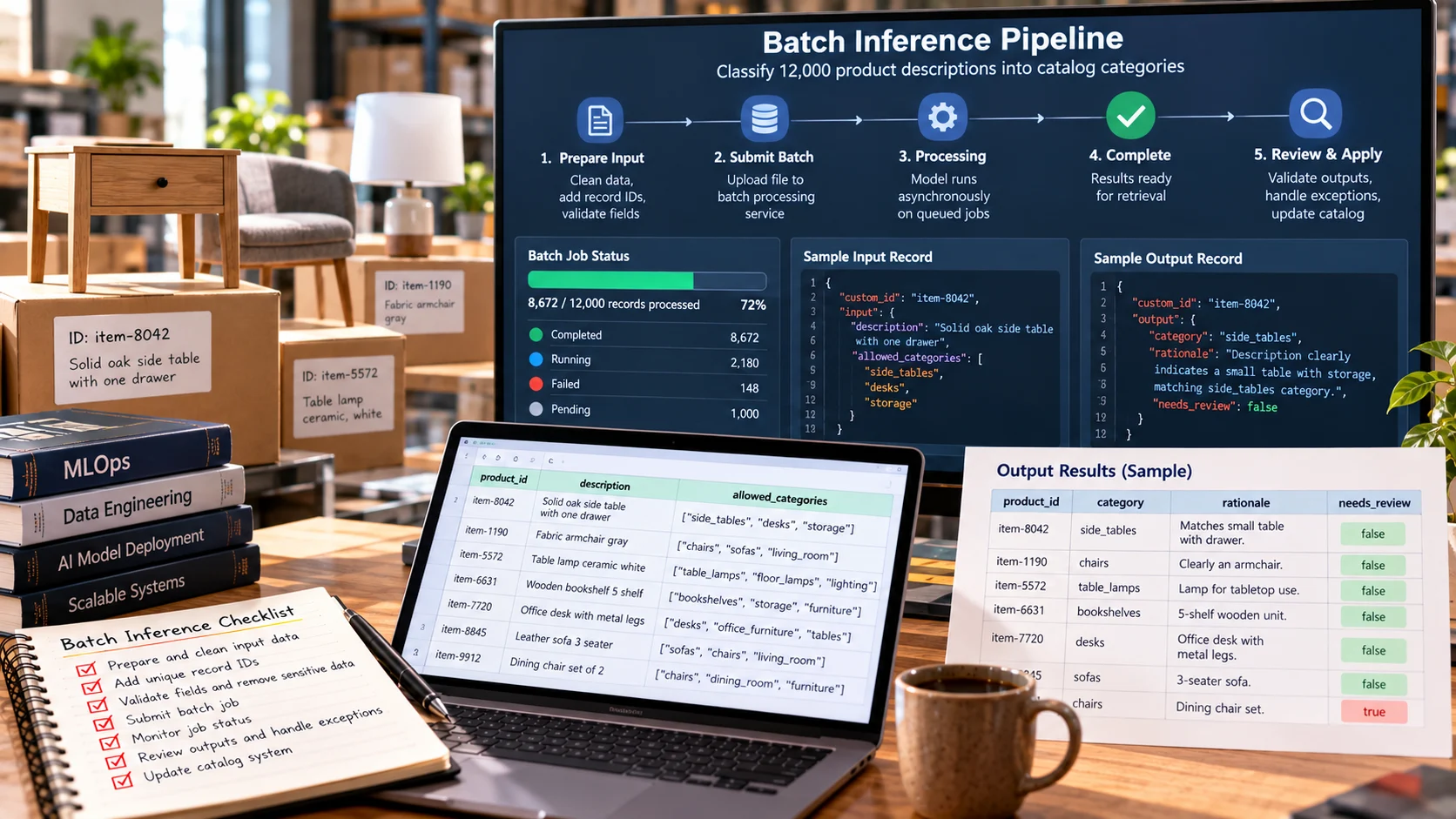
Suppose a furniture seller wants to classify 12,000 items into a controlled list of categories. Each record includes a product ID, existing description, and allowed category list. For each output, the system requests product_id, category, rationale, and a needs_review flag. The category must belong to the allowed list and the product ID must match the input. The goal is to reduce manual sorting, not to invent new catalog facts.
A simplified record might look like this:
{
“custom_id”: “item-8042”,
“input”: {
“description”: “Solid oak side table with one drawer”,
“allowed_categories”: [“side_tables”, “desks”, “storage”]
}
}
The conceptual expected output is side_tables, with a concise reason and a review flag if the description is ambiguous. Actual batch API request syntax varies by provider; this illustrative JSON is not a ready-to-upload file for any particular service. The business should never assume that a plausible label is necessarily correct without checking a representative sample.
Choosing the right chunk size
A batch large enough to use the service efficiently can still be too large to recover from conveniently. If one file contains all 12,000 records and fails at an operational boundary, the team may struggle to identify what finished. If every record becomes its own separately managed job, the overhead may be excessive. Choose manageable partitions based on service limits, expected processing time, file size, and how easily work can be retried.
A useful approach is to divide input by a stable business key or numbered shard. Save a manifest for each shard containing record counts, checksum, model configuration, and source-data version. If an output is missing, compare it with the manifest rather than inferring success from the number of returned lines alone.
Batch size can also affect throughput under rate limits and job concurrency caps. Test with a small representative set before launching a full production workload. A service may queue work rather than rejecting it, so end-to-end turnaround—not just upload time—is the key user-facing measure.
Handling failures and retries correctly
Failures occur at different levels: an entire job may be rejected, one record may contain invalid input, the provider may time out, or the output may be syntactically valid but semantically unacceptable. Handle those cases separately. Retry transient errors with bounded backoff; correct invalid records before resubmission; and route ambiguous predictions to review rather than repeating the same request indefinitely.
Make record processing idempotent where possible. If item-8042 is submitted twice during recovery, the destination catalog should not contain duplicate items or conflicting updates without explicit resolution. Use stable keys and upsert logic, and save the model version and timestamp with each result. Do not overwrite approved editorial changes merely because an old batch finishes later.
A completion report should list total inputs, completed outputs, invalid inputs, transient errors, reviews required, and records still missing. If 11,800 of 12,000 requests succeeded, the job’s overall status should not conceal the 200 unresolved cases. Operational quality depends on accurately representing partial success.
Quality assurance for generated outputs
Structural validation checks that required fields exist, categories are allowed, types are correct, and identifiers match. Semantic validation asks whether the output is grounded in the source. A category can be valid JSON and still be wrong. Review random samples from every major category and targeted samples from rare, high-cost, or confusing cases.
If the task involves summarization, test for omitted exceptions and invented claims. If it involves extraction, compare critical fields with source documents or a trusted system. For classification, report class-level precision and recall rather than only overall accuracy. Drift monitoring matters because supplier descriptions, customer vocabulary, and internal categories change over time.
Build quality gates before updating production records. A sensible catalog policy might accept unambiguous category assignments automatically but require review for ambiguous descriptions or unfamiliar brands. The exact thresholds should be chosen through evaluation and documented cost trade-offs.
Cost comparisons should include the whole pipeline
Some platforms offer batch processing under different prices or capacity pools than synchronous APIs. OpenAI’s Batch API, for example, documents asynchronous jobs with a separate rate-limit pool and service-specific turnaround expectations. Features and pricing may change, so check the current official documentation before budgeting.
The effective cost per useful result includes input preparation, model execution, storage, failed requests, human review, reconciliation, and reprocessing. A provider price reduction does not guarantee an overall saving if the system produces many unreliable outputs or fails to connect results to the right records.
For a rough hypothetical comparison, imagine 10,000 classification calls cost $0.004 each synchronously and $0.002 each through a batch offering. The model-call difference is $20. That amount could be outweighed by several hours of manual recovery if the batch workflow lacks proper IDs and validation. Evaluate expected total cost, not just a provider’s headline discount.
Privacy and retention considerations
Processing thousands of records amplifies the impact of a data-handling mistake. Classify data before export, obtain appropriate authority, remove unnecessary personal information, and enforce access limits on both input and output files. Temporary storage can become a shadow archive if there is no deletion schedule. Ensure logs do not leak model inputs through error messages.
Batch jobs may continue after an employee signs out or leaves the company. Ownership of queued work must therefore belong to an approved service identity and controlled process, not an individual’s browser session. For sensitive decisions, provide traceability to the model version, input source, validation result, and human approval where required.
The existing ByteScope guide to AI workflow automation discusses connecting operational steps; batch processing adds the need to reconcile asynchronous outputs without assuming that completion order matches submission order. The article on AI data analysis provides a complementary view of what teams can do after a reliable batch dataset has been produced.
Operational metrics worth tracking
Track submitted records per hour, successful records per hour, median and high-percentile turnaround, queue wait time, retry count, validation failure rate, manual-review rate, and total cost per accepted output. Also track freshness: a batch completed perfectly three days late may have no business value if the catalog release already passed.
Use a dashboard to distinguish system health from model quality. A healthy queue can produce inaccurate labels; an accurate model can be unavailable because an upstream export failed. Alert on missing source files, stuck jobs, unexpectedly high error rates, and delays beyond the business deadline. Recovery plans should specify which jobs can be safely rerun.
Reconciliation example with a failed shard
Suppose a catalog enrichment batch contains four shards of 3,000 records each. Three finish successfully; one produces 2,910 valid outputs, 60 invalid-input errors, and 30 missing records after a transient worker failure. The processing dashboard should report 11,910 valid outputs, 60 invalid cases, and 30 unresolved cases—not a misleading “four jobs completed.”
The recovery process first resolves malformed inputs where possible and resubmits only records that are safe to retry. It uses the original custom_id values and a manifest of expected identifiers to detect missing or duplicated output. When results return, an upsert keyed by product ID and source-data version prevents a late retry from overwriting a newer approved description.
This is why batch operations need a business reconciliation layer even when the model provider reports job completion. The final acceptance question is whether every required source record has a trustworthy disposition: accepted, rejected with a reason, or deliberately assigned to review.
Planning freshness and deadlines
An overnight batch should have a deadline aligned to its business use. If a catalog feed must publish at 8 AM, processing that finishes at 10 AM may force a delayed release regardless of model accuracy. Define maximum queue age, job cutoff, and what happens when the deadline cannot be met. Sometimes the right fallback is publishing unchanged existing product data rather than inventing values to fill gaps. Make that policy before the first incident.
Designing a data contract for batch outputs
Document required output fields and acceptable values before processing. For product categories, specify the approved taxonomy version and what the model should return when no category fits. Include a source identifier and model configuration so results can be reconciled after delays or retries. When the taxonomy changes midway through a long job, do not silently mix old and new labels; either hold the version constant for the batch or record the version with each record and handle the transition explicitly.
This small contract reduces ambiguous downstream updates and helps analysts understand why two otherwise similar products received different labels. It also makes auditing easier when a customer asks how a classification was produced.
Frequently asked questions
Is batch inference always cheaper?
No. Some services provide discounts or throughput advantages, but others do not. Total cost depends on overhead, model choice, failure handling, and provider terms.
Does batch inference improve AI accuracy?
Not inherently. It changes how requests are scheduled and processed. Accuracy still depends on model behavior, prompts, data quality, validation, and human review.
Can batch jobs include private data?
Only when the organization’s policies, applicable obligations, and provider controls allow it. Asynchronous processing adds storage, retention, and access-control questions that should be resolved before submission.
Conclusion
Batch inference is the right tool when large volumes of model work can wait for a controlled completion process. Design around stable record IDs, bounded retries, validation, privacy, and output reconciliation. The real gain is not merely sending requests in bulk; it is converting an expensive, fragile sequence of individual tasks into a measurable and recoverable workflow.
References
OpenAI API: Batch processing
Google Cloud: Batch predictions overview