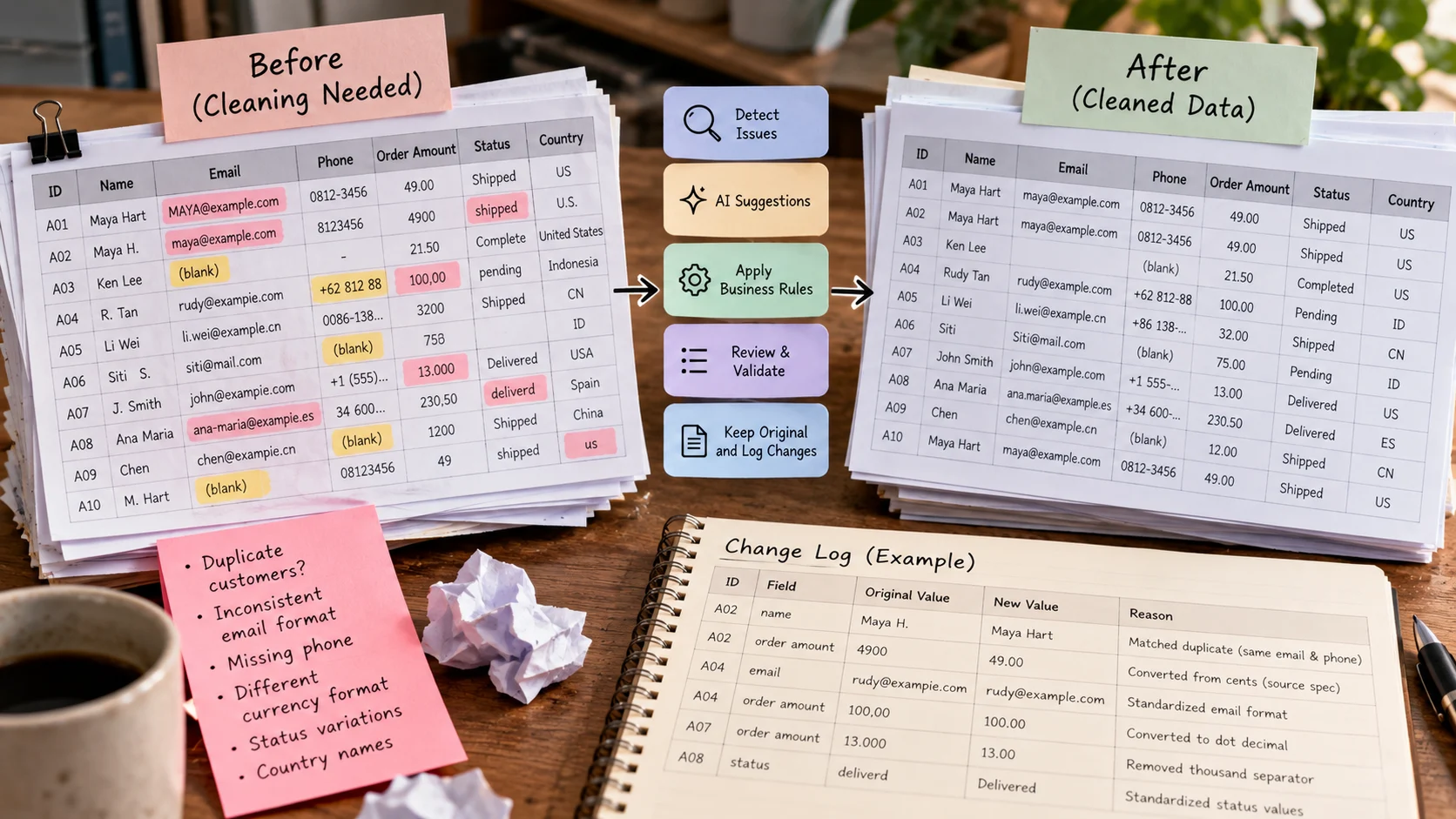
An online shop has customer records where one person appears under two spellings, phone fields have inconsistent formats, and some orders lack a currency. AI-assisted data cleaning uses statistical suggestions, pattern recognition, language interpretation, and rules to find problems in datasets. The central task is preparing trustworthy records, not drawing conclusions from already-clean data. ByteScope already has broader articles about spreadsheets and data analysis; this guide addresses upstream quality defects, reproducible fixes, and explicit change records. Quantitative examples below are hypothetical and should be adapted to the reader’s actual data.
Key Takeaways
Data cleaning starts with trustworthy definitions: a duplicate customer, a missing value, and a bad date are not the same problem.
AI can suggest normalizations or suspicious rows, but business rules should determine which proposed changes are acceptable.
Keep original values and a change log so automated corrections can be explained and reversed.
Test cleaning quality on representative records, including edge cases and legitimate near-duplicates.
Assess the reduction in operational rework, not only how visually neat the cleaned spreadsheet becomes.
Data Cleaning Starts With Trustworthy Definitions
Business datasets become messy for ordinary reasons. Staff abbreviate names differently, imports change date formats, customers update contact details, and multiple systems use the same field name for different meanings. An AI data-cleaning tool can identify patterns and suggest repairs, but it cannot independently decide which business rule is authoritative. The foundation is a documented definition of what a valid record looks like.
For example, a retailer might store order_amount as dollars in one export and cents in another. A model that sees both may infer an apparent outlier without knowing the unit conversion. If it “corrects” the amount incorrectly, the data looks neater while becoming less trustworthy. Before applying automated repairs, define the source of truth, field types, units, allowed values, and the business consequence of an error.
AI should assist with proposals, classification of anomalies, text standardization, and matching likely duplicates. Deterministic rules should handle checks that are already known, such as date parsing or required column types. The strongest workflow combines both instead of treating generative output as a replacement for ordinary data validation.
Diagnose Problems Before Changing Values
Missing values have different meanings
A blank customer phone number may mean “not collected,” “customer declined,” or “failed during import.” These states are not equivalent. Replacing all blanks with a fabricated number—or a guessed value based on nearby records—can corrupt downstream operations. Decide whether a missing field should be retained, filled from an authoritative source, or routed for investigation.
Duplicates require identity rules
Two rows with similar names are not automatically the same customer. One customer may have multiple emails, while two family members may share an address and phone number. Exact duplicates, probable matches, and separate legitimate records need different handling. Avoid merging accounts solely because an AI similarity score is high. Use permitted identifiers and human review for ambiguous cases.
Outliers may be correct
An unusually expensive transaction could reflect a bulk corporate purchase, not a typing error. A rare postcode may be valid. Flag outliers for review, but do not “normalize” them away without evidence. This distinction is particularly important when the dataset will later support fraud detection, because deleting unusual cases can weaken the model’s ability to recognize real anomalies.
Text variation can conceal consistent meaning
Values such as “United States,” “USA,” and “U.S.” may need a common code, but a normalization table must distinguish countries, states, product brands, and organization-specific abbreviations. AI can suggest candidate mappings for messy free-text categories. The approved mapping should then be stored as a reproducible rule that future data batches can apply consistently.
A Small Before-and-After Example
Consider an illustrative customer export:
Record Name Email Order amount Status
A01 Maya Hart MAYA@example.com 49.00 Shipped
A02 Maya H. maya@example.com 4900 shipped
A03 Ken Lee blank 21.50 Complete
A naive cleaner might combine A01 and A02, divide one price by 100, and invent a phone or email for A03. A careful approach first checks whether the two Maya rows refer to the same order or separate purchases; whether the source systems use dollars or cents; and what the status vocabulary should be. The email case can be standardized where appropriate, but identity and amount changes require source evidence.
The example illustrates why a clean-looking table is not enough. Every correction should be traceable to a business rule, verified lookup, or approved review. The log might say: “A02 amount converted from cents to dollars using the source-system export specification” rather than “AI fixed price.” If the specification is missing, quarantine the record instead of guessing.
Where AI Tools Fit in the Cleaning Stack
Profiling tools reveal missingness, unexpected types, frequency distributions, and duplicates. Traditional database queries and spreadsheet functions are often enough for this stage. Rule engines enforce accepted constraints and transformations. Probabilistic matching tools help identify possible entity duplicates when exact keys are unavailable. Language-model assistants can explain irregular categories, propose mapping tables, write validation code, and summarize flagged cases.
The methods have different risks. A language model may invent a plausible mapping from a poorly documented field. A similarity matcher can confuse two distinct people. A rigid rule may reject legitimate newly introduced codes. Each proposed change therefore needs an appropriate verification gate. Choose the tool according to the error class, not according to which interface offers the most impressive chatbot.
A Repeatable Cleaning Workflow
Preserve the raw dataset. Store an immutable snapshot with source identifiers, import time, schema version, and permitted access. Never overwrite the only evidence of the original records.
Profile the dataset. Measure missing fields, invalid dates, category variation, key uniqueness, and extreme values. Segment these counts by source system so the dominant causes become visible.
Document the rules. Define field types, permitted statuses, key constraints, units, and relationships. Have business owners approve rules that might alter financial or customer records.
Apply deterministic fixes first. Trim accidental whitespace, parse dates with known locale rules, and normalize approved status aliases. Log changes and retain the before value.
Use AI for unresolved patterns. Ask tools to propose candidate mappings or likely duplicates, but require evidence and review for meaningful changes. Assign confidence bands to suggestions only if those scores are validated for the workflow.
Validate repaired records. Re-run schema checks, reconciliation rules, and representative manual samples. Ensure that fixes did not create new duplicates, change totals, or alter historical meaning.
Export with an audit trail. Record data lineage, rule versions, unresolved exceptions, reviewer decisions, and the destination dataset version. Make the cleaning pipeline repeatable on the next import.
A first pilot should operate on a copy, not on the live customer database. If an automated fix creates problems, reverting to the raw snapshot and replaying only approved transformations should be straightforward. Cleaning that cannot be explained or reversed is difficult to govern.
How to Evaluate Cleaning Quality
Use measurable error categories. Completeness can be reported as the share of required fields that contain valid, meaningful values. Validity measures conformance to accepted rules. Uniqueness measures unintended duplicate records relative to the defined identity key. Accuracy requires checking against trusted external or operational evidence; a value may satisfy every formatting rule and still be factually wrong.
Review human workload as well as error percentages. An AI matcher that flags half the database for manual attention may not save time even if it identifies many legitimate duplicates. Measure precision of suggested corrections, false merges, unresolved exception counts, review time, and downstream improvements such as fewer failed deliveries or rejected invoices.
Avoid comparing only the number of changed cells. More changes are not necessarily better. A system that correctly leaves difficult records untouched may be safer than one that aggressively repairs everything. The objective is trustworthy information for an identified decision.
Common Failures and Better Alternatives
One failure is silent imputation, where an assistant fills missing ages, prices, or addresses with plausible guesses. Use explicit “unknown” states or authoritative lookups instead. Another is merging distinct people because fuzzy matching treats similar names as identity. Require suitable identifiers and manual approval for uncertain matches.
A third is breaking referential integrity by changing an identifier in one table without updating dependent records. Validate relationships across tables and export as a controlled transaction. A fourth is forgetting transformations: a polished CSV is delivered without a log of source values or rules. Version the cleaning logic, output, and exception report so later users can reproduce what happened.
Privacy and Practical Boundaries
Datasets frequently contain sensitive business and personal information. Remove unnecessary fields before sending them to an external AI service. Review service terms, permitted processing purposes, regional storage options, and access controls. If the team can accomplish a correction with a local rule, there may be no need to transmit the record to a remote model.
Cleaning must also preserve legitimate user corrections and deletion requests. A previously deleted profile should not be resurrected by a later import from an old system. Coordinate the cleaning pipeline with retention and consent policies rather than assuming technical consistency automatically establishes permission.
A successful AI data-cleaning project produces fewer business-impacting errors and better evidence about every change. The best tools expose uncertainty and let organizations distinguish formatting fixes from corrections that require facts, authority, or human judgment.
A transparent dirty-to-clean customer table
Raw customer ID Name Email Currency Issue
018 Alya Putri ALYA@example.com USD Normalization needed
018 Alya P. alya@example.com USD Possible duplicate, not proof
019 Ben Hart blank USD Missing contact field
020 Carla Rae carla@example.com blank Missing currency
First preserve an immutable raw file. Normalize email casing only when appropriate, flag the two 018 records for review, and do not invent Ben’s email or Carla’s currency. In Python, df.duplicated(subset=[‘customer_id’], keep=False) marks possible collisions; it does not tell you which record contains the truth. A data-cleaning log should capture the source row, transformation rule, timestamp, and reviewer for uncertain merges.
What the example teaches. Two people share a household telephone number, while one customer has two email spellings. A naïve deduplication rule collapses the first pair and misses the second. The team tests false merges separately from duplicate removal and stores reversible identity links rather than destructive record replacement.
Keep Corrections Reproducible Across Monthly Imports
A cleaning workflow should behave predictably when the next month’s export arrives. Store accepted mapping tables, duplicate rules, validation thresholds, and source-system assumptions in version-controlled files or another reviewable repository. For every changed value, preserve the original record identifier, transformation name, timestamp, and reviewer where required. If a vendor changes an input field, the pipeline should fail clearly instead of applying yesterday’s mapping to a new meaning.
Use a dry-run mode before modifying important records. It can report how many values would change, show representative examples, and flag unusual increases compared with the previous period. A sudden jump in converted currency values may indicate a broken unit assumption rather than an exciting opportunity to clean more cells.
A Simple Acceptance Test
An acceptable test includes a known clean record, a record with a formatting error, a genuine outlier, two likely duplicates that belong to different people, and a missing value that cannot be reconstructed safely. The cleaner should fix the straightforward formatting error, preserve the real outlier, avoid the dangerous merge, and leave the unknown field explicitly unresolved. This small test suite exposes whether the system is correcting evidence or simply forcing every row into a superficially tidy shape.
Decide Which Corrections Require Approval
Not every data-cleaning operation should be automatic. Trimming accidental spaces or standardizing a clearly documented date format may be reversible and low risk. Replacing a missing customer address with a model’s best guess is a different action: it creates information the company did not actually receive. Define a change policy with three classes: safe normalization, suggested correction requiring review, and unresolved record. For each changed row, preserve the original value, reason, tool version, and approving user when applicable.
Deduplication needs particular care. Two orders with identical totals on the same day may be legitimate separate purchases, while two customer records may share a phone number without representing the same person. Require additional evidence before merging operational entities, and provide a way to undo mistakes without losing the underlying event history.
Frequently Asked Questions
Can AI clean a spreadsheet automatically?
AI can propose transformations, but automatic replacement is risky when identifiers and business meanings are unclear. Preserve a raw copy and require review for high-impact changes.
How should missing values be handled?
Use a documented policy: leave missing values explicit, recover from an authoritative source, or impute only when analytically justified. Do not silently invent facts.
Is deduplication the same as removing identical rows?
No. Two records with small textual differences may describe the same entity, while identical names may describe different people. Match rules must reflect context.
How do you prevent incorrect changes?
Keep transformation logs, reversible operations, validation examples, and review thresholds for uncertain suggestions. Recheck downstream reports after changes.
Further Reading on ByteScope
AI Data Analysis Tools
How AI Training Data Works
Sources and Further Reading
pandas: Duplicate Data — Primary background reading; confirm applicability to your use case.
pandas: Working with Missing Data — Primary background reading; confirm applicability to your use case.