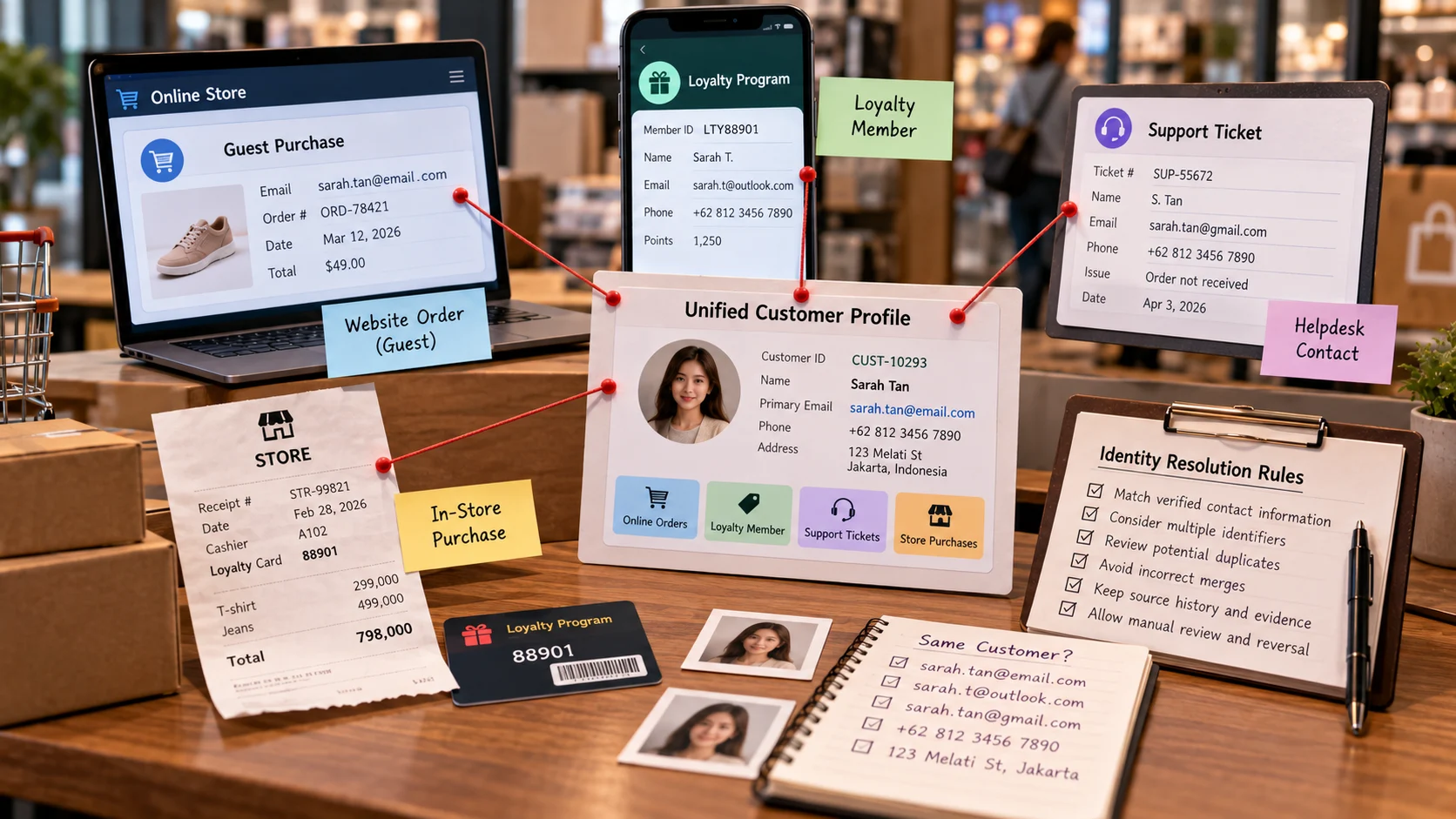
An online retailer sees the same customer appear as a guest purchaser, a loyalty member, and a helpdesk contact under different email aliases. Customer identity resolution links records believed to describe the same person or organization across apps, accounts, and interactions. It requires careful evidence, consent, and avoidance of incorrect merges. This is about record identity and matching logic, not the broader customer journey or sales follow-up workflows covered elsewhere on ByteScope. Quantitative examples below are hypothetical and should be adapted to the reader’s actual data.
Key Takeaways
Customer identity resolution joins records that appear to describe the same person or account across channels.
A shared device, household phone number, or recycled email address is not proof that two records belong together.
Test false merges separately from missed matches because incorrect merges can expose another person’s information.
Identity decisions should be documented, reviewable, and reversible when corrections are needed, especially when customer access is affected.
Counts of ‘unique customers’ depend on matching rules and should not be interpreted without the definitions.
Why One Customer Can Appear as Several People
Customers interact through websites, apps, store visits, support tickets, email campaigns, and loyalty programs. Each channel may create its own identifier. One person could use an email address when ordering, a phone number when contacting support, and a loyalty card in a physical store. Customer identity resolution attempts to determine which observations refer to the same real-world customer or account.
The task is deceptively difficult. Two people can share a surname, household address, device, or company account. One person can change phone numbers or use multiple email addresses. A mistaken merge exposes one person’s history to another and can contaminate marketing, support, or financial records. A mistaken split hides relevant context. The system should therefore make identity decisions based on evidence and acceptable business risk, not simply match similar-looking strings.
Deterministic and Probabilistic Matching
Deterministic matching uses known identifiers or explicit rules. A customer login tied to a verified account ID can provide a strong connection. An exact email match may be useful, but not all emails are unique, permanent, or verified. Deterministic logic is transparent, though it may miss legitimate matches when identifiers are missing or outdated.
Probabilistic matching considers several signals and estimates how likely records are to correspond. Similar names, shared phone numbers, addresses, purchase histories, or other authorized attributes may contribute to a candidate match. The model’s output is a suggestion whose reliability depends on training data and thresholds. Weak evidence should not become a forced identity merge merely because the system has to assign a record somewhere.
A mature workflow often uses multiple tiers: automatic merges for carefully validated high-confidence matches, human review for ambiguous candidates, and no merge where the evidence is insufficient. The thresholds should be tested against labeled pairs and adjusted to the cost of false merges versus missed merges.
Identity Graphs, Golden Records, and Provenance
Some systems represent entities and identifiers as an identity graph. A person may connect to a verified login, an email address, a loyalty account, and a mobile device under explicit rules. Edges carry provenance and sometimes confidence or validity periods. A graph can preserve evidence without flattening every observation into a single undifferentiated profile.
A golden record is a curated representation of key customer attributes, not proof that the organization knows everything about a person. Different attributes can have different authoritative sources: billing determines the invoicing address, a verified customer update may determine the current phone number, and a support ticket may contain a historical contact method. Merging records without source history makes later corrections difficult.
Maintaining change history matters when customers move, change names, or request deletion. The system must also distinguish a household, individual, organization, and device. These entities may be related without being identical. A family sharing a tablet should not automatically be treated as one buyer.
A Practical Identity-Resolution Project
State the use case. Improving support handoffs and measuring unique customers are different objectives, even if they use overlapping data.
List identity-bearing sources. Identify account IDs, verified contact fields, transaction identifiers, and channel events, along with the permission basis for their use.
Normalize carefully. Standardize formats such as phone numbers and email case where appropriate. Preserve original values and avoid assuming every local address rule is universal.
Generate candidate pairs. Use strong identifiers or blocking rules to narrow comparisons. Comparing every record with every other record can be wasteful and may increase false matches.
Evaluate match evidence. Check labeled examples representing both true matches and similar but distinct people. Measure false-merge and false-split behavior separately.
Apply tiered decisions. Approve high-confidence patterns, route uncertain cases for review, and leave unsupported identities separate.
Record provenance and reversibility. Store which records were linked, why, by which system version, and how a mistaken decision can be undone.
Monitor new data. Reassess identifiers when contact details change, accounts are closed, or channels introduce new fields.
A pilot should run on a controlled sample before changes are applied to the master CRM. Reviewers need tools to inspect the original records and understand why a match was proposed. If a system cannot explain which identifiers contributed to a decision, it is difficult to investigate privacy-impacting false merges.
Example: Online and In-Store Purchase Histories
Imagine a retailer with an online account for “Amira Stone” and a loyalty-card record for “A. Stone.” The online record uses a verified email; the in-store record has the same phone number but no email. The candidate may be a true match. Yet the phone could belong to a shared household, and two unrelated people may have used the same number over time. A robust system checks additional permitted evidence and may request confirmation instead of silently joining purchase histories.
Suppose the business later learns the records belong to different people. The merge must be reversible, including dependent marketing segments and support views. Removing a single link from the matching database may not undo copies already exported downstream. Identity resolution therefore depends on data lineage and downstream propagation, not just similarity scoring.
Match Quality and Business Outcomes
Precision among accepted matches is central when a wrong merge could expose sensitive customer data. Recall matters when missed links lead to duplicate outreach or incomplete service histories. These measures trade off against one another as thresholds change. Evaluate results by customer segment, source channel, and data recency to catch uneven performance.
Business metrics might include duplicate contact rates, conflicting support records, misdirected communications, and staff correction time. A high automated match count is not an achievement if customers have to correct mixed identities. Prefer a conservative system that explains uncertainty when the stakes are high.
Privacy, Consent, and Purpose Limits
Identity resolution is powerful precisely because it links data that may previously have been separate. Organizations should not assume that every technically possible linkage is permitted or expected by customers. Respect purpose limits, consent requirements, retention policies, and applicable rights to access or correct records. Use only attributes necessary for the documented purpose and apply role-based access to resolved profiles.
Browser cookies and device identifiers may be transient, shared, or subject to legal restrictions. Treat them as signals with limitations, not universal personal identities. Avoid building hidden cross-channel profiles without assessing privacy implications and providing the required notices or choices.
How to Choose a Platform
Compare systems based on matching rules, evidence visibility, export and deletion support, reversibility, source integration, and audit capabilities. Ask whether the platform distinguishes households from individuals, handles shared identifiers, and supports human review. Vendor claims of “a single customer view” should be tested on messy real scenarios rather than accepted as proof of correctness.
Customer identity resolution works best as a continuously governed evidence process. Good results connect trustworthy records while protecting the people behind them from accidental merges, inappropriate profiling, and uncontrolled reuse.
Reconciling multiple records for the same customer
A customer appears as “Maya H.” in a checkout database, “Maya Hart” in a help desk, and “M. Hart” in a newsletter system. Matching only by name would risk merging two different people. An identity-resolution process can use verified email, consented account IDs, order history, and explicit confidence rules to create an identity graph without permanently discarding source records.
Record Key evidence Suggested handling
Checkout 1042 Verified email A Canonical customer candidate
Support 889 Same verified email A Link with audit trail
Newsletter 541 Same surname, different email Do not auto-merge
Identity resolution is a probabilistic evidence problem, not permission to combine all personal information for any purpose. Consent, retention, and access boundaries still apply.
What the example teaches. A customer buys as a guest and later signs in under a loyalty account. A verified transaction-to-account association supports a link, whereas shared address alone is weak evidence. An identity graph records why the link exists and permits a correction when another household member claims the order.
Why Identity Matching Needs an Undo Button
An incorrect merge can spread into CRM segments, billing records, support tools, marketing lists, and analytics datasets. Correcting only the master profile may leave contaminated derivatives. Design a reversible link operation that records the candidate pair, evidence, decision date, reviewer, and dependent systems. When an error is discovered, downstream corrections should be traceable and not silently abandoned.
The same challenge arises when profiles are split. If a shared household was mistakenly treated as one person, past activity may need careful reassignment without exposing one family member’s details to another. A review process should follow the organization’s privacy and account-access rules rather than presenting every record to any employee who requests a correction.
Match Thresholds Depend on the Consequence
A marketing analytics system might tolerate some unidentified repeat customers, because a missed merge mainly affects aggregate counts. A system granting access to account history should be far more conservative: merging two unrelated people can disclose private information. Therefore, a single global similarity threshold may be inappropriate across the organization. Define approval levels by application and validate them using labeled examples.
Also examine drift in identifiers. Phone numbers are recycled, households change, and customers switch email addresses. A match that was reasonable when first observed can become misleading later. Periodically reassess evidence and respect explicit customer corrections instead of allowing historical model suggestions to overrule them indefinitely.
Reporting Coverage and Uncertainty
Publish the number of resolved identities, proportion routed to review, and error estimates from a labeled test sample. Explain that an identity count depends on definitions such as individual, account, or household. A dashboard that suddenly shows fewer unique customers after a matching algorithm change may reflect a data-processing change rather than an actual business trend. Record model revisions and recompute comparative metrics where necessary.
Why a Shared Identifier Does Not Always Mean the Same Person
A household can share a phone number, a store tablet can serve hundreds of shoppers, and an email account can be reassigned. Treating any one identifier as infallible can merge unrelated histories and expose information to the wrong person. Identity systems need documented rules for which signals are strong, which are contextual, and what should happen when evidence conflicts. A verified account ID may deserve a different weight from a device cookie or a typed name.
Include reversibility in the design. If staff discover that two people were merged, can the system separate their profiles and reconstruct original source events without destroying legitimate transactions? Test merges and splits on synthetic identities before accepting the matching rules. Evaluate false merges as well as missed merges; in privacy-sensitive settings, an incorrect merge may be much more damaging than an unresolved duplicate.
Measure Identity Quality With Reviewable Pairs
Create a labeled evaluation set of pairs that definitely belong to the same customer, definitely belong to different customers, and remain ambiguous. Measure false merges and missed merges separately; do not collapse them into a single “match rate.” Include common surnames, family contact information, shared devices, and corrected email addresses. Review the errors with stakeholders who understand customer-service and privacy consequences.
When an algorithm or threshold changes, run the same evaluation again and compare downstream customer counts. Large changes may reflect altered matching logic instead of real changes in the business.
Frequently Asked Questions
Is identity resolution the same as a customer data platform?
No. An identity platform may implement matching, but identity resolution is the process of deciding which records represent the same person or account.
Can email alone prove two records match?
It can be strong evidence when verified and current, but shared or recycled email addresses create exceptions. Combine signals carefully.
Why are false merges particularly harmful?
False merges can expose one person’s information to another or corrupt service history. They therefore deserve strict review and easy reversal.
How should consent affect matching?
Only link information for authorized purposes, record relevant permissions, and support correction and deletion requirements across connected systems.
Further Reading on ByteScope
AI Customer Service Tools
Responsible AI Guide
Sources and Further Reading
Twilio Segment: Identity Resolution — Primary background reading; confirm applicability to your use case.
NIST: Privacy Framework — NIST primary material for frameworks and evaluation methods.