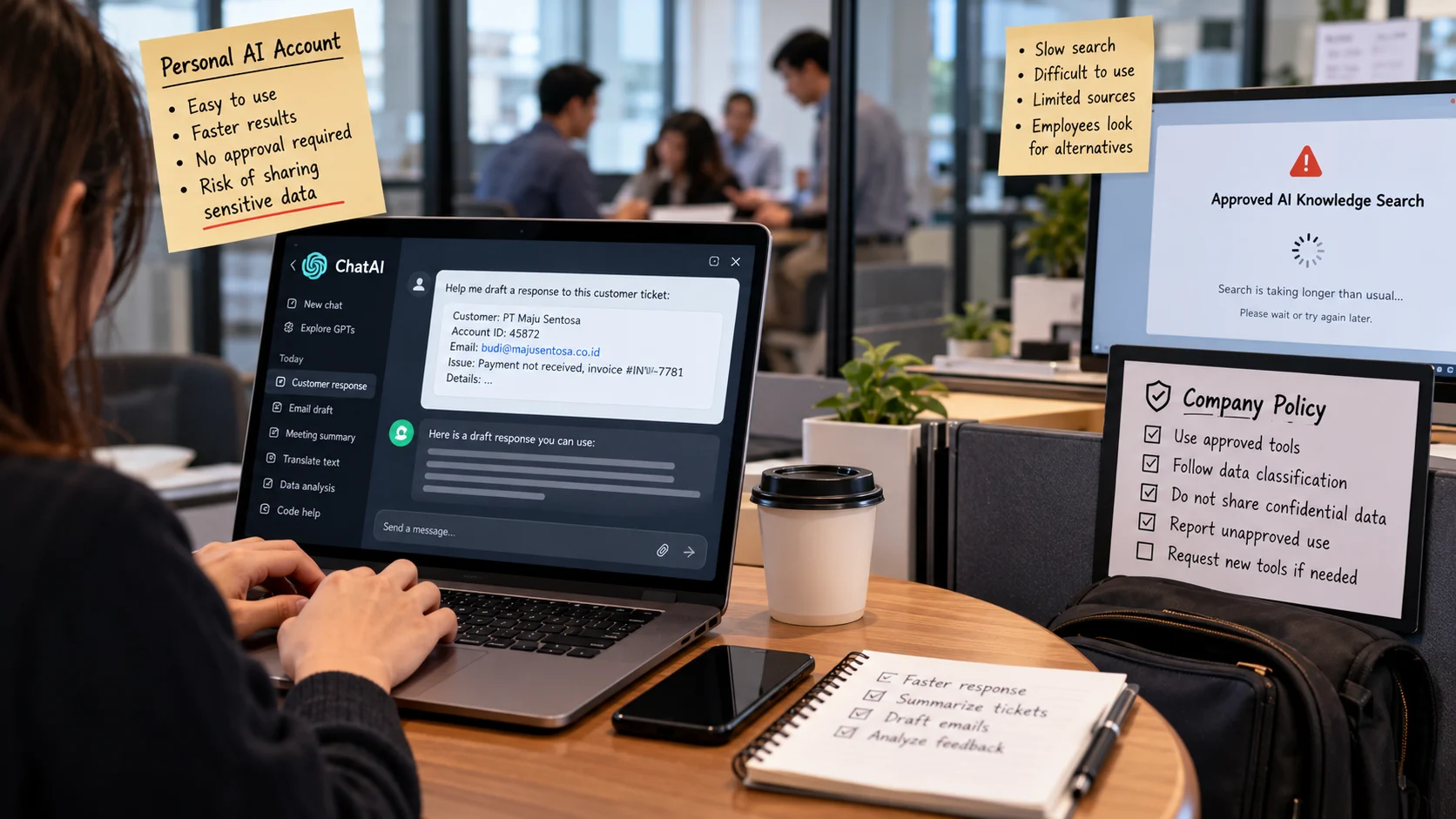
Employees paste support tickets into personal AI chat accounts because the approved knowledge search is slow and difficult to use. Shadow AI describes the use of AI services, accounts, browser extensions, or embedded features without an organization’s established evaluation or approval process. It can signal unmet employee needs as well as privacy and security gaps. This is an organizational discovery and policy guide, not a repetition of the earlier general AI guardrails explainer. Quantitative examples below are hypothetical and should be adapted to the reader’s actual data.
Key Takeaways
Shadow AI describes use of AI tools outside an organization’s approved visibility, procurement, or governance process.
Understand which jobs employees are trying to complete before choosing restrictions or approved alternatives.
Set clear data classifications and explain what can and cannot be shared with different services.
Incident reporting should help contain exposure and improve tools, rather than discourage people from disclosing mistakes.
Measure adoption, exceptions, and sensitive-data exposure while revisiting policy as products and risks change.
Why Shadow AI Appears in Ordinary Workplaces
Shadow AI is the use of artificial-intelligence systems outside an organization’s approved governance or technology process. It may involve an employee pasting customer details into a public chatbot, a team buying an AI meeting assistant with a personal card, or a department connecting an automation service to business data without security review. The motivation is often practical: people want to save time, solve a difficult task, or work around slow purchasing procedures.
Treating every unapproved use as deliberate misconduct misses an important signal. Employees may have found a legitimate unmet need. Yet overlooking the issue can expose confidential information, create inconsistent outputs, and leave the business unable to explain which services process its data. An effective policy addresses both sides: useful experimentation and responsible boundaries.
Different Uses Create Different Levels of Risk
A designer asking a public AI tool for generic headline ideas presents a different risk from a staff member uploading a private employee file. A salesperson drafting an email from invented examples differs from one copying a real customer conversation into an unreviewed service. A developer using code completion on public demonstration code differs from one exposing proprietary source repositories or secret credentials.
Risk depends on the information used, the application’s capabilities, provider terms, storage practices, and resulting business action. Tools that can only help draft text are not identical to autonomous agents authorized to send messages, edit databases, or approve purchases. A useful policy classifies these scenarios instead of writing a vague rule that “AI is allowed” or “AI is prohibited.”
Discover Usage Without Creating a Surveillance Culture
Start by asking teams which tasks they want AI to assist with, which tools they currently use, and where approved alternatives fall short. A confidential or nonpunitive disclosure route can improve visibility. Complement employee feedback with authorized expense reviews, software inventories, and ordinary security controls where appropriate and lawful. Do not introduce invasive monitoring without a justified need and clear policy.
A practical inventory includes the service name, owner, business use case, type of input data, access permissions, connected applications, subscription method, and whether the service trains on or stores submitted information according to its current terms. Record uncertainties instead of falsely declaring every vendor safe because it is popular.
The immediate objective is to find the highest-risk uses. Discovering one workflow that sends regulated customer documents to an unknown service may matter more than counting dozens of harmless idea-generation sessions.
Define Green, Amber, and Red Activities
An illustrative classification might permit green activities such as generic brainstorming using public, non-sensitive information. Amber activities could include using an approved AI service to summarize selected internal documents under an approved data-processing arrangement and access controls. Red activities could include submitting passwords, secret keys, private health records, unapproved customer exports, or granting write access to critical systems without authorization.
These colors are examples, not legal classifications. The organization should determine its own thresholds with security, privacy, operations, and relevant legal stakeholders. The policy should explain what happens when a task falls between categories. A clear route to request approval is better than forcing employees to guess.
Data classification helps. Label which information is public, internal, confidential, or specially restricted. Align the allowed AI services and tool permissions with those categories. Restrict connector access, limit logs where possible, and apply retention rules to prompts and uploaded files. Staff need short practical examples, not only a lengthy legal document.
A Safe Adoption Process
Listen to employees. Gather the tasks prompting unapproved AI usage, such as preparing meeting notes, summarizing research, or drafting customer responses.
Identify the real data involved. Determine whether users submit private records, employee information, intellectual property, or credentials.
Assess service behavior. Review vendor processing terms, retention options, administrative controls, regional requirements, permissions, and incident response commitments.
Offer approved alternatives. Where the task has value, provide a tool that can perform it within acceptable governance rather than only forbidding the existing one.
Pilot with defined limits. Limit access and data scope, establish review requirements, and measure whether the tool truly improves the work.
Train for realistic scenarios. Demonstrate how seemingly harmless inputs can contain personal data and why an AI answer needs verification before business use.
Create a fast exception process. Teams should know how to request a new tool and expect a timely response from the responsible function.
Review the policy regularly. AI services, integrations, and data-processing terms change. New tools may create risks that the original rules did not anticipate.
A small company may not have a formal AI governance office. It can still assign an owner, publish a one-page policy, maintain a vendor list, and document exceptions. Scale the process to actual risk instead of importing every enterprise-level control at once.
Example: An Unapproved Meeting Assistant
A project manager enables an AI meeting recorder to reduce note-taking. It captures participants’ voices, generates a summary, and stores the recording in a third-party service. The original need is legitimate, but the team has not confirmed whether participants were informed, what data is retained, or who can access the transcript. The generated summary also incorrectly identifies one person as agreeing to a deadline.
A constructive response is to stop unreviewed recording, assess past exposure where necessary, and offer an approved workflow with consent practices, permissions, defined retention, and summary review. The manager can still benefit from meeting notes without treating every automated sentence as an authoritative commitment. This approach resolves the real need while fixing the governance gap.
How to Measure Improvement
Count and categorize discovered workflows, review time for tool requests, adoption of approved services, completed training, and material incidents or near misses. Measure the benefit side too: employee time saved and quality of output after verification. A policy that takes months to approve harmless uses may push experimentation back into the shadows.
Do not use a single “number of banned apps” as the success metric. Fewer visible apps can mean better governance or simply less reporting. The stronger signal is whether employees know the rules, can obtain workable tools, and can raise uncertainties early.
Governance Without False Confidence
Approval is not a permanent certification. A vendor may change features, add connectors, alter retention options, or revise contractual terms. Reassess services when permissions expand or sensitive data types are introduced. When an assistant gains access to outbound email or write-capable APIs, enforce authorization outside the model and require appropriate human confirmation.
The goal is not to eliminate experimentation. It is to make useful experimentation visible, safe, and accountable. Shadow AI becomes manageable when businesses recognize the work people are trying to accomplish and provide controlled ways to accomplish it.
A safe policy for unofficial workplace AI use
A marketing employee pastes a customer complaint into an unapproved public chatbot to draft a reply. The content includes a phone number and purchase details. The immediate problem is not simply that an AI tool was used; it is that customer data crossed a supplier boundary without a reviewed purpose or retention arrangement. An organization can respond with a short approved-tools list, clear data classifications, an easy request process for new tools, and training that shows staff how to redact or avoid sensitive inputs.
Task Allowed route Escalation
Generic headline brainstorming Approved AI workspace No customer data
Customer complaint summarization Reviewed enterprise environment Privacy review for new integration
Uploading employment records Not through unreviewed tools HR/security approval
An effective policy offers a usable approved alternative; blanket prohibition often drives the behavior out of view.
What the example teaches. Employees are using personal chat accounts to rewrite confidential support responses. A survey reveals the approved search system takes too long. The company adds a safer tool with access restrictions and a short permitted-data guide, while maintaining a channel for reporting accidental disclosure.
Building an Approval Checklist for New AI Services
A lightweight intake form should ask what task the employee wants to perform, whether business or personal data will be supplied, which people can access results, and whether the tool connects to internal systems. Record the vendor, requested permissions, subscription cost, expected benefit, and a responsible owner. Questions should be answerable without a full procurement project for every low-risk trial.
Route requests by risk. Generic brainstorming with public content may require only adherence to basic guidance, while access to confidential documents or write-capable integrations deserves a formal security and privacy review. Employees should receive a clear decision and usable alternative when a proposed service cannot be approved. An opaque rejection process can drive staff back toward personal accounts.
Responding to a Possible Data Exposure
If an employee discovers that a private spreadsheet was uploaded to an unapproved tool, the response should prioritize containment and assessment rather than hiding the mistake. Determine what data was shared, what service received it, whether it was retained or forwarded, and whether legal or contractual notification duties apply. Preserve necessary evidence with appropriate access controls. A trained response team may revoke credentials, request deletion where supported, or notify affected parties according to actual obligations.
Afterward, examine why the employee resorted to the tool. Perhaps the approved alternative was unavailable or the policy failed to explain which data could be used. Improvement should address the workflow and organizational incentives as well as individual behavior.
Training With Realistic Prompts
Training should contrast safe and unsafe examples. “Draft a generic agenda for a product kickoff” can be low risk, while “summarize this unredacted customer account export” is materially different. Teach employees to inspect integrations and file permissions, verify generated claims, and avoid granting an assistant authority to send messages or change accounts without approval. Short recurring examples are easier to apply than abstract warnings about AI risks.
Make the Approved Alternative Easier to Use
A company can prohibit unapproved tools and still fail to reduce shadow AI if employees have no workable alternative for summarizing permitted material or drafting routine emails. Inventory the legitimate tasks that people are trying to accomplish. For each task, offer an approved method with clear data classifications, access rules, and a predictable route for requesting a new capability. Employees are more likely to follow a policy they can actually use than one that answers every question with a prohibition.
In training, show two concrete examples: a public product description that can be processed with an approved assistant, and an internal customer export that must not be pasted into a consumer tool. Explain the difference in terms of who may access the data and how it will be retained. This is more actionable than asking staff to “use AI responsibly” without examples.
Handle an AI Incident Without Punishing Disclosure
If an employee accidentally submits restricted information to an unapproved assistant, immediate reporting can reduce harm. The response process should identify what was shared, which service received it, whether logs or retention settings can be controlled, who should evaluate contractual or legal notifications, and what credentials or documents need protection. Avoid instructing staff to delete local evidence before an authorized incident responder can understand the event.
Use incidents to improve training and procurement. A recurring workaround may reveal that the approved tools are too slow or unavailable for an important job. The policy should reduce risky behavior while making legitimate work possible, not simply hide the problem from management.
Frequently Asked Questions
Is every unapproved AI tool dangerous?
No. Risk differs by task, data sensitivity, account settings, vendor terms, and tool permissions. The problem is uncontrolled use without adequate evaluation.
How can a small company discover shadow AI?
Start with voluntary discussion and approved-app inventories. A nonpunitive survey can reveal why employees use personal AI accounts.
Should employees be punished for AI use?
A proportionate policy should encourage early reporting and remediation, while consequences for serious misconduct follow established organizational procedures.
What belongs in an AI acceptable-use policy?
Include permitted use cases, prohibited data, vetted tools, review requirements, incident reporting, and a process for requesting exceptions.
Further Reading on ByteScope
AI Guardrails Explained
Responsible AI Guide
AI Agents Explained
Sources and Further Reading
NIST: AI Risk Management Framework — NIST primary material for frameworks and evaluation methods.
NIST: Privacy Framework — NIST primary material for frameworks and evaluation methods.