
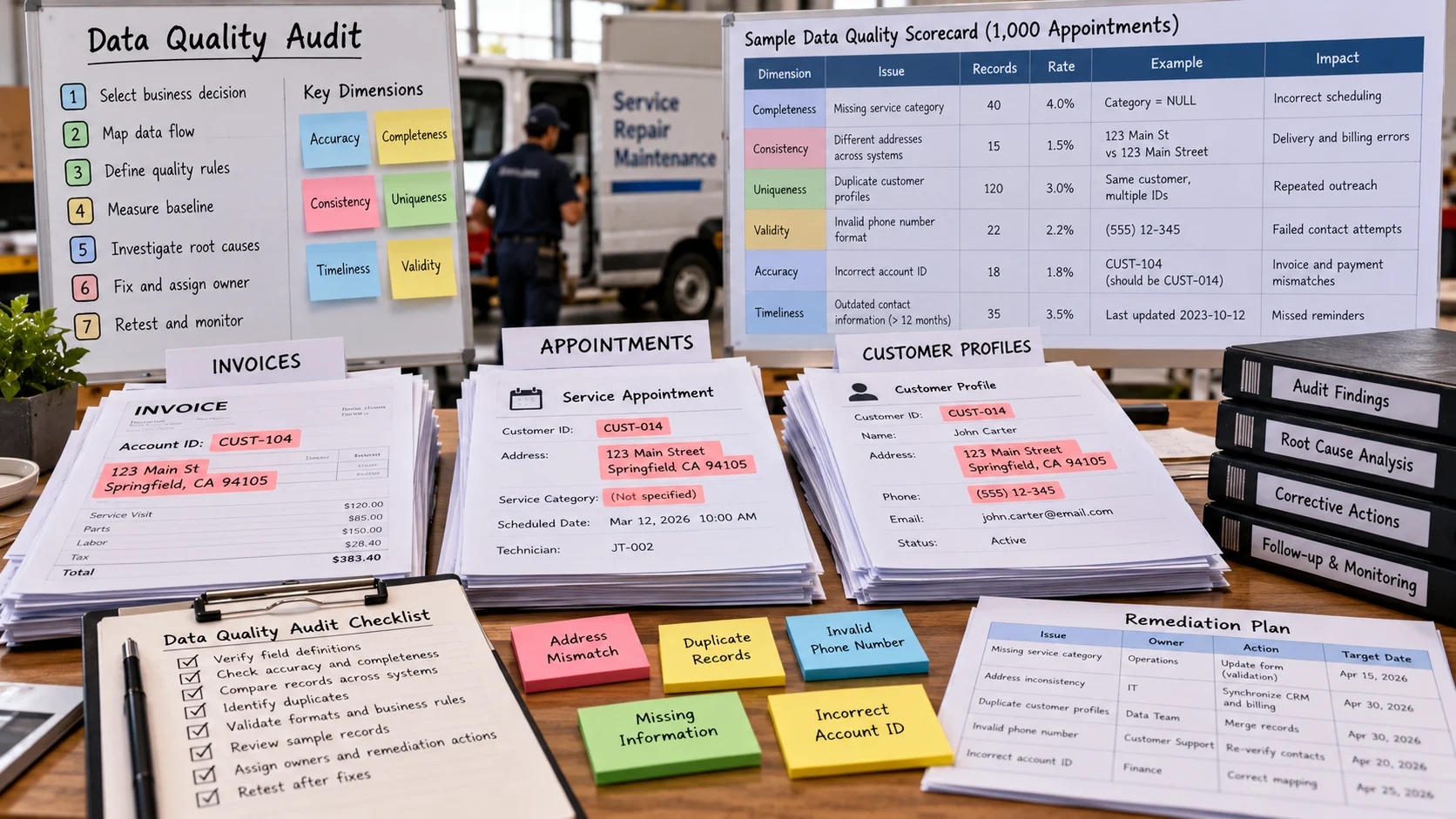
A regional service provider discovers that invoices, appointments, and customer profiles disagree about account IDs and addresses. A data quality audit is a repeatable examination of whether records are accurate, complete, consistent, timely, usable, and appropriate for a business decision. It connects defects to affected workflows. An audit measures and governs quality; it is not the same as a one-time AI data-cleaning run that edits values in a file. Quantitative examples below are hypothetical and should be adapted to the reader’s actual data.
Key Takeaways
A data quality audit identifies the fields, systems, and processes that create unreliable business records.
Review accuracy, completeness, consistency, uniqueness, timeliness, and validity as distinct dimensions.
Sample real records and reconcile important values with authoritative sources instead of relying only on dashboard percentages.
Assign defect remediation to the system where errors originate, not just the downstream analyst who notices them.
Report operational improvements such as fewer invoice corrections alongside technical quality scores.
What a Data Quality Audit Is—and Is Not
A data quality audit is a structured investigation into whether records are reliable enough for a defined business purpose. It measures defects, identifies causes, assigns responsibility, and verifies corrective action. An audit is not the same as running a spreadsheet cleaner once or buying an analytics dashboard. It answers why errors occur and which decisions those errors threaten.
For a small business, the scope should be practical. Auditing every column in every application at once can consume staff time without yielding a clear benefit. Start with one consequential process: invoicing, appointments, inventory replenishment, customer follow-ups, or payroll. Trace the records used in that process from creation to the final decision. The audit should connect each issue to an operational consequence such as late payment, repeated outreach, or incorrect stock counts.
Six Dimensions Worth Assessing
Accuracy asks whether a value matches reality or a trusted source. An address can have the correct format but still be outdated. Completeness asks whether essential information is present. An invoice missing its tax identification field may not be usable even if all other fields are correct.
Consistency checks whether related records agree across systems: the CRM says a customer is active while billing shows the account closed. Uniqueness asks whether an entity that should be represented once appears more than once. Timeliness measures whether information is updated soon enough to support the decision. Validity asks whether values obey formats, ranges, codes, and business constraints.
These dimensions overlap but should not be collapsed into one score. A dataset may be 99% complete and still inaccurate on a critical bank-account field. Report quality by field, source, and business impact. The same 1% error rate can be minor in a marketing preference field and catastrophic in a payment destination.
Build a Small Audit Register
For each selected field or rule, record the intended meaning, source owner, quality dimension, test, observed defect count, example, affected workflow, and proposed remedy. For instance, an appointment system might show 120 duplicate customer profiles among 4,000 active records. That is a 3% duplicate-record rate by the chosen definition, but the auditor should investigate whether these profiles cause double reminders, lost notes, or billing errors before estimating business impact.
Choose denominators carefully. A rate based on all historical records can hide severe problems in recently imported data. Report the observation window and segmentation: source channel, date of import, product line, or branch. Do not compare periods with different definitions as if quality had improved simply because one team changed the counting rule.
A defect register also needs an owner. “IT will fix it” is not an action plan. Name the process owner who defines correct information, the technical owner who implements the change, and the reviewer who signs off on the outcome.
A Practical Seven-Step Audit Method
Select one business decision. For example, whether a customer should receive an overdue-payment reminder. Identify the records that decision uses.
Map the data flow. Trace account identifiers, invoice statuses, due dates, and contact channels from source systems to the reminder process.
Define accepted rules. State which fields are mandatory, which values are permitted, and which system resolves conflicts.
Measure a baseline. Run reproducible queries or export checks on a documented sample. Count defects by class and severity.
Investigate root causes. Review where defects first appeared: manual entry, migration, broken synchronization, ambiguous instructions, or old imports.
Prioritize corrective work. Address issues by risk and frequency. Some require code fixes; others require training or a better form design.
Retest and monitor. Re-run the same rules after changes, check a fresh sample, and set a schedule appropriate to how quickly data quality can deteriorate.
Preserve evidence of both findings and fixes. Otherwise a future staff member may repeat the same failed cleanup because nobody documented why a rule was chosen. The audit can be light-weight—a spreadsheet and a set of saved queries may be enough—but it should be repeatable.
Sample Scorecard for a Service Company
Suppose a repair service audits 1,000 recent appointments. It finds 40 records missing a service category, 15 customer IDs that map inconsistently across systems, and 20 appointments with timestamps older than the last customer confirmation. Those counts illustrate three different problems. Missing categories may hinder technician preparation. Inconsistent IDs can misattribute work. Stale timestamps can cause missed or duplicated visits.
Do not simply add 40 + 15 + 20 and declare a 7.5% “data quality failure rate.” Some records may contain multiple problems, and the risks are not equal. Instead, report each defect separately, estimate overlap, and relate findings to an operational metric such as appointment rework or customer complaints. If an overall risk score is necessary, document its weighting and limitations.
The improvement plan may include making service type mandatory in the booking form, resolving identity mapping rules, and synchronizing confirmation status. Each action should have a measurable result and a rollback plan for data transformations.
Root Causes Matter More Than One-Time Cleanup
A cleanup may repair old records while the original error-generating workflow continues unchanged. Duplicate leads might be created because three intake channels lack a shared identifier. Missing categories might result from a form that permits a blank selection. Invalid dates might come from inconsistent timezone conversions between systems.
Look for patterns in where and when problems appear. Interview people who enter and use the records. Sometimes a field is consistently blank because employees legitimately do not know the value, not because they are careless. The correct response may be adding an “unknown” state instead of requiring fabricated answers. A well-designed audit improves the process producing data, not only the data produced yesterday.
Using AI Without Losing Auditability
AI can suggest suspicious records, cluster variations in category labels, explain query results, and help draft validation rules. Those suggestions need verification. A model may conclude that two people with similar names are duplicates or that an outlier price is incorrect when both records are legitimate. Auditors should preserve original values and document the evidence for a proposed correction.
Use deterministic tests wherever rules are explicit: required fields, unique identifiers, date constraints, and allowed status values. AI can be valuable for ambiguous free text, but it should not be the sole authority for changing payment details or identity records. Keep audit logs and approval thresholds.
Report Outcomes That Matter
The audit report should identify scope, date, method, sample limitations, defects, affected decisions, action owners, deadlines, and follow-up checks. It should also explain where the business lacks sufficient evidence to declare the data accurate. Transparency about uncertainty is more useful than an impressive-looking score based on weak validation.
Track quality measures alongside business outcomes. A reduced duplicate rate is worthwhile if it also reduces repeated customer calls or order confusion. A faster data entry process is not necessarily better if it produces more downstream corrections. Audits create value when they turn repeated problems into accountable process improvements.
Privacy and Retention in Audit Work
Auditors often need to compare records across systems, which can expose customer and employee details. Limit access to necessary fields, protect exports, and avoid sending raw files to external assistants without reviewing the legal and security implications. A defect example in a report can usually be anonymized or replaced with a synthetic illustration.
Treat temporary audit copies as controlled data with an appropriate retention schedule. Deleting unnecessary working files after the audit reduces risk. Ensure that changes preserve documented deletion requests and do not resurrect records from archived databases.
For small businesses, the strongest audit is one that staff can repeat after a process change. Begin with the data behind one important decision, measure defects honestly, fix their sources, and verify that the next batch of records is better than the last.
A practical six-dimension data quality scorecard
Dimension Test on an order table Example observation
Completeness Required customer_id present 96% populated
Uniqueness Distinct order_id values 12 repeated IDs
Validity Currency matches allowed codes Three invalid values
Consistency Amount agrees between systems Eight disagreements
Timeliness Updates reach reporting within SLA Median delay 27 hours
Accuracy Sample checked against source receipts 18 of 20 correct
All numbers are illustrative. A business should avoid compressing the table into a single unexplained quality score: an invalid tax identifier may matter far more than a missing optional marketing field. Choose tests according to business decisions, assign owners, and document thresholds and exceptions. A data quality audit differs from data cleaning because it measures and prioritizes defects before prescribing repairs.
What the example teaches. The provider’s staff can locate invoices, but a significant share uses obsolete customer IDs copied from older systems. Rather than report that “the database is dirty,” the audit identifies affected processes, checks a sample against original records, and assigns the upstream intake rule to an owner.
Audit Sampling Without Hiding Rare Errors
A company with a million records may not inspect each one manually, but its audit sample must represent the risks being evaluated. Include recent and older records, different entry channels, and unusual transaction types. If nearly all records come from one branch, the company-wide defect estimate may be misleading. When rare but costly failures are important, add a targeted risk sample and distinguish it from the randomly selected representative sample.
Document how records were selected. A convenience sample of clean, familiar accounts will generally understate problems. For severe financial or privacy-impacting defects, automated full-population checks may be appropriate even when detailed human review is sampled. Sampling strategy should be chosen with the expected error cost and confidence needed for the business decision.
Turn Findings Into Preventive Controls
If invoices repeatedly lack payment terms, repairing existing records is only part of the answer. Investigate whether the entry form permits blank terms, whether an integration drops the field, or whether staff lack a defined process. A preventive change might involve making the field mandatory at the appropriate stage, correcting the API mapping, or training employees on exceptions.
Retest both the historical records and new submissions after implementing the fix. Quality improvement is stronger when the rate of new defects falls, not just when an old spreadsheet looks clean. Document who owns the control and how failure will be detected in the future.
Communicating Results Without a Misleading Score
Present the most consequential findings first, then describe coverage and uncertainty. A report might say that customer identifiers match across two systems for 97% of recently sampled eligible records, while exceptions remain in one import channel. This is more actionable than a composite “quality score of 97” that conceals several unrelated measures. Include the source, test logic, denominator, and date so readers can evaluate what the result actually means.
Turn Audit Findings Into Owned Remediation Tasks
A quality scorecard is useful only when the organization knows who will act on it. Assign every critical defect a source-system owner, a measurable correction, and a review date. If invoices lack valid customer identifiers, the problem might originate in a form that accepts blank fields rather than in the analytics database where the defect becomes visible. Fix the earliest legitimate point in the workflow; repeatedly cleaning downstream exports can conceal the source problem.
Report changes in both error rate and operational consequence. A reduction in missing values is encouraging, but fewer delayed invoices or shorter reconciliation times may better demonstrate actual business value.
Frequently Asked Questions
What is the first step in a data quality audit?
Choose a consequential report or workflow, identify its required fields, and agree what correct values mean. Then measure those fields against trustworthy sources.
How often should a small business audit its data?
Frequency depends on change rates, error costs, and data volume. Critical checks may run automatically every day, while broader reviews can be periodic.
Is a 100% completeness score sufficient?
No. Every field can be filled yet inaccurate, outdated, duplicated, or attached to the wrong record. Multiple dimensions are required.
Who should own data quality?
The business process owner should define what correct means, while data or IT staff implement checks and help diagnose technical causes.
Further Reading on ByteScope
AI Data Analysis Tools
Measuring Digital Innovation Value
Sources and Further Reading
UK Government: Data Quality Framework — Primary background reading; confirm applicability to your use case.
pandas: Working with Missing Data — Primary background reading; confirm applicability to your use case.