Digital twins are often presented with dramatic imagery: a glowing three-dimensional
factory floating beside the real building, a virtual aircraft covered in live sensor data,
or an entire city recreated inside a computer.
Those visualizations are impressive, but they can also make the idea seem more complicated
and futuristic than it needs to be.
At its core, a digital twin is useful because it gives people a digital way to understand
something that exists in the physical world. The twin may represent a machine, building,
vehicle, production line, energy system, warehouse, or another real-world asset or process.
Information from the real system is connected to a digital representation so people can
monitor conditions, explore relationships, test possible changes, and make better-informed
decisions.
The three-dimensional model is optional.
The decision value is not.
A sophisticated visualization that nobody uses to make a meaningful decision is less
valuable than a relatively simple model that helps a maintenance team identify a problem
before a machine stops working.
That distinction is important because digital twins are often discussed as technology
objects. A more practical perspective is to treat them as
decision systems.
They create a bridge between what is happening in the physical world and what people can
observe, compare, test, and improve digitally.
What Is a Digital Twin?
A digital twin can be understood as a digital model connected in some meaningful way to a
physical object or process.
The word twin can create the impression that the digital version must reproduce
every detail of the physical system. In practice, that is rarely necessary.
A useful digital twin represents the characteristics that matter for the decision being
made.
If engineers want to monitor the temperature and vibration of a motor, the twin may focus
on operating conditions, maintenance history, load, and performance indicators.
If a building manager wants to understand energy consumption, the model may focus on room
occupancy, temperature, equipment operation, electricity use, and weather conditions.
If a logistics team wants to improve warehouse flow, the twin may represent inventory,
locations, movement patterns, processing times, and capacity.
The model does not need to recreate reality for its own sake.
It needs to represent enough of reality to answer useful questions.
A Digital Twin Is More Than a 3D Model
One of the most common misunderstandings is assuming that any digital visualization of a
physical object is a digital twin.
A three-dimensional model can be useful without being a digital twin.
For example, an architectural model may show the geometry of a building. It may help people
understand its layout and appearance, but if the model contains no meaningful connection
to the building’s operating information, it functions primarily as a digital representation.
A digital twin becomes more valuable when the digital representation reflects relevant
real-world conditions.
The connection might involve sensor readings, operational records, maintenance data,
environmental information, or other sources.
This connection allows the model to answer more interesting questions:
- What is happening now?
- Is the system behaving normally?
- What changed?
- What may happen if current conditions continue?
- What would happen if we changed something?
- Which action appears most appropriate?
Those questions reveal why the real value of a digital twin lies beyond visualization.
The ByteScope Mirror-to-Decision Loop
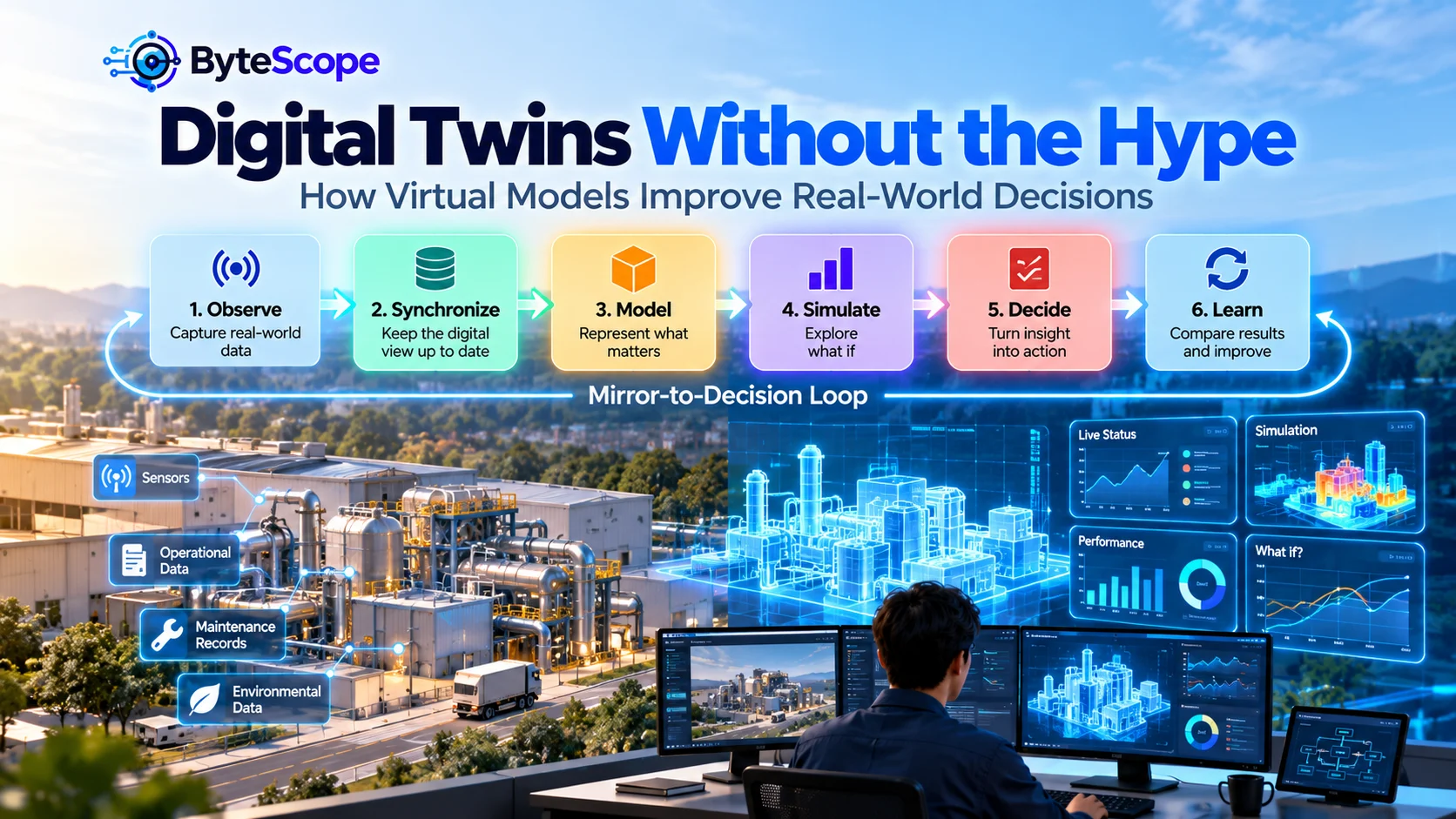
To understand digital twins without getting lost in technical terminology, ByteScope uses
a six-stage framework called the Mirror-to-Decision Loop.
The stages are:
Observe → Synchronize → Model → Simulate → Decide → Learn.
The framework emphasizes that a digital twin should not end with a digital representation.
Information should eventually help someone make or improve a real-world decision.
1. Observe: Capture What Matters in the Real World
Every useful digital twin begins with observation.
The system needs information describing some part of reality.
That information may come from sensors, machines, software logs, maintenance records,
transaction systems, cameras, environmental measurements, user input, or manually collected
data.
The important question is not:
“How much data can we collect?”
It is:
“Which observations are necessary for the decisions we want to improve?”
Consider a refrigerated storage facility.
A company could collect hundreds of variables, but if the primary goal is preventing
temperature-related product loss, the most important observations may include temperature,
humidity, door status, refrigeration performance, and time.
Collecting irrelevant information creates additional storage, integration, and maintenance
requirements without necessarily improving the decision.
Digital twins therefore benefit from selective observation.
2. Synchronize: Keep the Digital View Connected to Reality
Observation becomes more useful when the digital representation can be updated with
information from the real system.
The update does not always need to happen every second.
Some applications need near-real-time information. Others may work perfectly well with
updates every hour, every day, or after a significant event.
The required timing depends on the decision.
A rapidly moving manufacturing process may require frequent updates because conditions
can change quickly.
A building-maintenance model may be useful with slower updates.
This highlights a broader principle in digital innovation:
real-time is not automatically better.
Faster data creates value only when faster decisions create value.
Synchronization also requires clarity about which source should be trusted.
If one system reports that a machine is operating while another reports that it is offline,
the twin needs rules for determining which information is authoritative.
3. Model: Represent the Parts of Reality That Matter
The model is where raw observations become a structured representation.
A model may describe relationships between components, operating limits, physical
characteristics, historical behavior, expected performance, or other relevant conditions.
The word model does not necessarily mean artificial intelligence.
A digital twin may use:
- engineering equations;
- business rules;
- statistical models;
- historical comparisons;
- simulation software;
- machine-learning models;
- combinations of several approaches.
Artificial intelligence becomes useful when the problem benefits from capabilities such as
pattern recognition, prediction, classification, anomaly detection, or interpretation of
complex data.
Readers who want a broader introduction to how AI systems use data and learned patterns can
read ByteScope’s guide to
how artificial intelligence works
.
The choice of model should depend on what the system needs to understand, not on which
technology sounds most advanced.
4. Simulate: Ask “What If?” Before Changing Reality
This is where digital twins can become particularly powerful.
Once a digital system represents relevant aspects of a physical process, people may be
able to test possible changes digitally before applying them in the real world.
Imagine a warehouse considering a different storage layout.
Changing the physical warehouse directly could disrupt operations. A digital model may
allow planners to test different layouts and estimate how they affect worker movement,
processing time, congestion, or storage capacity.
A building operator may test different heating schedules before changing control settings.
A factory may explore how production changes affect machine utilization.
The important word is explore.
A simulation does not magically reveal the future. It produces results according to the
assumptions and information built into the model.
If those assumptions are poor, the simulation can produce very precise-looking answers
that are still misleading.
5. Decide: Turn the Digital Model Into Real-World Action
A digital twin becomes operationally valuable when it influences a decision.
That decision may be simple:
- inspect a machine;
- change a maintenance schedule;
- adjust an operating parameter;
- move inventory;
- investigate unusual energy consumption;
- reroute a process.
The twin may provide information rather than make the decision automatically.
For example, the system might show that a machine’s vibration pattern is increasingly
different from its normal range. A technician then determines whether inspection is
necessary.
In other situations, low-risk actions might be automated.
The decision structure should reflect the consequence of being wrong.
This is the same principle behind responsible use of AI. ByteScope’s article on
responsible AI
discusses why reliability, oversight, accountability, and appropriate human involvement
matter when automated systems influence decisions.
6. Learn: Compare the Prediction With What Actually Happened
A useful digital twin should not only make predictions or recommendations.
It should create an opportunity to learn.
Suppose the system predicts that changing a production schedule will reduce machine
congestion by 15 percent.
The organization makes the change.
What happened?
Did congestion actually decrease?
Did another bottleneck appear?
Were the assumptions correct?
Did the system miss an important variable?
Comparing predicted outcomes with real outcomes improves understanding.
This closes the Mirror-to-Decision Loop:
Observe → Synchronize → Model → Simulate → Decide → Learn → Observe again.
The digital twin becomes more valuable when it participates in an ongoing learning process
rather than functioning as a one-time visualization.
A Digital Twin Can Be Simple
The phrase “digital twin” sometimes creates the impression that organizations need advanced
3D environments, specialized hardware, massive cloud infrastructure, and sophisticated
AI.
Some digital twins do involve those technologies.
But conceptual complexity should match the problem.
Imagine a greenhouse operator.
The physical system includes temperature, humidity, lighting, irrigation, and plant
conditions.
A useful digital representation might show historical and current environmental conditions,
compare them against desired operating ranges, identify unusual changes, and help the
operator evaluate different irrigation or ventilation schedules.
The interface might be a dashboard rather than a 3D greenhouse.
It can still provide the central value associated with digital twins: connecting physical
conditions to digital understanding and better decisions.
Digital Twin vs. Dashboard
A dashboard displays information.
A digital twin may do more.
A dashboard might show that a machine currently operates at 82 degrees Celsius.
A digital twin may combine that observation with the machine’s normal behavior, operating
load, maintenance history, related components, and expected performance.
It may help answer:
Is 82 degrees normal under this load?
Is the temperature increasing faster than usual?
Does this pattern resemble previous problems?
What may happen if the current condition continues?
The difference is not that dashboards are inferior. Many digital twins use dashboards as
their interface.
The distinction is that a twin attempts to represent relationships and behavior, not merely
display isolated metrics.
Digital Twin vs. Simulation
Simulation and digital twins also overlap, but they are not necessarily identical.
A simulation can model a hypothetical system without being continuously connected to a
specific real-world counterpart.
For example, engineers might simulate the airflow through a generic design.
A digital twin becomes more specific when information about an actual asset or process
helps keep the model relevant to its real operating condition.
A digital twin may use simulations, but simulation is one capability rather than the entire
concept.
Digital Twin vs. Digital Replica
A digital replica may visually resemble the physical object while containing little
operational intelligence.
Think of a detailed 3D model of a machine.
It may be excellent for training, documentation, or design.
But if it does not reflect the machine’s actual condition or support operational analysis,
its value is different from that of an active digital twin.
The difference can be summarized simply:
A replica shows what something looks like.
A useful twin helps explain what something is doing.
Where Digital Twins Can Create Practical Value
Manufacturing
Factories can use digital representations of equipment and production processes to monitor
performance, identify bottlenecks, support maintenance decisions, and explore operational
changes.
Instead of looking at one machine in isolation, teams can examine how machines interact
across a production line.
Buildings
A building twin may connect environmental conditions, occupancy, equipment performance,
and energy consumption.
Facility teams can investigate why certain areas consume more energy, identify equipment
that behaves unusually, or test operating changes before applying them broadly.
Logistics and Warehousing
Warehouses contain movement: products arrive, are stored, picked, packed, and shipped.
A digital model can help teams understand congestion, storage utilization, worker movement,
equipment availability, or order-processing delays.
Energy Systems
Energy systems contain changing relationships between supply, demand, storage, equipment,
and environmental conditions.
Digital representations can help operators observe those relationships and evaluate
operational scenarios.
Vehicles and Equipment
A digital twin of a vehicle or complex machine can combine operational information with
maintenance history and expected performance.
The objective is not simply to know where the asset is.
It is to understand how it is behaving.
The Maintenance Example: From Calendar-Based to Condition-Informed Decisions
Maintenance offers one of the clearest ways to understand digital-twin value.
A simple maintenance program may inspect a machine every three months regardless of how
intensively the machine has been used.
That approach is predictable but not always efficient.
One machine may operate continuously under heavy load. Another may run only occasionally.
Yet both receive the same inspection schedule.
A digital twin can potentially combine operating hours, load, temperature, vibration,
maintenance history, and other relevant information to provide a more informative picture.
Instead of asking only:
“Is it time for scheduled maintenance?”
the organization can ask:
“How is this specific machine actually behaving?”
The answer may help technicians prioritize inspections.
This does not mean automatically replacing professional maintenance judgment.
The twin provides evidence.
People decide what the evidence means.
The Digital Twin Is Only as Good as Its Data
Digital twins can appear authoritative because they combine visualizations, numbers,
predictions, and simulations.
But the system still depends on its inputs.
A failed sensor can create misleading information.
A calibration problem can distort measurements.
Missing maintenance records can make historical comparisons incomplete.
Incorrect assumptions can make simulations unrealistic.
This is why data quality should be part of digital-twin design from the beginning.
Teams need to know:
- where each important data source originates;
- how frequently it updates;
- how reliable it is;
- what happens when it becomes unavailable;
- whether its meaning is clearly defined.
Analytics tools can help people explore patterns in operational data. ByteScope’s guide to
AI data analysis tools
explains how modern tools can assist users with exploring datasets, identifying patterns,
and interpreting results.
But sophisticated analysis cannot compensate for fundamentally unreliable observations.
A Digital Twin Does Not Know Everything
One danger of highly visual digital systems is that they can create an illusion of complete
understanding.
A digital twin is a model.
Every model leaves something out.
Suppose a warehouse simulation predicts that a new layout will reduce average picking time.
The model may represent product locations and worker movement accurately but ignore the
learning period required for employees to adapt to the new layout.
The simulation is not necessarily wrong.
It is incomplete.
Decision-makers should therefore ask:
- Which variables are represented?
- Which variables are missing?
- Which assumptions influence the result?
- How uncertain is the prediction?
- What conditions would make the model unreliable?
Good digital-twin decisions require understanding the limits of the twin.
Why More Detail Is Not Always Better
It can be tempting to build increasingly detailed models.
More detail feels more realistic.
But every additional data source and component adds cost.
The system must collect, store, synchronize, secure, maintain, and interpret that
information.
If the extra detail does not change a decision, it may create complexity without value.
A useful design principle is:
Model the minimum amount of reality required to improve the decision.
This keeps the twin focused and easier to maintain.
The Risk of Building a Twin Before Defining the Question
Organizations can become excited by the possibility of creating a digital twin and begin
with the technology.
They purchase modeling software, connect sensors, and build impressive interfaces.
Only later do they ask what decisions the system should support.
That reverses the ideal sequence.
A stronger project begins with questions such as:
- Which decision is currently difficult?
- What information is missing from that decision?
- What relationship do we need to understand?
- Would testing scenarios digitally reduce risk or cost?
- How would a better decision create measurable value?
If those questions do not produce clear answers, a digital twin may not be the right
investment.
Digital Twins and Artificial Intelligence
AI and digital twins are often mentioned together because they can complement each other.
The twin provides structured information about a physical system.
AI can help identify patterns, estimate future conditions, classify anomalies, or analyze
large quantities of operational information.
For example, a twin may track the behavior of multiple machines.
A machine-learning model could potentially identify operating patterns associated with
unusual behavior.
But AI is not required for every digital twin.
A rules-based model may be entirely sufficient if the relationships are well understood.
The technology should again follow the decision.
Digital Twins and Human Expertise
One of the most useful roles of a digital twin is not replacing experts but giving them a
better environment for applying expertise.
A technician understands the sounds, history, and behavior of equipment in ways that may
not exist in the data.
An operations manager knows that an unusual production pattern resulted from a temporary
staffing problem.
A building manager may know that an energy spike occurred because a particular event was
held that evening.
The digital system provides evidence.
Human expertise provides context.
Strong decision systems combine both.
When a Digital Twin Is Probably Overkill
Not every physical process needs a digital twin.
The concept may be unnecessary when:
- the asset is simple and inexpensive;
- failure has little operational impact;
- conditions rarely change;
- existing monitoring already answers the important questions;
- the organization cannot act on the additional information;
- the cost of maintaining the model exceeds the potential benefit.
A thermometer does not need a digital twin merely because creating one is technically
possible.
Technology earns its place when it improves a meaningful decision.
Seven Questions Before Building a Digital Twin
Before investing in a digital-twin project, ask:
- Which real-world decision are we trying to improve?
- Which physical conditions influence that decision?
- Can those conditions be observed reliably?
- How frequently does the digital representation need to update?
- What model or relationships are necessary?
- What action will someone take based on the output?
- How will we determine whether the twin actually improves the outcome?
These questions keep the project focused on value rather than visualization.
A Practical Digital Twin Maturity Path
Organizations do not need to build the final version immediately.
A digital twin can mature gradually.
Level 1: Visibility
Collect important operating information in one place.
Level 2: Context
Connect measurements with asset identity, history, operating conditions, or related
components.
Level 3: Comparison
Compare current conditions with normal ranges, historical performance, or expected
behavior.
Level 4: Prediction
Use appropriate models to estimate what may happen if current conditions continue.
Level 5: Simulation
Explore alternative scenarios before changing the physical system.
Level 6: Decision Integration
Connect insights to maintenance, operations, planning, or other workflows where people
can act on them.
The maturity path should stop wherever additional complexity stops creating meaningful
value.
How to Measure Digital Twin Value
A digital twin should eventually improve an operational outcome.
Possible measures include:
- reduced unplanned downtime;
- lower maintenance cost;
- faster problem diagnosis;
- improved energy efficiency;
- higher equipment utilization;
- reduced waste;
- fewer operational errors;
- faster scenario evaluation;
- better planning accuracy.
The most appropriate metric depends on the original decision problem.
Avoid measuring success by the number of sensors connected or the sophistication of the
visualization.
Those are implementation characteristics, not business outcomes.
Frequently Asked Questions
What is a digital twin in simple terms?
A digital twin is a digital representation of a real-world asset, process, or system that
uses relevant information about the real system to support monitoring, analysis,
simulation, or decision-making.
Does a digital twin have to be a 3D model?
No. A 3D model can be useful, but a digital twin can also use dashboards, diagrams,
analytical models, or other representations. The important characteristic is the meaningful
connection between the real system and the digital representation.
Does a digital twin require real-time data?
Not always. The required update frequency depends on the decision. Some systems need
near-real-time information, while others may provide useful insights with hourly, daily,
or event-based updates.
Is artificial intelligence required for digital twins?
No. Digital twins can use engineering models, rules, statistics, simulations, AI, or
combinations of these approaches. AI becomes useful when the problem benefits from
prediction, anomaly detection, pattern recognition, or other learned capabilities.
What is the difference between a digital twin and a simulation?
A simulation can explore the behavior of a hypothetical system. A digital twin is typically
connected to information about a specific real-world asset or process. Digital twins may
use simulations as one of their capabilities.
Can small businesses use digital twins?
Potentially, yes, but the concept should be proportional to the problem. A small business
does not need a highly sophisticated 3D environment. A simpler digital model connected to
operational information may provide value if it helps improve an important decision.
What is the biggest limitation of a digital twin?
A digital twin is still a model. Its usefulness depends on the quality of its data,
assumptions, representation, and the ability of users to interpret and act on its output.
It cannot perfectly reproduce every aspect of reality.
The Bottom Line
Digital twins become easier to understand when the futuristic imagery is removed.
The core idea is straightforward:
use digital information and models to understand a real-world system more clearly and make
better decisions about it.
The ByteScope Mirror-to-Decision Loop summarizes that process:
Observe → Synchronize → Model → Simulate → Decide → Learn.
Observation connects the digital system to reality.
Synchronization keeps the representation relevant.
Models organize the relationships that matter.
Simulation allows teams to explore possibilities.
Decisions turn insight into action.
Learning compares expectations with what actually happened.
The most valuable digital twin is therefore not necessarily the most visually impressive
or technically complicated.
It is the one that helps answer a question that was previously difficult to answer.
What is happening?
Why is it happening?
What might happen next?
What would happen if we changed something?
What should we do?
Did the decision actually work?
When a digital twin helps people answer those questions more reliably, it becomes more
than a virtual representation.
It becomes part of the decision system connecting the digital world back to the physical
one.