Artificial intelligence models learn from examples. Those examples are collectively known as training data. The quality, diversity, scale, and preparation of that data can strongly influence how well a model performs and what kinds of mistakes it makes.
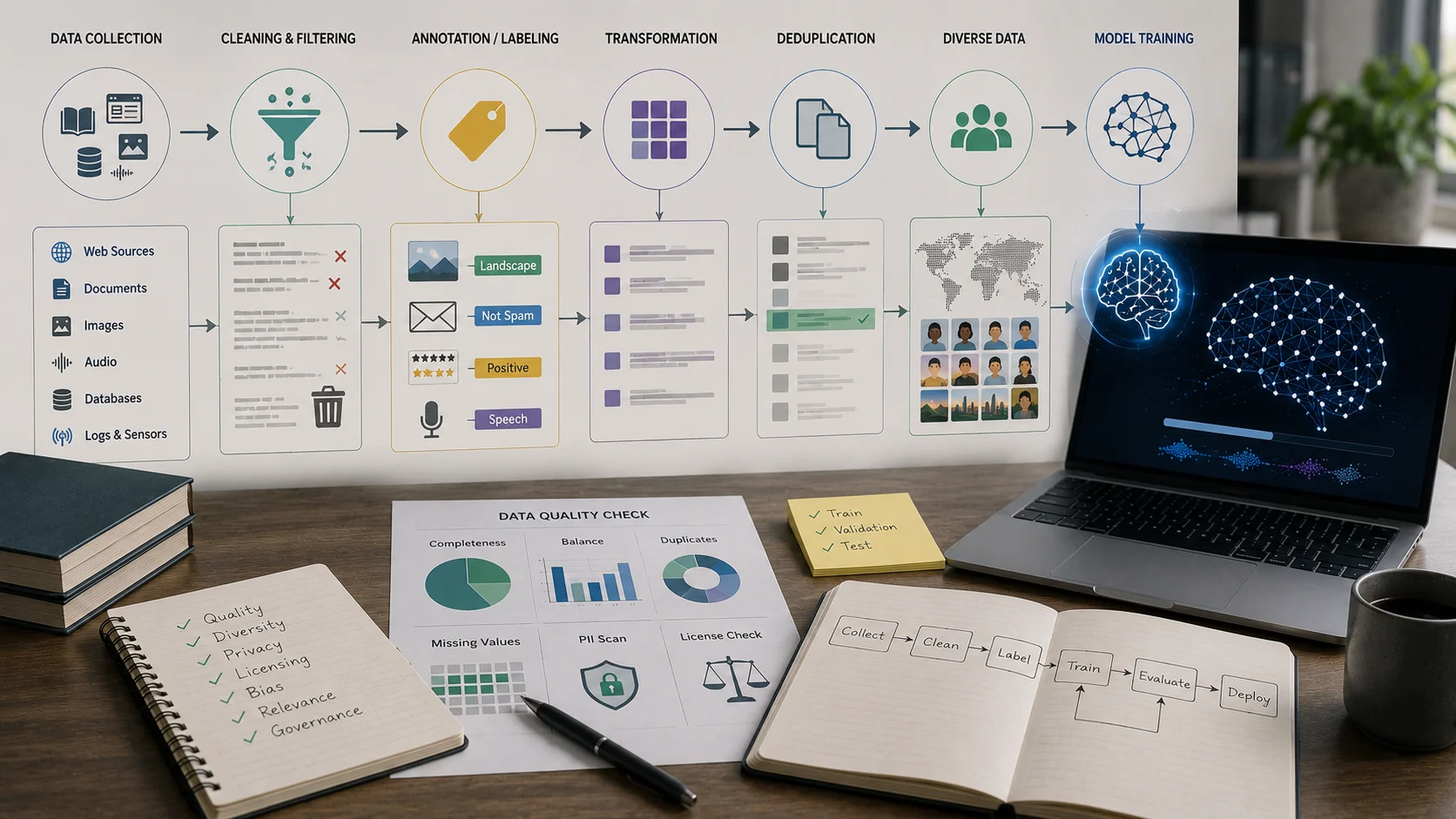
Training data is not simply “information uploaded into AI.” It goes through a pipeline that may include collection, filtering, labeling, transformation, deduplication, sampling, and evaluation.
What Counts as Training Data?
The answer depends on the model. A language model may train on text and code. A vision model may use images paired with labels or captions. A speech model may use audio with transcripts. A multimodal model may combine several formats.
Structured datasets such as tables, sensor readings, product records, and numerical measurements can also be used in machine learning.
Supervised Training Data
In supervised learning, examples include a target or label. An email might be labeled “spam” or “not spam.” An image might have a category. A user request might be paired with an ideal response.
The model learns to produce outputs that match those targets.
Label quality matters. Inconsistent or ambiguous labels create inconsistent learning signals.
Unsupervised and Self-Supervised Data
Modern foundation models can learn from large collections of data without requiring a human label for every example. Self-supervised objectives create training targets from the data itself.
Language models, for example, can learn by predicting missing or next pieces of text. This allows learning from enormous text corpora.
Data Cleaning
Raw data is often messy. It can contain duplicates, broken formatting, spam, low-quality text, corrupted files, personally identifiable information, or irrelevant material.
Cleaning pipelines try to remove or reduce these problems. The exact filtering choices affect the model’s eventual behavior.
Deduplication
Duplicate examples can cause a model to overrepresent certain patterns and can complicate evaluation. Deduplication attempts to identify repeated or near-identical data.
This can also help reduce the chance that benchmark questions are repeatedly present in training data.
Data Diversity
A model trained on a narrow slice of the world may perform poorly for users or situations that are underrepresented. Diversity can involve language, geography, writing style, domain, demographic context, image conditions, and many other dimensions.
More diverse data does not automatically eliminate bias, but it can reduce blind spots when combined with appropriate evaluation.
Training Data and Bias
Models can learn undesirable patterns that exist in their data. Historical discrimination, stereotypes, unequal representation, and harmful language can all influence outputs.
This is why data governance and evaluation are part of responsible AI. Bias management cannot be solved only by adding a safety filter after training.
Privacy and Personal Information
Training datasets may contain personal information if collection and filtering are not carefully managed. Organizations need policies for consent, data minimization, retention, and legal compliance.
Developers fine-tuning a model on company data should also check whether confidential records or customer information are necessary for the task.
Copyright and Licensing
Training data can include copyrighted or licensed material, creating legal and policy questions that differ by jurisdiction and use case.
Organizations should understand the rights associated with datasets they collect or purchase and the terms that apply to model development and distribution.
Synthetic Training Data
AI-generated examples can supplement real data. Synthetic data may help create rare cases, balance categories, or generate additional training scenarios.
The risk is that model-generated mistakes can be copied back into training. Synthetic data needs quality control just like human-created data.
Training Data vs. Fine-Tuning Data
A foundation model may be pretrained on a very large dataset and later adapted using a smaller targeted dataset. That later process is fine-tuning.
Fine-tuning data often needs especially consistent examples because the goal is to shape a specific behavior.
Evaluation Data Must Be Separate
A model should be tested on data it did not train on. Otherwise, evaluation may measure memorization rather than generalization.
Teams commonly separate training, validation, and test data so they can tune the system while preserving an independent final evaluation.
The Bottom Line
AI training data is the collection of examples used to teach a model. Its quality depends on much more than size. Cleaning, diversity, labeling, privacy, licensing, bias management, and evaluation all influence the result.
Good models require good data pipelines. Better algorithms cannot fully compensate for training data that is irrelevant, inconsistent, unsafe, or poorly governed.
A Practical Checklist Before You Rely on Ai Training Data
Define the job first. Decide what success means before choosing a model or product. A system can look impressive in a demo while solving the wrong problem. Write down the expected output, the information it may use, the acceptable error rate, and which decisions still require a person.
Test representative examples. A useful first test is to inspect a sample for duplicates, labeling consistency, missing groups, private information, and licensing before training begins. Include normal cases and difficult edge cases. The goal is to learn where the system is dependable and where it needs stronger instructions, additional tools, or human review.
Verify important outputs. Do not confuse fluency with correctness. Check facts, calculations, citations, permissions, and important transformations against a reliable source. The more expensive or difficult an error would be to reverse, the stronger the verification process should be.
Review privacy and access. Understand what information is being sent to the system, where it is stored, and who can retrieve it later. Give connected AI tools only the permissions they need. Sensitive data should follow the same governance rules that apply elsewhere in the organization.
Measure value over time. Track time saved, correction rate, reliability, user satisfaction, and operational cost. A tool that feels fast during the first week may not create lasting value if people spend the same amount of time fixing its output.
Common Mistakes to Avoid
One common mistake is choosing technology before defining the workflow. Another is testing only ideal examples. Teams also tend to add automation without planning what happens when the model is uncertain, the data is missing, or a connected service fails.
The most important limitation to keep in mind is that large datasets can amplify systematic errors if collection and curation choices are weak. Build the workflow around that reality rather than assuming future model improvements will automatically solve it.
Frequently Asked Questions
Is AI training data always more accurate than a simpler approach?
No. AI is valuable when the task benefits from language understanding, pattern recognition, generation, or flexible decision support. A deterministic rule, database query, spreadsheet formula, or conventional software function can be better when the task is predictable and exact.
Do I need to understand the mathematics behind AI training data?
No. A conceptual understanding is enough for most users and product decisions. Mathematics becomes more important when you are implementing, optimizing, or researching AI training data at a technical level. Start with the purpose, inputs, outputs, tradeoffs, and failure modes before going deeper into equations.
What is the safest way to start using AI training data?
Begin with a narrow, reversible use case. Keep source material or original data available, review the output manually, and document the situations where the system fails. Expand automation only after the workflow performs consistently on representative examples and users know how to recover when it is wrong.