
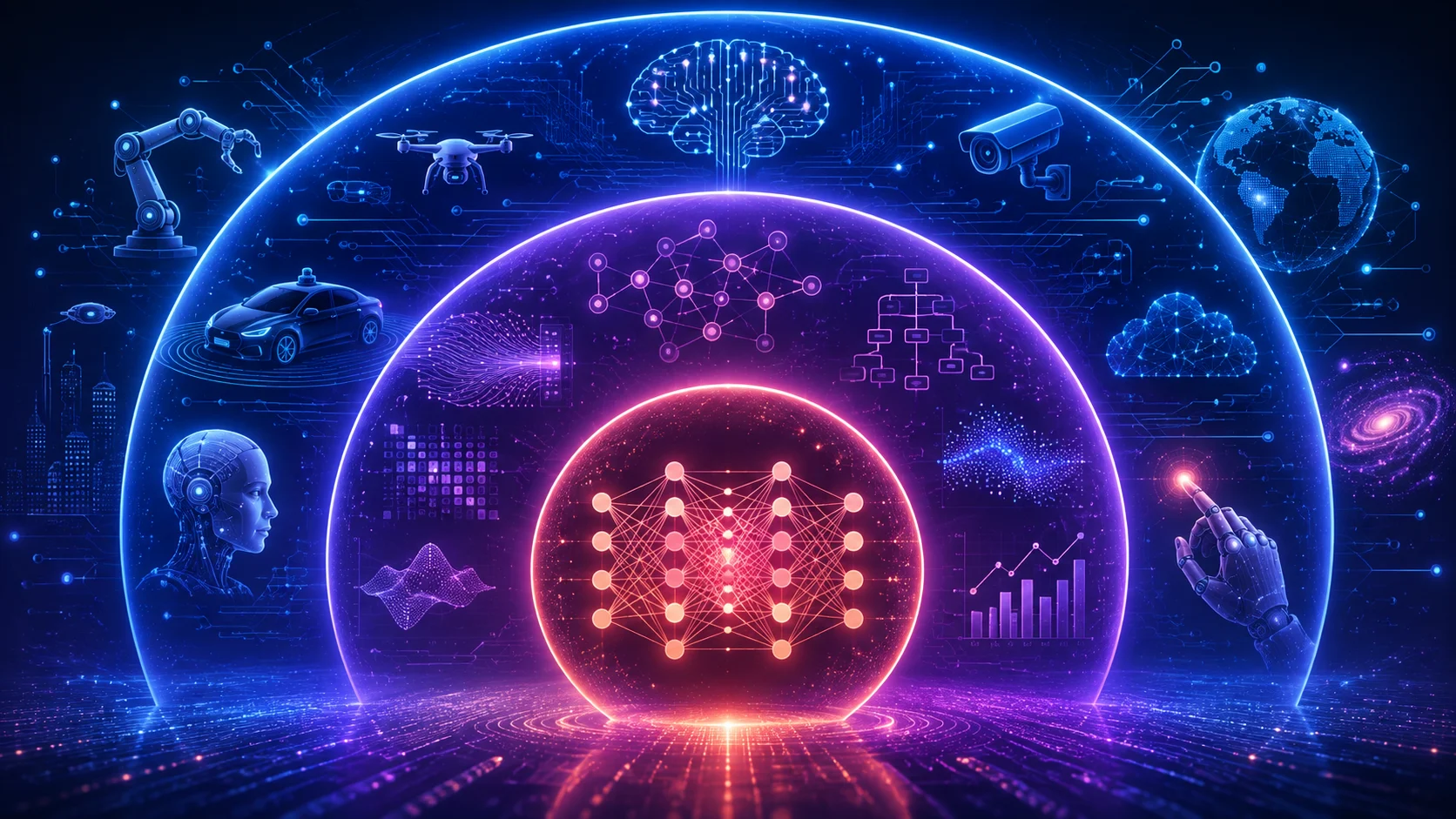
Artificial Intelligence, Machine Learning, and Deep Learning are often mentioned together, which makes them sound interchangeable. They are closely connected, but they describe different levels of the same technological landscape. Artificial Intelligence is the broadest field, Machine Learning is a major approach within AI, and Deep Learning is a specialized form of Machine Learning based on multi-layer neural networks. The simplest way to picture the relationship is AI → Machine Learning → Deep Learning. Understanding that hierarchy makes it easier to judge what a technology actually does instead of treating every AI system as the same thing.
What Is Artificial Intelligence?
Artificial Intelligence, or AI, is the broad field of creating computer systems that can perform tasks associated with human intelligence. Those tasks may involve language processing, prediction, planning, pattern recognition, decision-making, or problem solving. AI does not always learn from data. Some systems use rules, logic, search methods, or other techniques designed directly by humans. A rule-based expert system, for example, can make decisions by following predefined conditions without using Machine Learning. This wider scope is why AI should be seen as the umbrella concept rather than a single method.
What Is Machine Learning?
Machine Learning is one of the most important ways to build AI systems. Instead of programming every rule manually, developers provide data and algorithms that allow the system to identify useful patterns. A spam filter can learn from examples of unwanted and legitimate messages, while a recommendation system can use behavior patterns to suggest products, music, or videos. The model does not “understand” those examples as a person would; it adjusts mathematical relationships so its predictions improve. Machine Learning is especially useful when the patterns are too complicated or numerous to express as fixed rules.
What Is Deep Learning?
Deep Learning is a branch of Machine Learning that uses neural networks with many layers. The word “deep” refers to the number of processing layers, not to human-like depth of thought. These networks can learn increasingly complex representations from data, making them useful for image recognition, speech recognition, natural language processing, computer vision, and generative AI. In many cases, Deep Learning can learn useful features directly from raw data instead of relying as heavily on humans to define them in advance. That capability is powerful, but it often requires more training data, computing resources, and engineering effort than simpler Machine Learning methods.
How AI, Machine Learning, and Deep Learning Are Connected
The relationship is hierarchical rather than competitive. AI contains many approaches for creating intelligent behavior, and Machine Learning is one of those approaches. Deep Learning is then a more specialized approach within Machine Learning. An analogy is transportation: transportation is the broad category, cars are one type of transportation, and electric cars are a specific type of car. In the same way, every Deep Learning system is a Machine Learning system, and every Machine Learning system belongs to AI, but not every AI system uses Machine Learning and not every Machine Learning system uses Deep Learning.
Key Differences Between AI, Machine Learning, and Deep Learning
The biggest difference is scope. AI describes the overall goal of building systems that perform intelligent tasks, while Machine Learning describes a data-driven method for achieving some of those goals. Deep Learning narrows the method further by using deep neural networks, especially for complex patterns in images, audio, video, and language. Traditional Machine Learning can often work with smaller datasets and simpler models, but it may require more manual feature engineering, meaning people choose which characteristics of the data are important. Deep Learning can learn many of those representations automatically, although humans still make major decisions about data, architecture, evaluation, and deployment. That distinction also shapes cost, transparency, and maintenance.
Human involvement and computational requirements also vary between the approaches. A relatively small Machine Learning model may be trained on ordinary hardware and provide results that are easier for developers or analysts to interpret. Deep Learning systems can involve millions or billions of parameters and may require GPUs or other specialized processors, especially at larger scales. More computing power can support more complex models, but it also increases development cost and infrastructure requirements. The appropriate level of complexity therefore depends on what the system actually needs to accomplish.
Machine Learning vs Deep Learning in Practice
Machine Learning is often a strong choice when data is structured, the dataset is moderate, and interpretability or speed matters. It is widely suited to tasks such as fraud detection, demand forecasting, customer segmentation, and prediction using business data. Deep Learning is especially valuable when the input is complex and difficult to describe manually, such as photographs, speech, video, or large amounts of text. A vision model, for example, can learn visual features directly from pixels instead of depending on engineers to define every relevant shape. Deep Learning is not automatically better, however; simpler models can be cheaper, faster, easier to explain, and more appropriate when data or computing power is limited.
The difference is particularly noticeable in feature engineering. Traditional Machine Learning often depends on humans deciding which variables or characteristics should be presented to the model. Deep Learning can learn many useful representations during training, reducing the need to define every feature manually. That capability helps with complicated information such as images and language, where manually describing every meaningful pattern would be difficult. However, automatic feature learning can also make a model harder to interpret, creating a trade-off between capability and transparency.
Why Deep Learning Became So Important
Deep Learning became central to modern AI because several developments arrived together. Larger digital datasets provided more material for training, while GPUs and specialized processors made the required calculations more practical. Neural-network techniques and training methods also improved, allowing larger and more capable models to be built. These advances supported major progress in computer vision, speech processing, language models, and generative AI. Deep Learning therefore became important not because it replaced every other Machine Learning approach, but because it proved especially effective for problems involving complex, high-dimensional data that had been difficult for earlier systems to handle.
Strengths, Limitations, and Choosing the Right Approach
Each approach has different strengths and trade-offs. Machine Learning can deliver strong predictions with less computing power and may be easier to interpret, while Deep Learning can handle complex data and learn rich representations but often needs more resources and training time. AI more broadly can also include rule-based or hybrid systems when learning from data is unnecessary. Choosing between them depends on the problem, data availability, budget, computing resources, required accuracy, explainability, and development time. A simpler solution is often preferable when it performs the task reliably, because greater technical complexity does not automatically produce greater practical value.
Data quality remains important for both Machine Learning and Deep Learning. A sophisticated model trained on incomplete, biased, or inappropriate data can still produce unreliable results. Deep Learning may be particularly difficult to explain because decisions can emerge from interactions across many network layers, while simpler models may offer more transparent relationships between inputs and outputs. Security, privacy, maintenance, and human oversight must also be considered when systems are deployed in real environments. Technical performance is only one part of deciding whether an AI approach is suitable.
The Future of AI, Machine Learning, and Deep Learning
AI, Machine Learning, and Deep Learning will continue to develop together across software, healthcare, education, business, robotics, research, automation, and creative industries. Many systems will combine several approaches rather than relying on only one. A product might use Deep Learning for speech or language, a simpler Machine Learning model for prediction, and rule-based logic for safety or control. This combination reflects how real technology is built: engineers choose methods according to the problem rather than according to which label is most fashionable. As these technologies become more integrated into everyday tools, understanding their differences will become increasingly useful for non-specialists as well.
Conclusion
Artificial Intelligence is the broadest field, Machine Learning is a major approach within AI, and Deep Learning is a specialized form of Machine Learning built around deep neural networks. Their differences affect how systems learn, how much data and computing power they need, how easy they are to interpret, and which problems they handle best. Deep Learning has enabled many modern AI capabilities, but it is not universally superior to simpler methods. Choosing the right approach requires balancing performance with data availability, cost, complexity, and transparency. Knowing how AI, Machine Learning, and Deep Learning fit together gives readers a clearer way to evaluate products, research, and technology news without confusing related concepts that serve different roles.