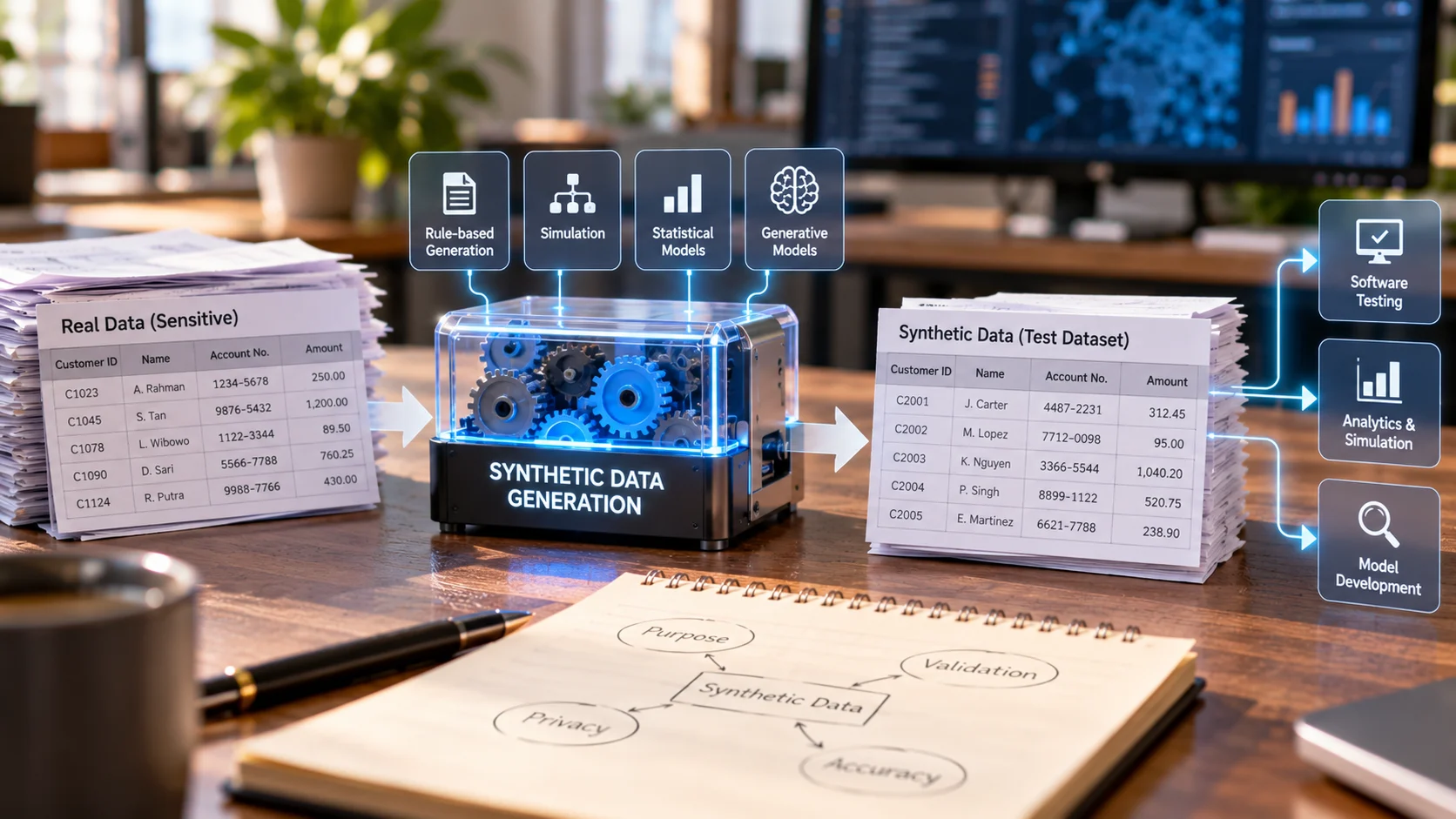
A bank software team needs transaction-like records to test a new dashboard without distributing real customer accounts to every developer. Synthetic data is artificially generated information designed to reproduce useful properties of a real data domain. It may help testing, simulation, and model development, but it does not automatically preserve privacy or statistical validity. This guide concentrates on generation methods and validation choices rather than repeating a general discussion of AI training data. Quantitative examples below are hypothetical and should be adapted to the reader’s actual data.
Key Takeaways
Synthetic records should be designed for a specified test or analytical decision; plausibility alone does not establish usefulness.
Rule-based fixtures, simulations, statistical generators, and learned generators solve different problems and require different checks.
Compare downstream performance, important distributions, edge cases, and privacy leakage rather than judging a dataset by size.
Keep deliberate test anomalies separate from samples intended to approximate real-world patterns, and label their intended use.
Generated information is not automatically anonymous, representative, or suitable evidence for a live business decision.
Synthetic Data Is a Design Choice, Not a Privacy Label
A synthetic dataset consists of records generated according to rules, simulations, statistical models, or other procedures rather than copied directly as an ordinary production export. The word synthetic describes how the records were created; it does not establish that they are representative, safe to share, or appropriate for every analytical purpose. A software tester wants predictable transactions that exercise screens and validation rules. A fraud analyst wants plausible patterns, including difficult anomalies. A researcher assessing population relationships wants certain correlations preserved. These are different specifications, and a dataset can succeed at one while failing another.
The first question is therefore not which generator can produce the most rows. It is what decision those rows must support. If the goal is testing a checkout form, artificial addresses and deliberately malformed payment fields may be useful. If the goal is evaluating a recommendation model, a dataset must preserve relationships between users, products, and events sufficiently well to test the model. Mixing those goals can create misleading results: a thousand neat artificial customers may pass software tests while offering no trustworthy evidence about customer behavior.
Four Approaches to Generating Synthetic Records
Handwritten rules and seeded examples
A rule-based generator uses explicit conditions such as permitted order statuses, valid date ranges, and relationships among invoice totals. It is reproducible and excellent for exercising known business rules. Consider a store where the order total must equal the sum of line items minus discounts plus tax. A test generator can create valid examples and intentionally violate each condition to verify that the application rejects bad input. The main weakness is that human-written rules rarely capture every subtle relationship present in real operational data.
Simulation of an underlying process
Simulation models a process rather than imitating rows. A delivery operation may simulate incoming orders, pickup queues, travel delays, and failed deliveries. Changing the simulated demand allows developers to test busy periods that have not yet occurred. Credibility depends on whether the assumed process reflects real behavior. A simulator with constant travel times may produce comfortable but unrealistic workload forecasts, particularly when weather or traffic produces heavy-tailed delays.
Statistical sampling and probabilistic models
Statistical generators estimate distributions, dependencies, and categories, then sample new combinations. They may preserve aggregate patterns such as typical basket sizes or the association between region and payment method. Yet matching a few averages is not enough. If an unusually high refund rate occurs in a small customer group, a generator that smooths away that difference may fail a downstream fraud test. Review marginal distributions and important joint relationships, not only attractive histograms.
Generative machine-learning models
More complex methods learn from approved source examples and generate candidate records. Depending on the domain, these may involve tabular generators, language models, image synthesis, or specialized time-series methods. Their expressive power can be useful for complex patterns, but increases the need for governance and evaluation. Training data may contain sensitive combinations or historical bias, and a learned generator can reproduce unwanted patterns. The generated data must still pass schema, plausibility, and disclosure tests.
What Synthetic Data Must Preserve—and What It Can Change
A helpful design document separates invariants, statistical properties, and deliberate exceptions. Invariants are rules that must always hold, such as a paid invoice having a valid invoice number. Statistical properties are quantities whose approximate pattern matters, such as the distribution of order amounts or the correlation between transaction time and channel. Deliberate exceptions are artificial edge cases inserted to test error handling: unknown currency codes, duplicated records, unusually long customer names, or contradictory timestamps.
The appropriate blend depends on the audience. A development team’s dataset may deliberately include impossible combinations because the system must reject them. A dataset used to estimate business impact should not casually include impossible combinations, because they distort calculations. It is useful to label test-only anomalies and keep them separate from statistically representative samples so reports do not mistake deliberate defects for customer behavior.
Rare events deserve special treatment. A random sample from a learned distribution might almost never include a chargeback or a high-value invoice, although those cases are exactly what a review workflow must handle. A pragmatic solution is a mixed dataset: generated everyday records plus separately documented boundary cases. Record which examples are synthetic approximations and which are engineered tests.
Measuring Usefulness Without Assuming Fidelity
There are several distinct evaluation questions. Validity asks whether fields satisfy business rules. Fidelity asks whether important distributions and relationships resemble an appropriate reference dataset. Utility asks whether the generated records support the intended downstream task. Coverage asks whether critical segments and situations are represented. Disclosure risk asks whether generated material exposes information about source individuals or records. These dimensions are complementary rather than interchangeable.
For a software test fixture, validation might mean every generated record conforms to a schema unless specifically marked as a negative test, and every rejection path is exercised. For a model training experiment, utility is better assessed by holding back permitted real examples for testing, training comparable candidate models, and evaluating both performance and subgroup errors. This is sometimes described as train-on-synthetic, test-on-real, but the particular comparison must be suitable for the task and legal context.
Document the evaluation split before generating results. If a generator learned from all records, including the supposed holdout, the experiment can overstate generalization. Keep test data separated when feasible, and avoid reporting one accuracy number without checking segments, uncommon categories, and cases where the model is not confident. Synthetic data can improve coverage for certain tasks without accurately reproducing the whole real distribution; specify which objective matters.
Why Privacy Does Not Follow Automatically
Removing names and replacing them with invented names is not an adequate privacy assessment. A record with a distinctive combination of age range, location, transaction amount, and purchase timing may still reveal information. A learned generator could memorize training examples or reproduce unusual combinations. Whether a particular dataset presents unacceptable disclosure risk depends on the source sensitivity, generation process, adversary capabilities, and intended release.
Separate internal test access from public distribution. A dataset circulated only to an authorized development team has a different exposure profile from one posted on a public repository. Examine membership-inference, attribute-inference, and linkage risks when relevant, and do not promise anonymity merely because no literal name appears. Privacy-preserving techniques, including differential privacy in appropriately designed systems, impose specific mathematical or operational conditions; they are not interchangeable with the word synthetic.
A cautious workflow also controls the original source records. Minimize access, document why sensitive attributes are needed for generation, establish deletion and retention rules, and assess whether an external generation service receives the data. For regulated information, qualified legal and privacy review may be necessary before a generator is trained or samples are shared.
A Practical Generation and Review Process
Write a use-case statement. For example: “Create 5,000 artificial orders to test checkout, refunds, and accounting reconciliation, including boundary cases.” Describe what the dataset will not be used to prove.
Define the schema and dependencies. Document field types, allowed categories, date order, referential integrity, units, and relationships that must hold.
Choose the simplest suitable generator. Rule-based data may be sufficient for testing a form. A complex generative model adds maintenance and risk if the required behavior is straightforward.
Identify protected information. Decide which real records, if any, are necessary to estimate patterns, and whether those records can lawfully be used for that purpose.
Generate small pilot batches. Produce enough examples to inspect systematically before creating a large dataset. Preserve generator versions and random seeds when reproducibility matters.
Run automated and human checks. Test constraints and distributions, then investigate suspiciously realistic individual records, missing segments, and implausible correlations.
Test the actual downstream application. Use the samples to run the dashboard, validation process, or model experiment. Measure the outcome it was created to support.
Release with documentation. Identify purpose, limitations, excluded uses, provenance, privacy findings, generation settings, and contact person for corrections.
If a test fixture is updated as the product evolves, version the dataset together with the expected outputs. Otherwise developers may mistake a changing synthetic sample for a code regression. Conversely, do not freeze the fixture so permanently that it no longer covers new features and failure modes.
When Synthetic Data Is a Poor Substitute
Some tasks require direct measurement of reality. A company should not infer customer demand, disease prevalence, fraud rates, or the effect of a policy change from an unvalidated synthetic dataset as if those estimates were observed facts. Synthetic distributions can inherit assumptions, omit unobserved populations, and amplify biases in source examples. They can be excellent for developing workflows while remaining unsuitable for final business decisions.
A useful stopping condition is inability to establish sufficient task utility or privacy protection. If a synthetic dataset cannot reproduce the corner cases needed for testing, add controlled examples or use carefully governed real test data. If privacy testing shows unacceptable linkage risk, restrict access, change the generation approach, or do not release the dataset. A smaller but justified dataset is better than an enormous collection of plausible-looking rows without a reliable purpose.
Testing a small synthetic customer dataset
Suppose a retailer has a table with customer age band, purchase channel, order value, and return flag. A generator creates 10,000 synthetic rows for dashboard testing. A good review compares distributions, relationships, rare-category representation, and downstream query behavior. It also checks whether unusually distinctive customer combinations were reproduced too closely. Merely removing names from a real dataset does not guarantee anonymity, and synthetic generation does not automatically solve disclosure risk.
In a useful experiment, analysts train the same simple classifier on the synthetic set and a permitted real training set, then evaluate both on a separate real holdout. Similar average accuracy can conceal substantial failure on a small customer segment. The report should therefore discuss utility, fairness, and privacy attack testing as separate dimensions rather than reporting one synthetic-data score.
What the example teaches. An artificially generated transaction table preserves common purchase sizes but loses unusual high-value events. It helps test ordinary screens yet misses an important fraud-review path. The team adds rule-based boundary cases and checks privacy leakage before distributing the dataset.
Documentation That Makes a Dataset Reusable
A synthetic dataset without documentation can be surprisingly difficult to interpret. Include its schema, generation method, approved uses, exclusions, creation date, random seed if relevant, and results of utility and privacy evaluations. If it deliberately oversamples rare failures, say so: the apparent event frequency must not be mistaken for real prevalence. Describe whether generated values are independent samples, linked sequences, or repeated records tied to a simulated entity. Those relationships determine which analyses make sense.
Also identify the dataset’s limits. A sample designed to test invoice validation may not support conclusions about customer segmentation. A table created from one branch’s transactions may not represent other regions. If source data changes substantially, regenerate and revalidate rather than assuming an old synthetic fixture remains realistic indefinitely. Good documentation gives users a reliable basis for deciding what the data can and cannot establish.
Frequently Asked Questions
Is synthetic data automatically private?
No. A synthetic dataset can resemble, leak, or allow inference about source records. Privacy needs explicit assessment, especially when generation learned from sensitive data.
Can synthetic data replace all real data?
It can support testing or some model-development tasks, but real-world validation remains important. Synthetic data may omit unusual patterns that matter operationally.
How do you test synthetic data quality?
Check distributional fidelity, downstream utility, edge-case coverage, and disclosure risk. A useful dataset need not look identical for every statistic.
When are rule-based examples preferable?
Rule-based generation is useful when exact constraints or rare boundary cases matter more than reproducing the full complexity of an observed distribution.
Further Reading on ByteScope
How AI Training Data Works
AI Benchmarks Explained
Sources and Further Reading
NIST: Synthetic Data Evaluation Guide — NIST primary material for frameworks and evaluation methods.
NIST: Privacy Framework — NIST primary material for frameworks and evaluation methods.