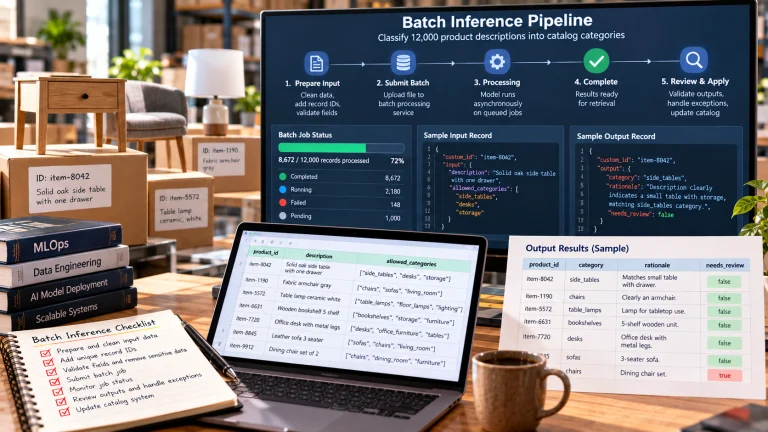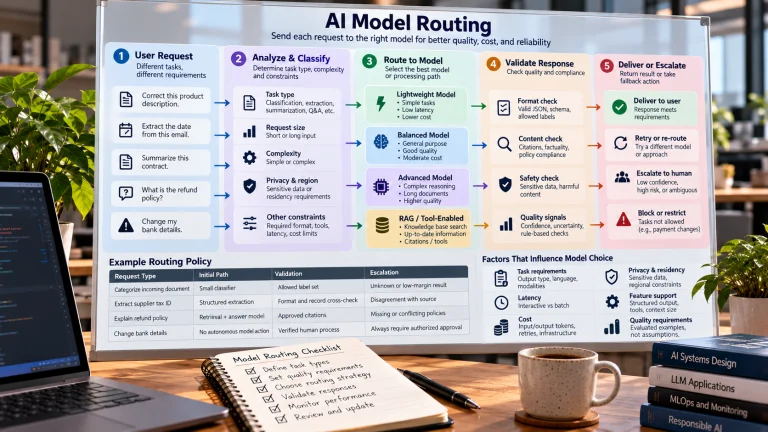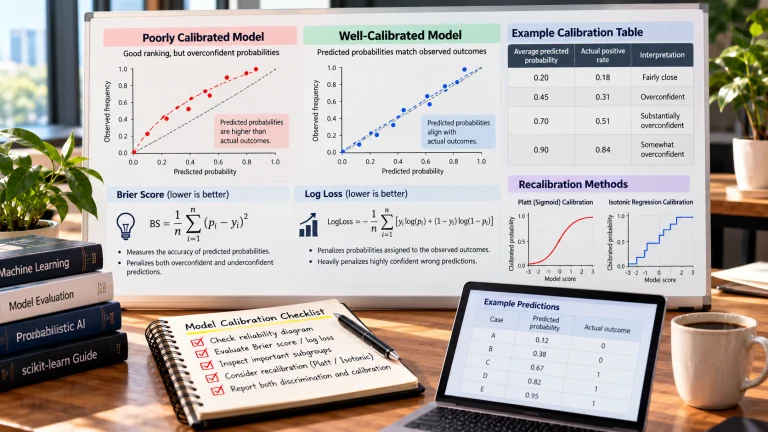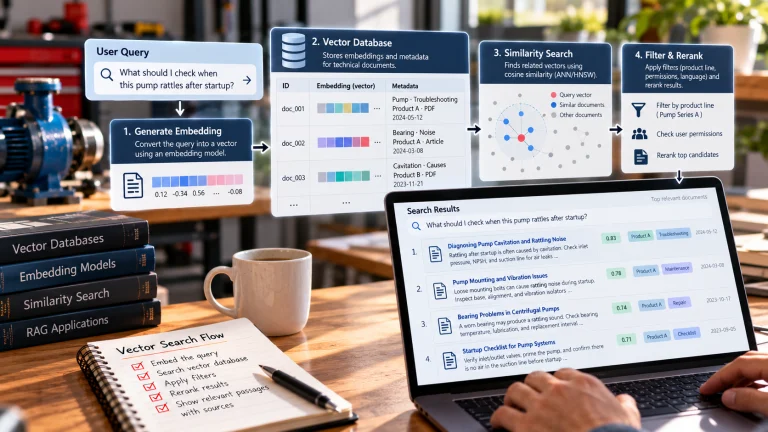
A mobile writing assistant wants to preserve useful tone classification while reducing inference memory and network dependence. Knowledge distillation transfers selected behavior from a larger or stronger teacher model to a smaller student model through training objectives derived from teacher predictions, generated examples, or intermediate representations. It differs from quantization: distillation trains a new model to imitate useful behavior, while quantization changes numerical precision in a model representation. Quantitative examples below are hypothetical and should be adapted to the reader’s actual data.
Key Takeaways
Knowledge distillation trains a student model to learn useful behavior from a teacher, rather than merely reducing numerical precision.
The teaching signal can involve class probabilities, representations, or generated examples; its usefulness depends on the task.
Compare a distilled student with a supervised-only student and the teacher on the same untouched test set.
Student quality, inference speed, memory requirements, and rare-case failures belong in the same evaluation.
Compression is successful only when the smaller deployment meets the application’s real quality and resource needs.
Why Teach a Smaller Model?
A powerful model may provide excellent predictions but be expensive to deploy, slow to respond, or impractical to run on a local device. Knowledge distillation is a training approach in which a student model learns from information produced by a teacher model. The teacher is generally stronger on the chosen task, although the value of the method depends on the setting. The goal is not to store an entire large network inside a tiny one. It is to transfer useful behavior so the student performs well within a smaller computational budget.
Consider a company that needs to classify incoming support requests into billing, delivery, account access, and other categories. A large teacher may be accurate but unnecessary for tens of thousands of routine tickets. A smaller student could be trained to reproduce the teacher’s useful classification behavior and then run at a lower cost. However, a student that performs well on common tickets might fail when messages are multilingual, ambiguous, or contain rare safety issues. Distillation is successful only if the retained capabilities match real needs.
Hard Labels Versus Soft Targets
Ordinary supervised classification often uses hard labels. An example may be labeled “delivery,” and the training objective rewards the model for predicting delivery. A teacher can provide more information: for example, delivery 0.75, billing 0.18, account access 0.05, and other 0.02. These probabilities are hypothetical, but they illustrate a valuable distinction. The teacher communicates that billing is a more plausible alternative than account access, even though delivery is the most likely class.
A student trained on appropriately transformed teacher probabilities may learn relationships between classes that hard labels alone do not convey. The probabilities are often called soft targets. The student is not necessarily told that every teacher prediction is correct; it learns a behavior pattern weighted by the selected objective. A teacher can be confidently wrong, and repeatedly imitating those errors can damage the student.
Temperature sometimes appears in distillation objectives. A higher temperature applied to logits can soften a probability distribution so differences among less likely classes become more visible. Training code commonly combines a distillation loss against teacher outputs with a supervised loss against ground-truth labels. The exact weighting and temperature are hyperparameters to tune; they are not universal constants that work for every architecture or dataset.
Distillation Is More Than One Algorithm
Response-based distillation
The student imitates teacher output distributions, classifications, generated responses, or other observable predictions. It can be attractive when only outputs are available, but teacher access limits what can be learned. For a text assistant, generated teacher explanations or answers may be used as additional training examples, subject to licensing and quality checks.
Feature-based distillation
When internal representations are accessible, a student may be trained to match selected intermediate features from the teacher. Different networks can have incompatible dimensions, so mappings or additional layers may be needed. This approach transfers more than final predictions but requires tighter access to model internals.
Relation-based and task-specific methods
Some techniques teach relationships among examples or customize the objective to a task such as ranking, speech recognition, or object detection. A single term, knowledge distillation, therefore covers a family of training methods. The method should be evaluated against the student architecture and application goal rather than chosen from a headline claiming that one network has been “compressed.”
A Hypothetical Teacher–Student Experiment
Suppose the teacher achieves 94% accuracy on a separate held-out support-ticket sample and requires a costly server. A small baseline student trained only on labeled tickets achieves 85%. A distilled student reaches 90% with the same smaller architecture. These figures are illustrative and do not predict a real deployment. The improvement is meaningful only if the experiment controls training data, evaluation cases, and relevant computing conditions.
Accuracy alone may conceal important failures. If the distilled model misroutes account-compromise reports, the business cost could be high even if routine delivery tickets improve. Examine confusion matrices and per-category precision and recall. Include messages with mixed intents, typos, non-English text, unusual phrasing, and ambiguous requests. A ticket that could be both billing and delivery may require a multi-label output or an escalation path rather than forcing one class.
Record the inference measurements under comparable conditions: memory footprint, latency distributions, throughput, energy consumption if it matters, and system cost. Training a distilled student has its own cost, which may be worthwhile only when enough future requests justify it. A cheap inference endpoint is not automatically economical after accounting for teacher labeling, training, validation, and maintenance.
Designing an Effective Distillation Pipeline
Define the student’s operating envelope
Specify the actual workload, languages, devices, latency budget, and acceptable errors. If the student only needs to triage support categories, don’t assume success requires matching the teacher on general reasoning benchmarks. Conversely, do not approve a student for more consequential tasks because it happens to perform well on narrow classification tests.
Build a trustworthy learning set
Combine suitably licensed and permitted examples with ground-truth labels where available. Deduplicate repeated records, separate held-out evaluation data, and avoid allowing examples from the final test set to influence teacher-generated training material. If the teacher outputs were produced with sensitive customer messages, apply privacy controls to the teacher interaction and stored responses.
Choose what the teacher communicates
For classification, probabilities may carry useful class relationships. For text generation, teacher outputs may be filtered or scored before training. For internal-feature methods, choose which layers to match and whether the student needs projection layers. The output interface, model access, and data policies may constrain this decision.
Train a baseline and distilled candidate
A basic student trained on available labels gives a fair point of comparison. Without that baseline, a team cannot tell whether distillation contributed the improvement or whether the student architecture was already sufficient. Vary important settings deliberately: teacher temperature, training mixture, loss weighting, and example composition. Track experiments and model revisions.
Evaluate outside the teacher’s comfort zone
The teacher’s own preferences should not be the only judging standard. Use independent human-reviewed labels or task outcomes when possible. Test difficult and underrepresented examples. For generated text, distinguish surface similarity from correctness: two answers can use different wording and both be correct, and a polished answer can still be factually wrong.
Deploy with a fallback
Monitor drift, uncertainty, and new types of requests. Route out-of-scope or high-risk cases to a stronger model or human review according to business rules. Keep model lineage so teams know which teacher, training data, and settings produced a particular student version.
Distillation, Quantization, and Pruning Compared
Technique What changes? Main trade-off
Knowledge distillation A student is trained to reproduce useful teacher behavior Training effort and possible capability loss
Quantization Numerical precision of model values is reduced Numerical approximation and hardware compatibility
Pruning Selected model weights, connections, or structures are removed Reduced capacity and possible need for retraining
These methods can be combined. A small student may later be quantized for a device that lacks sufficient memory. But their effects should be measured separately: a distillation experiment tests transferred behavior, while a quantization experiment measures precision changes on a given architecture. Marketing statements that group all three under “compression” can obscure which intervention created which benefit.
Limitations, Bias, and Responsible Use
Distillation can transmit a teacher’s systematic mistakes, preferences, and blind spots. A teacher that performs poorly on uncommon dialects may generate misleading training targets for those dialects. A student may also lack the capacity to retain rare capabilities that the teacher provides. More imitation data is not always the solution; better labeled examples, a more suitable objective, or a different student architecture may be needed.
Do not train on private data merely because the final network is small. Student weights or outputs may still have privacy or memorization risks, and teacher-service terms may constrain how outputs can be used. Review licenses for models, datasets, and generated labels. For high-impact use cases, retain independent evaluation and meaningful human oversight rather than treating a student as automatically safe because it is cheaper.
The most credible success claim is narrow and measurable: the distilled student meets the required task-quality threshold with lower observed resource use on the target workload. That is more useful than saying a smaller model has inherited the “intelligence” of a larger one without specifying what was retained.
How a teacher can transfer softer predictions to a student
Imagine a teacher classifier assigns 0.72 probability to “sports,” 0.22 to “fitness,” and 0.06 to “finance” for a product article. A normal hard label might only say “sports.” During distillation, the student can learn from the richer teacher distribution, which preserves information about similarity between classes. The student is trained to reduce a combination of hard-label loss and soft teacher–student divergence, often with a temperature that softens both distributions for learning.
A simplified training sketch is:
teacher_probs = softmax(teacher_logits / T)
student_probs = softmax(student_logits / T)
loss = alpha * hard_label_loss + (1 – alpha) * T*T * KL(teacher_probs, student_probs)
update(student, loss)
The pseudocode omits framework details; T*T is a conventional scaling choice in classic formulations. Distillation is not guaranteed to preserve specialized knowledge, bias properties, or reasoning quality. The student needs its own evaluation on target-device costs and hard cases.
What the example teaches. The teacher performs strongly on ordinary classification examples but struggles with uncommon customer wording. If the student is trained only on the teacher’s outputs, it can reproduce the same blind spot. Independent labeled examples are used to test whether the student actually meets the product requirement.
Deciding Whether Distillation Is Worth the Training Effort
Distillation is not automatically preferable to using an existing smaller model. Estimate how many inferences the application will perform, the cost and time of teacher labeling, training infrastructure, evaluation, and ongoing model maintenance. Compare a trained student against a strong off-the-shelf baseline under equivalent task conditions. If the gap is tiny, the extra training process may not be justified.
Consider the cost of maintaining domain knowledge as well. A distilled support classifier trained on last year’s product categories may require refreshed examples when the business launches new services. The student does not continuously inherit teacher updates after training. Teams must decide when to rebuild the student, when to route uncertain cases to the teacher, and how to detect failure patterns before they cause operational harm.
Choosing a Student Model and a Teaching Signal
The student architecture does not need to duplicate the teacher. A team might choose a lightweight classifier with a fixed label set even when the teacher is a general language model. In that case, the first design decision is what information the student should imitate: final class probabilities, intermediate representations, generated rationales, or a mixture of teacher predictions and ground-truth labels. These are different training setups and should not be presented as equivalent.
A useful pilot tests three baselines on exactly the same holdout data: the student trained from labeled examples alone, the student trained with teacher-derived targets, and the teacher itself. If the distilled student beats the supervised student on common cases but fails rare classes, the next step may be better class coverage rather than more distillation epochs. Report inference latency and resource needs alongside task quality so the comparison reflects why a smaller model was desired.
Frequently Asked Questions
Is distillation the same as quantization?
No. Quantization reduces precision in an existing model; distillation usually trains a different model using teacher-derived learning signals.
Does the student need teacher source code?
Not always. Some methods work from teacher probabilities or generated examples exposed through an API, subject to licensing and usage terms.
Can a student become more accurate than its teacher?
It can outperform its teacher on a narrow task if training data and objectives are well suited, but that does not imply superior general capabilities.
What is the main risk of teacher-generated labels?
Incorrect or biased teacher responses may become training targets. Independent labels and difficult evaluation examples help reveal this inherited weakness.
Further Reading on ByteScope
Small Language Models Explained
How AI Training Data Works
Sources and Further Reading
Hinton, Vinyals and Dean: Distilling Knowledge — Research paper; evaluate methods and limitations.
PyTorch: Knowledge Distillation Tutorial — PyTorch model optimization and training documentation.