
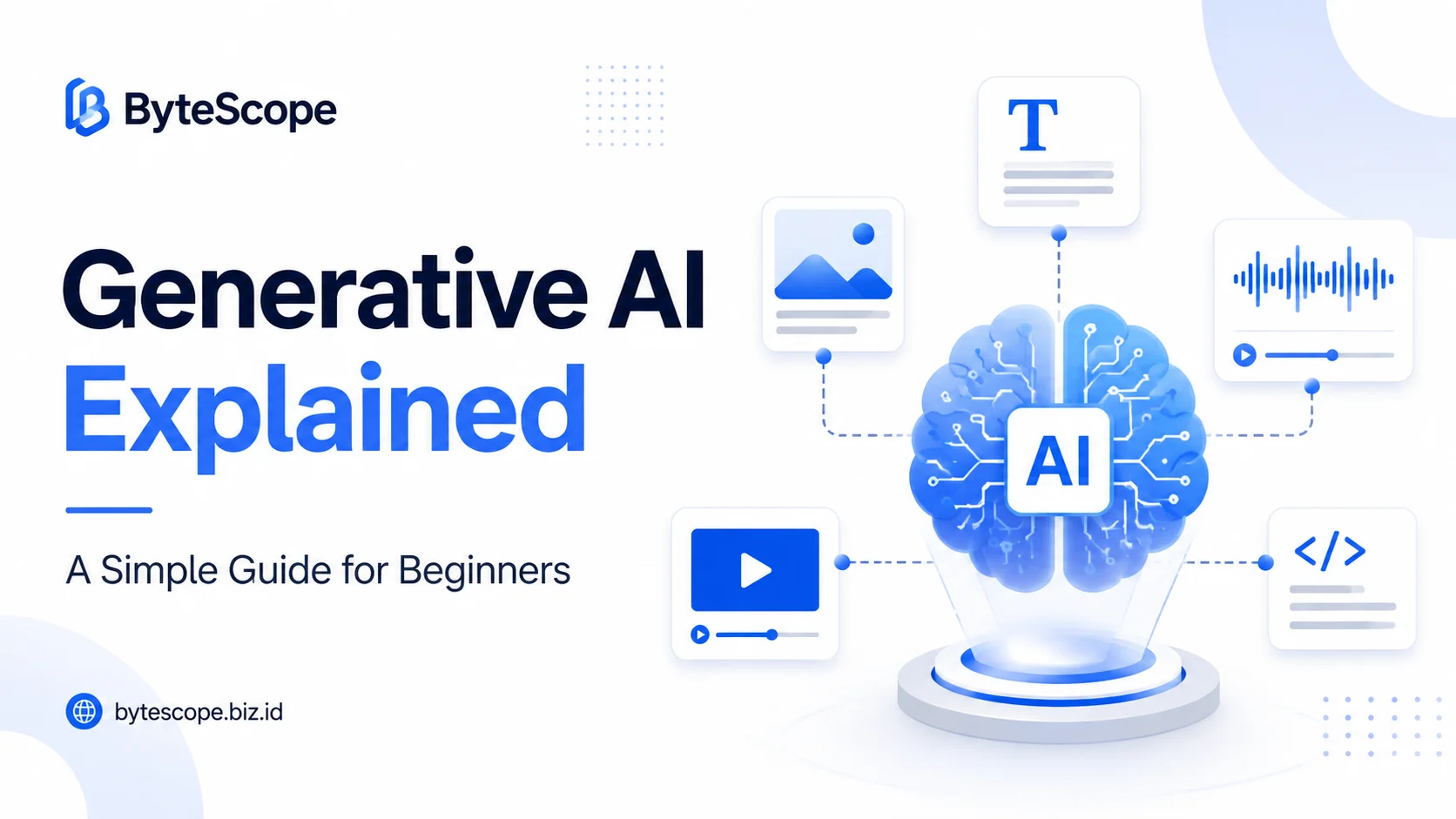
A few years ago, most people encountered artificial intelligence quietly through search results, recommendations, spam filters, or navigation apps. Generative AI changed that experience because people can now ask an AI system to produce something new: a paragraph, an image, code, a voice clip, or a video. That shift has made AI more visible in classrooms, offices, creative work, and digital tools. For beginners, the key is to understand Generative AI as technology that learns patterns from data and uses them to generate content.
What Is Generative AI?
Generative AI is a branch of artificial intelligence designed to create content from patterns learned from collections of data. Instead of only classifying information or predicting outcomes, generative systems can produce text, images, audio, video, software code, and other outputs in response to a user’s instruction. That instruction is called a prompt, and it can be simple or detailed about tone, audience, format, and purpose. The result may feel original because the model combines learned patterns in new ways rather than returning one fixed answer.
Traditional AI often focuses on analyzing or predicting. A spam filter classifies unwanted email, while a recommendation system predicts which video or product a user may prefer. Generative artificial intelligence goes further by producing a new response, which helps explain why it feels different from earlier software.
How Does Generative AI Work?
At a simple level, Generative AI learns patterns from training data through machine learning. During training, an AI model processes large amounts of material and adjusts its internal parameters to recognize relationships within that material. A language model learns patterns between words, phrases, concepts, and writing structures, while an image model learns visual relationships involving shapes, colors, objects, and styles. The model does not understand the world exactly as a human does; it builds mathematical patterns that help it produce plausible results.
When a user enters a prompt, the model uses those patterns to generate an output. For text, this often means predicting which word or part of a word is most suitable next based on context. Image systems use different methods, but the broad idea is similar: the prompt guides the system toward a result that matches patterns learned during training. Clearer prompts usually produce more relevant output because they reduce ambiguity. Even then, the model is generating a likely answer, not automatically verifying every statement.
What Can Generative AI Create?
Text is one of the most familiar examples. AI tools can draft emails, summarize documents, rewrite sentences, brainstorm ideas, explain difficult topics, or adapt content for a different audience. Image generators can create illustrations, concept art, mockups, and design ideas from written instructions. Other systems can generate synthetic voices, music, short videos, or software code. These capabilities turn natural-language instructions into content that might otherwise require more time or specialist tools.
In professional settings, Generative AI is used across marketing, education, software development, research, customer service, business operations, and creative industries. A marketing team may explore campaign ideas, a developer may ask it to explain an error, and a student may request a simpler explanation of a difficult concept. Researchers can use AI to organize notes or summarize material, while customer-service teams may draft responses. The strongest results usually come when people use AI as a starting point and then review, edit, and verify the output.
Benefits of Generative AI
The biggest advantage of Generative AI is often speed. Tasks that once began with a blank page can start with a draft, a rough idea, or several possible directions. This can improve productivity in repetitive work, brainstorming, summarization, content creation, and early-stage analysis. It can also make certain tasks more accessible, such as exploring visual concepts or understanding unfamiliar code. These benefits are most useful when AI supports human judgment rather than replacing it.
Generative AI also makes experimentation easier. A business can compare several messages, a writer can test different tones, and a learner can request multiple explanations of the same concept. Interactive AI tools also let users refine results with follow-up prompts instead of starting from scratch. Faster output, however, does not automatically mean better quality.
Limitations and Risks
Generative AI can produce incorrect information while sounding confident. These mistakes are often called hallucinations, and they happen because the system is designed to generate plausible responses rather than guarantee factual accuracy. A model may invent a citation, misstate a date, misunderstand context, or provide a polished answer that is wrong. Bias can also appear because training data reflects patterns and gaps found in human-created material. For important decisions, AI output should be checked against reliable sources and, when necessary, qualified experts.
Privacy and copyright are also important considerations. Users should avoid entering confidential or sensitive information into AI tools unless they understand how the service handles that data. AI-generated content may raise questions about ownership, attribution, training data, or similarity to existing work, depending on the tool and local law. Overreliance creates another risk because people may stop checking facts or developing their own skills. Human review is essential when AI-generated content will be published, submitted, or used to guide real decisions.
Is Generative AI Difficult to Use?
Most beginners do not need programming skills to start using Generative AI. Many tools work through a simple chat box or visual interface, so the useful skill is learning to give clear instructions. A vague prompt such as “write about AI” gives little direction, while “explain Generative AI in plain English for a beginner using two real-world examples” provides useful context about topic, audience, and format. Users can then ask the system to shorten, clarify, expand, or reorganize the result. Good prompting is less about finding a secret formula and more about communicating the task clearly.
The Future of Generative AI
Generative AI is likely to become more deeply integrated into everyday software rather than remaining a separate category of tools. Writing apps, office software, search products, design platforms, coding environments, and customer-service systems are increasingly adding generative features into existing workflows. Future systems may become better at working with text, images, audio, and video together while connecting with external tools and structured data. Regulation, copyright rules, workplace policies, and public expectations will also influence how the technology is used.
Conclusion
Generative AI is best understood as a powerful content-generation technology, not a digital mind that thinks exactly like a human. It learns patterns from data, responds to prompts, and can produce new material across text, images, audio, video, and code. Its value lies in helping people work faster, explore ideas, automate routine tasks, and interact with information in flexible ways. At the same time, its outputs can be inaccurate, biased, incomplete, or inappropriate, so human judgment remains essential.
For beginners, the most useful approach is to see Generative AI as a tool that extends human capability. It can suggest, draft, organize, explain, and create, while people remain responsible for context, accuracy, ethics, and final decisions. Learning to use it well is less about mastering complex technology and more about understanding what it can do, where it can fail, and when human expertise still matters.