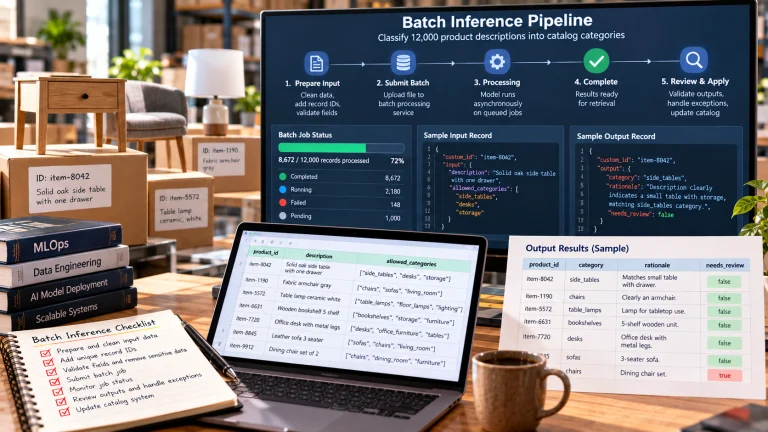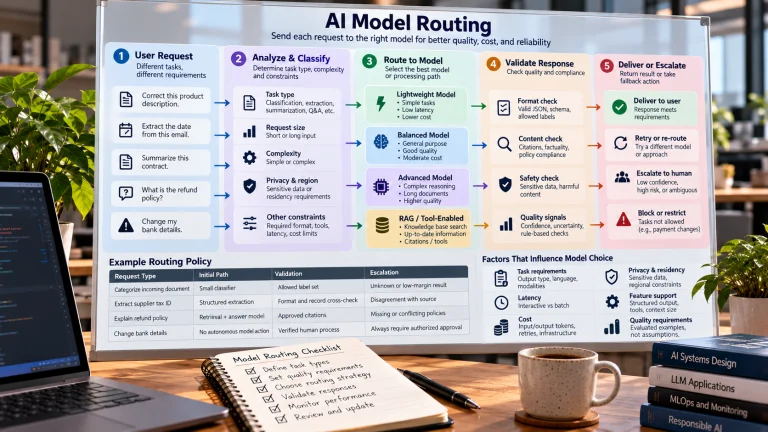
AI model releases are frequently accompanied by tables showing performance on mathematics, coding, reasoning, safety, or knowledge tests. These standardized evaluations are known as benchmarks.
Benchmarks are useful because they create a common task or dataset for comparison. But a benchmark score is not the same as a complete measure of intelligence, reliability, or suitability for a real application.
What Is an AI Benchmark?
An AI benchmark is a defined evaluation designed to measure performance on a particular capability. It may contain questions, coding tasks, images, documents, conversations, or simulated scenarios.
The model’s outputs are scored using automatic metrics, human evaluation, model-based grading, or a combination of methods.
Why Benchmarks Are Useful
Without standardized tests, model comparisons would depend entirely on anecdotes. A benchmark creates a repeatable environment in which several systems can attempt the same task.
This helps researchers measure progress, identify weaknesses, and compare design choices.
Benchmarks are also useful for tracking whether a new model version improves one capability while degrading another.
Different Benchmarks Measure Different Things
A coding benchmark does not directly measure writing quality. A mathematics test does not tell you how well the model handles customer support. A visual reasoning benchmark may say little about long-document analysis.
Model quality is multidimensional. One number cannot summarize every capability.
Accuracy Is Only One Metric
Real applications may care about latency, cost, calibration, safety, robustness, multilingual performance, tool use, refusal behavior, citation quality, or consistency.
A model that is slightly less accurate but much faster and cheaper could be the better choice for a high-volume workflow.
This is especially important when comparing small language models with larger systems.
Benchmark Contamination
A benchmark becomes less informative if its questions or very similar examples appear in training data. The model may perform well partly because it has seen the material before.
Researchers try to reduce this risk through private test sets, new evaluations, contamination analysis, and continuously refreshed tasks.
The problem is difficult because large AI training datasets can include enormous amounts of public information.
Static Benchmarks Can Become Saturated
When many leading models score near the top of a benchmark, the test loses its ability to distinguish between them. Researchers then need harder or more realistic evaluations.
Rapid AI progress makes this especially important. A benchmark that was challenging a few years ago may become routine.
Human Evaluation
Some qualities are difficult to score automatically. Humans can compare answers for helpfulness, clarity, factuality, style, or instruction following.
Human evaluation introduces its own challenges. Reviewers can disagree, preferences can vary by culture or domain, and evaluation can be expensive.
Clear rubrics and multiple reviewers help improve consistency.
Model-Based Grading
Another approach uses a strong AI model to evaluate outputs from other models. This can scale faster than human review, but the evaluator model has its own biases and errors.
Model-based grading is most useful when validated against human judgments and when the scoring rubric is explicit.
Safety and Risk Evaluations
Responsible model evaluation should include more than capability. Tests may examine harmful content, bias, privacy leakage, prompt injection, misuse, robustness, or reliability under adversarial conditions.
NIST’s AI risk-management work emphasizes testing, evaluation, verification, and validation as part of trustworthy AI practice.
Your Own Benchmark May Matter Most
A business choosing a model should create a representative evaluation set from its actual tasks. A customer support team might test real anonymized questions. A developer tool might test issues from its codebase. A research assistant might evaluate citation accuracy on documents used by the organization.
This local benchmark often predicts practical usefulness better than a general leaderboard.
Benchmarks and Reasoning Models
Reasoning models are often evaluated on difficult mathematics, coding, or scientific tasks. Higher scores can indicate stronger problem-solving capability, but organizations still need to test latency, cost, and reliability on their own workflows.
The Bottom Line
AI benchmarks are standardized tests that help compare model capabilities. They are valuable for measuring progress and identifying strengths, but every benchmark captures only part of the picture.
Use public benchmark results as evidence, not as a final buying decision. The most important evaluation is whether the model performs reliably, safely, and efficiently on the tasks you actually need it to do.
A Practical Checklist Before You Rely on Ai Benchmarks
Define the job first. Decide what success means before choosing a model or product. A system can look impressive in a demo while solving the wrong problem. Write down the expected output, the information it may use, the acceptable error rate, and which decisions still require a person.
Test representative examples. A useful first test is to build a small internal evaluation set from real tasks and compare it with public leaderboard results. Include normal cases and difficult edge cases. The goal is to learn where the system is dependable and where it needs stronger instructions, additional tools, or human review.
Verify important outputs. Do not confuse fluency with correctness. Check facts, calculations, citations, permissions, and important transformations against a reliable source. The more expensive or difficult an error would be to reverse, the stronger the verification process should be.
Review privacy and access. Understand what information is being sent to the system, where it is stored, and who can retrieve it later. Give connected AI tools only the permissions they need. Sensitive data should follow the same governance rules that apply elsewhere in the organization.
Measure value over time. Track time saved, correction rate, reliability, user satisfaction, and operational cost. A tool that feels fast during the first week may not create lasting value if people spend the same amount of time fixing its output.
Common Mistakes to Avoid
One common mistake is choosing technology before defining the workflow. Another is testing only ideal examples. Teams also tend to add automation without planning what happens when the model is uncertain, the data is missing, or a connected service fails.
The most important limitation to keep in mind is that public benchmarks can become saturated, contaminated, or poorly aligned with the work your users actually perform. Build the workflow around that reality rather than assuming future model improvements will automatically solve it.
Frequently Asked Questions
Is AI benchmarks always more accurate than a simpler approach?
No. AI is valuable when the task benefits from language understanding, pattern recognition, generation, or flexible decision support. A deterministic rule, database query, spreadsheet formula, or conventional software function can be better when the task is predictable and exact.
Do I need to understand the mathematics behind AI benchmarks?
No. A conceptual understanding is enough for most users and product decisions. Mathematics becomes more important when you are implementing, optimizing, or researching AI benchmarks at a technical level. Start with the purpose, inputs, outputs, tradeoffs, and failure modes before going deeper into equations.
What is the safest way to start using AI benchmarks?
Begin with a narrow, reversible use case. Keep source material or original data available, review the output manually, and document the situations where the system fails. Expand automation only after the workflow performs consistently on representative examples and users know how to recover when it is wrong.