
Digital innovation often rewards speed.
A team discovers a problem and quickly adds a new application.
A manual task takes too long, so someone builds an automation.
Two systems do not communicate, so a spreadsheet is placed between them.
A customer needs a new feature, so developers add another integration.
A report is difficult to produce, so someone creates a temporary workaround.
Each decision may be completely reasonable.
The problem appears later.
Six months pass.
Nobody remembers why one spreadsheet is required.
Three different applications contain customer information.
An automation depends on a field that another team renamed.
Employees have created manual steps to compensate for an integration that occasionally
fails.
A software subscription remains active even though nobody is sure who still uses it.
The organization continues moving forward, but every new improvement becomes slightly
harder.
This accumulation can be thought of as innovation debt.
Innovation debt is the hidden operational complexity created when organizations solve
digital problems quickly without fully resolving the dependencies, duplication, maintenance,
governance, or architectural consequences left behind.
Like financial debt, it is not automatically bad.
A temporary shortcut can help an organization learn quickly, respond to customers, or test
an idea without making a large investment.
The danger begins when temporary solutions quietly become permanent infrastructure.
Innovation Debt Is Not the Same as Technical Debt
The concept resembles technical debt, but the two are not identical.
Technical debt usually refers to compromises inside software development: code that was
written quickly, architecture that needs refactoring, tests that were skipped, or systems
that become harder to maintain.
Innovation debt is broader.
It can exist even when nobody is writing custom software.
A marketing team may have innovation debt because five different tools store overlapping
customer information.
A finance team may have it because an automated workflow depends on several spreadsheets
maintained manually.
A small business may have it because every new digital service has been added without
retiring the old one.
A customer-service team may have it because employees need to move between six platforms
to resolve one request.
The debt lives in the overall operating system of the organization.
It appears in tools, data, workflows, integrations, permissions, processes, and human
knowledge.
Why Digital Innovation Naturally Creates Debt
Organizations do not usually create innovation debt intentionally.
It emerges because immediate problems are often more visible than future complexity.
A customer problem needs to be solved today.
A manager needs a report this week.
A team needs a new workflow before the next campaign.
Building a temporary solution may be faster than redesigning the entire system.
That can be the correct decision.
The risk is forgetting that the temporary solution created a future obligation.
Every shortcut silently asks a question:
“Who will eventually clean this up?”
If nobody owns that question, shortcuts begin to accumulate.
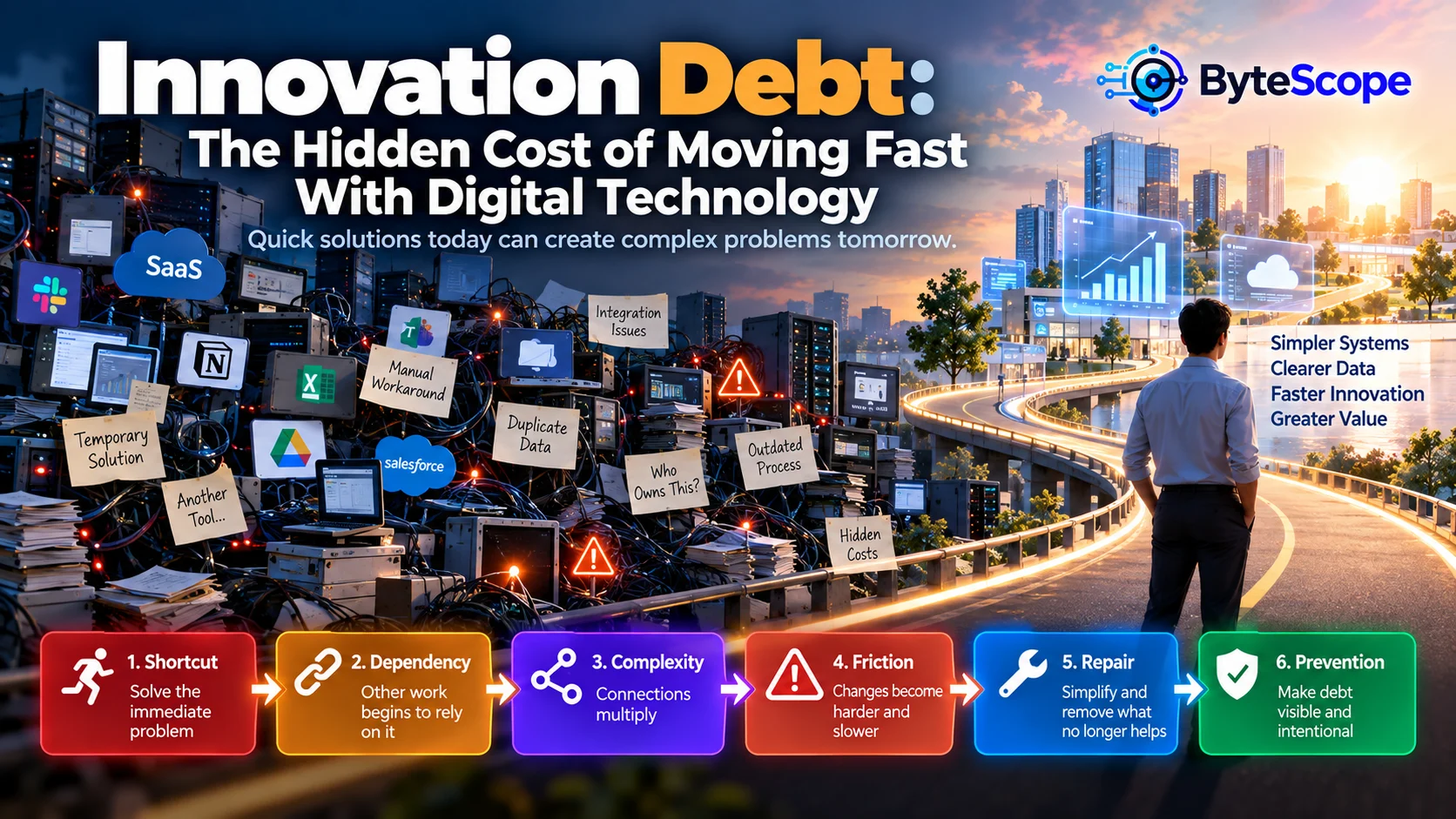
The ByteScope Innovation Debt Cycle
ByteScope uses a six-stage framework to explain how innovation debt develops:
Shortcut → Dependency → Complexity → Friction → Repair → Prevention.
The cycle begins with a reasonable short-term decision and can end in either growing
complexity or deliberate system improvement.
1. Shortcut: Solve the Immediate Problem
A shortcut is not necessarily careless.
It may be a practical response to uncertainty.
Imagine a small company receiving customer requests through several channels.
The team needs one place to track them, so someone creates a shared spreadsheet.
That may be an excellent solution.
It is inexpensive, familiar, flexible, and can be implemented immediately.
The spreadsheet becomes innovation debt only if the process grows beyond what it can
reliably support and nobody revisits the architecture.
Shortcuts are useful when they are treated as experiments.
They become dangerous when they are treated as invisible permanent infrastructure.
2. Dependency: Other Work Begins to Rely on the Shortcut
The temporary spreadsheet works well.
Soon another employee uses it to prepare weekly reports.
An automation reads new rows and sends notifications.
The finance team adds another column.
Management creates a dashboard based on the spreadsheet.
A customer-service process begins referencing its status field.
The spreadsheet has not changed much visually.
Its importance has changed dramatically.
It is now a dependency.
This is how innovation debt grows quietly.
The original tool may have been simple, but more systems and processes begin depending on
it.
Changing it becomes harder because nobody is entirely certain what will break.
3. Complexity: Connections Multiply
Once dependencies accumulate, complexity increases.
One system exports a file.
Another automation imports it.
A formula transforms the data.
Someone manually corrects exceptions.
A dashboard reads the cleaned version.
Another employee downloads the dashboard data into another spreadsheet for monthly
reporting.
Individually, every step may make sense.
Together, they create a system that is difficult to explain.
This is closely related to the hidden structure discussed in
The Hidden Architecture of Digital Innovation
.
Digital systems become fragile when data, workflows, decisions, and integrations evolve
without a clear architecture.
4. Friction: The Debt Starts Charging Interest
Innovation debt becomes visible when the organization tries to change something.
A new system needs to be introduced.
A field needs to be renamed.
A customer workflow needs to change.
A business rule needs to be updated.
Suddenly, a simple change requires investigation across multiple tools.
Teams begin asking:
- Does anything else depend on this?
- Which spreadsheet is the correct one?
- Who owns this automation?
- Why does this integration exist?
- Can we safely remove this tool?
- What happens if we change this field?
This is the “interest” on innovation debt.
The organization is paying additional effort because earlier complexity was never
resolved.
5. Repair: Simplify Before Adding More
Eventually, organizations reach a point where adding another workaround becomes more
expensive than fixing the underlying structure.
Repair may involve:
- retiring unused tools;
- consolidating duplicate data;
- rebuilding fragile automations;
- documenting important workflows;
- removing unnecessary approvals;
- replacing manual transfers with reliable integrations;
- clarifying which system owns each type of information;
- eliminating redundant reports.
Repair is not glamorous.
It rarely produces the excitement associated with launching a new AI feature or digital
platform.
But it can create more long-term innovation capacity than adding another tool.
6. Prevention: Make Debt Visible Before It Compounds
The final stage is not eliminating all innovation debt.
That would often be unrealistic.
The goal is to make debt intentional.
If a team creates a temporary solution, record:
- why it exists;
- who owns it;
- which systems depend on it;
- what limitations it has;
- when it should be reviewed.
This turns hidden debt into managed debt.
The organization can choose when to repay it instead of discovering it accidentally during
the next important change.
The First Form of Innovation Debt: Tool Sprawl
Digital tools are easier to adopt than ever.
A department can subscribe to a new application in minutes.
This accessibility is valuable.
It can also create tool sprawl.
Marketing uses one project manager.
Operations uses another.
Sales uses a separate customer platform.
Finance maintains spreadsheets.
Teams adopt different AI assistants.
Documents are stored across several services.
Each tool solves a legitimate local problem.
Collectively, they may create organizational complexity.
The problem is not the number of tools itself.
The problem is overlap without clarity.
The Tool Addition Test
Before adopting another digital product, ask five questions:
- What specific problem does this tool solve?
- Can an existing tool already solve enough of the problem?
- Which information will the new tool store?
- How will it connect with the existing workflow?
- Which existing tool or process can eventually be removed?
The fifth question is particularly useful.
If every new tool is added while nothing is ever removed, complexity almost always
increases.
The Second Form: Duplicate Data
Duplicate data is one of the most expensive forms of hidden innovation debt.
A customer record exists in the sales platform.
A second version exists in accounting software.
A third version exists in an email marketing system.
A fourth exists in a spreadsheet.
The organization now has four versions of the same customer.
The real problem appears when they disagree.
Which address is correct?
Which subscription status is current?
Which email preference should be trusted?
Duplicate data forces organizations to spend time reconciling reality.
One Concept, One Owner
A useful principle for reducing data debt is:
Every important business concept should have a clearly defined authoritative
source.
This does not mean data can exist in only one location.
Copies may be necessary for analytics, integration, performance, or operational purposes.
But teams should know which system owns the truth.
Without that rule, every integration becomes a negotiation between competing versions.
The Third Form: Automation Debt
Automation can remove repetitive work quickly.
It can also create invisible dependencies.
Imagine an automation that:
- detects a new form submission;
- creates a spreadsheet row;
- sends an email;
- creates a task;
- updates a customer record;
- notifies a messaging channel.
The workflow works perfectly for months.
Then someone changes the form field.
Part of the automation stops working.
Nobody notices immediately because the failure occurs behind the interface.
Automation debt appears when automated workflows become important but are poorly documented,
rarely monitored, or owned by nobody.
The article
When Automation Helps—and When It Hurts
explores why automation should include verification, exception handling, and human
escalation.
Those principles also reduce automation debt.
The Fourth Form: Integration Debt
Integrations allow systems to work together.
But every integration creates a relationship that needs maintenance.
APIs change.
Authentication methods change.
Fields change.
Business rules change.
A connected system may be replaced.
The more integrations an organization has, the more important it becomes to know:
- which systems are connected;
- what information moves between them;
- how often the transfer occurs;
- who owns the integration;
- how failures are detected.
An integration that nobody remembers can become a surprisingly important failure point.
The Fifth Form: Workflow Debt
Sometimes technology changes while the underlying process remains untouched.
A paper approval becomes a digital approval.
An emailed spreadsheet becomes an online form.
A manual report becomes an automated report.
The interface changes.
The workflow does not.
This creates workflow debt because outdated process assumptions remain embedded inside new
technology.
The organization becomes more efficient at performing work that may no longer need to
exist.
Digitizing a Bad Process Does Not Make It Good
Before digitizing a workflow, ask:
- Does this step still need to exist?
- Does this approval reduce meaningful risk?
- Does this information need to be collected?
- Could the system obtain this information elsewhere?
- Why is this handoff necessary?
Removing unnecessary work is often more valuable than automating it.
The Sixth Form: Knowledge Debt
Some digital systems work only because one person knows how they work.
That employee understands which spreadsheet matters.
They know which automation occasionally fails.
They remember which report must be manually corrected.
They know that one status should never be changed before another system updates.
None of this knowledge exists in documentation.
The organization has created knowledge debt.
If that person leaves, takes vacation, changes roles, or simply forgets a detail, the
system becomes difficult to maintain.
The “Only Maria Knows” Warning Sign
A simple way to detect knowledge debt is to listen for phrases such as:
- “Ask Maria; she knows how this works.”
- “Don’t touch that field.”
- “We have always done it this way.”
- “I think that spreadsheet feeds another report.”
- “Nobody knows who built that automation.”
These sentences indicate that part of the digital architecture lives inside human memory.
That is fragile infrastructure.
The Seventh Form: Customer Experience Debt
Innovation debt eventually reaches customers.
Internal complexity can produce:
- contradictory information;
- repeated requests for the same data;
- slow resolution;
- incorrect status updates;
- broken self-service workflows;
- customers being transferred between departments.
ByteScope’s
The Invisible Customer Journey
examines how internal routing, waiting, decisions, and integrations shape what customers
actually experience.
Innovation debt is often invisible internally until customers begin feeling its effects.
Why Fast-Growing Companies Are Particularly Vulnerable
Growth creates pressure.
A company may double its customers before its internal systems are ready.
Teams respond pragmatically.
They add spreadsheets.
They introduce another SaaS application.
They build quick integrations.
They create new manual roles to bridge gaps.
These solutions allow the company to continue growing.
But the operating structure may become increasingly complicated beneath the surface.
Eventually, employees spend more time coordinating systems than serving customers.
That is the moment when innovation debt begins limiting innovation itself.
Why Small Businesses Can Accumulate Debt Faster Than Expected
Innovation debt is not only an enterprise problem.
Small businesses often adopt affordable tools one at a time.
The first application solves scheduling.
The second handles email marketing.
The third manages invoices.
The fourth organizes projects.
The fifth adds AI assistance.
Each purchase may be small.
The combined system can become difficult to manage.
The
Small-Business Innovation Ladder
recommends scaling technology only after improvements have produced evidence of value.
That discipline also helps prevent unnecessary innovation debt.
Cloud Services Can Hide Complexity
Cloud software makes digital infrastructure easier to consume.
That convenience can hide dependencies.
An organization may rely on dozens of external platforms, each with its own:
- subscription;
- permissions;
- data;
- API;
- authentication;
- billing;
- security configuration;
- integration requirements.
The infrastructure feels simple because the physical servers are invisible.
Operational complexity still exists.
ByteScope’s
From Cloud to Edge: Where Digital Innovation Actually Happens
discusses how computing location creates trade-offs in cost, resilience, governance, and
maintenance.
Innovation debt adds another question:
how many external dependencies can the organization realistically understand and
govern?
Digital Twins Can Accumulate Debt Too
Advanced digital systems are not immune.
A digital twin may begin with a focused objective.
Over time, teams connect more sensors, add more data, introduce additional simulations,
and expand the model.
More detail can create value.
It can also create maintenance burden.
The earlier ByteScope article
Digital Twins Without the Hype
argued that organizations should model only the amount of reality needed to improve a
decision.
That principle also prevents innovation debt:
complexity should earn its place.
The Innovation Debt Audit
Organizations do not need a complex consulting program to begin identifying innovation
debt.
Start by creating an inventory.
Tools
Which digital tools are actively used?
Who owns each one?
Are several tools performing the same function?
Data
Where does important information live?
Which system is authoritative?
Where is data duplicated?
Automations
Which workflows run automatically?
Who receives alerts when they fail?
When were they last reviewed?
Integrations
Which systems exchange information?
Is the dependency documented?
Workflows
Where do employees still copy information manually?
Which approvals or handoffs appear unnecessary?
Knowledge
Which systems depend on knowledge held by only one person?
The Red-Yellow-Green Debt Map
After creating the inventory, classify each dependency.
Green
The system is understood, actively maintained, clearly owned, and still appropriate.
Yellow
The system works but has known limitations, overlapping functions, weak documentation, or
maintenance concerns.
Red
The system is fragile, unsupported, unclear, duplicated, or creates significant operational
risk.
The goal is not to immediately eliminate everything classified as red.
The goal is to make hidden debt visible enough to prioritize.
Not All Innovation Debt Should Be Repaid Immediately
This point is important.
Organizations have limited resources.
A temporary solution may be ugly but stable.
Replacing it could consume months of work while creating little customer or operational
value.
The correct strategy is therefore not:
“Remove all debt.”
It is:
“Repay the debt that is limiting important change.”
Prioritize debt that:
- creates frequent failures;
- affects customers;
- creates security or compliance concerns;
- requires substantial manual maintenance;
- prevents important integrations;
- makes future projects significantly slower;
- depends on unsupported technology.
The 80/20 Cleanup Strategy
A full digital redesign is rarely necessary.
Often, a small number of dependencies create most of the friction.
One duplicated customer database may cause dozens of reconciliation problems.
One fragile spreadsheet may support several critical reports.
One unreliable integration may generate repeated manual work.
One unnecessary approval may delay thousands of routine transactions.
Identify those high-leverage points first.
Innovation debt should be reduced strategically, not cosmetically.
Build a Retirement Habit
Organizations are usually good at launching technology.
They are often much worse at retiring it.
Every new system receives a project plan.
Old systems quietly remain.
A healthier digital operating model includes retirement as part of adoption.
Whenever a new platform is introduced, explicitly decide:
- which old process it replaces;
- which data needs migration;
- when the old system stops receiving new information;
- when access should be removed;
- how long historical data must be retained.
Innovation should include subtraction.
Create an Innovation Debt Budget
Teams can also treat debt as a normal part of digital planning.
Not every development cycle or operational improvement period should focus entirely on new
features.
A portion of capacity can be reserved for:
- removing outdated automations;
- documenting critical workflows;
- consolidating tools;
- improving integrations;
- cleaning duplicate data;
- simplifying permissions;
- retiring obsolete processes.
This creates continuous maintenance instead of waiting for complexity to become a crisis.
Measure Complexity, Not Just New Features
Digital teams often celebrate what they add.
New integrations.
New applications.
New automations.
New AI capabilities.
Organizations should also observe what those additions do to system complexity.
Useful indicators may include:
- number of active tools;
- number of duplicate data sources;
- manual handoffs per workflow;
- number of unsupported automations;
- integration failure frequency;
- time required to implement routine changes;
- number of applications an employee needs for one task;
- percentage of systems with clear ownership.
The objective is not to minimize every number.
It is to notice when complexity grows faster than value.
A Practical Example: The Marketing Technology Stack
Imagine a marketing team that starts with an email platform.
Later it adds:
- a landing-page builder;
- a CRM;
- analytics software;
- a social scheduling tool;
- an automation platform;
- an AI writing assistant;
- a customer data tool.
Each addition solved a real problem.
Several years later, customer attributes are defined differently across systems.
Some integrations work in only one direction.
Former employees created automations nobody understands.
Several tools contain overlapping features.
Campaign reporting requires manual reconciliation.
The company does not necessarily need another platform.
It may need architecture cleanup.
A Practical Example: The Small Service Business
A small consulting company begins with email and spreadsheets.
As it grows, it adds scheduling, invoicing, project management, cloud storage, customer
management, and AI tools.
Eventually, employees need to update a customer in three places.
Nobody is sure whether the project-management system or CRM contains the correct contact
information.
Invoices are generated digitally, but project completion is still confirmed manually
through messages.
The company has successfully digitized.
It has not necessarily simplified.
Reducing innovation debt might mean connecting fewer systems more deliberately rather than
adding another one.
AI Can Reduce Debt—and Create It
Artificial intelligence can help organizations understand documentation, analyze data,
generate code, classify information, summarize workflows, and automate repetitive tasks.
These capabilities can reduce existing complexity.
AI can also accelerate the creation of new complexity.
Employees can now build scripts, automations, agents, and content processes much faster.
The barrier to creating digital solutions is falling.
That makes governance more important, not less.
If hundreds of AI-assisted workflows are created without ownership, documentation, or
review, organizations may accumulate innovation debt faster than before.
The Innovation Speed Paradox
The most interesting consequence of innovation debt is a paradox.
Organizations move quickly to innovate.
The resulting complexity eventually makes them move slowly.
A new feature that once took one week now takes one month because developers must account
for several old integrations.
A workflow change becomes difficult because several teams depend on undocumented
spreadsheets.
A software migration is postponed because nobody knows what depends on the old system.
Innovation debt can therefore become anti-innovation infrastructure.
The shortcuts that originally increased speed eventually consume it.
Eight Questions Before Creating More Innovation Debt
Before adding another digital solution, ask:
- What problem are we solving?
- Is this a temporary experiment or intended permanent infrastructure?
- What existing tools or systems will depend on it?
- Where will its data live?
- Who owns maintenance?
- How will failures become visible?
- What existing process or tool can eventually be removed?
- When should this solution be reviewed again?
Answering these questions does not eliminate innovation debt.
It makes the debt deliberate.
Frequently Asked Questions
What is innovation debt?
Innovation debt is accumulated digital complexity created by shortcuts, overlapping tools,
duplicate data, fragile integrations, poorly documented automation, outdated workflows,
and temporary solutions that become permanent.
Is innovation debt always bad?
No. Temporary solutions can help organizations experiment, respond quickly, and avoid
large investments before requirements are clear. The risk appears when temporary
dependencies become permanent without review or maintenance.
What is the difference between innovation debt and technical debt?
Technical debt typically focuses on compromises within software engineering. Innovation
debt is broader and can include software, SaaS tools, workflows, integrations, duplicate
data, permissions, organizational processes, and undocumented human knowledge.
How can a company identify innovation debt?
Inventory important tools, data sources, automations, integrations, workflows, and
ownership. Look for duplicated systems, manual workarounds, unclear responsibility,
unsupported dependencies, repeated data entry, and processes that nobody fully understands.
Should organizations remove every old tool?
No. An older tool may still provide reliable value. The goal is not modernization for its
own sake. Organizations should prioritize systems whose cost, risk, fragility, or
complexity materially limits operations or future improvement.
Can AI create innovation debt?
Yes. AI can make it easier to create automations, scripts, agents, and digital workflows.
If those systems lack ownership, documentation, monitoring, and appropriate controls,
organizations can accumulate new forms of complexity quickly.
How often should digital systems be reviewed?
There is no universal schedule. Critical systems and fast-changing environments may need
frequent review, while stable systems can be reviewed less often. The important point is
that ownership and review should be deliberate rather than occurring only after something
breaks.
The Bottom Line
Digital innovation does not only create new capabilities.
It creates obligations.
Every tool needs ownership.
Every integration needs maintenance.
Every automation needs monitoring.
Every important dataset needs a definition.
Every shortcut eventually needs a decision:
keep it, improve it, replace it, or remove it.
The ByteScope Innovation Debt Cycle captures that progression:
Shortcut → Dependency → Complexity → Friction → Repair → Prevention.
Shortcuts allow organizations to move quickly.
Dependencies make those shortcuts important.
Complexity grows as systems connect.
Friction appears when the organization tries to change.
Repair removes the dependencies that no longer justify their cost.
Prevention makes future debt visible before it becomes difficult to manage.
The goal is not to create a perfectly clean digital environment.
Perfect architecture can become its own form of delay.
The goal is to keep complexity proportional to value.
Organizations should be able to move fast when speed matters and simplify when accumulated
shortcuts begin slowing everything down.
That balance may be one of the most important capabilities in modern digital innovation.
Because the real measure of innovation is not how quickly an organization can add new
technology.
It is whether the organization can continue changing without becoming trapped by everything
it added before.