Digital innovation can sound expensive. The phrase often brings to mind enterprise software,
consulting teams, artificial intelligence projects, cloud migrations, custom applications,
and transformation programs with budgets far beyond what a small business can reasonably
spend.
That image creates a misleading conclusion: meaningful digital innovation belongs to large
companies.
In practice, small businesses may have one important advantage. Their systems are often
smaller, decision paths are shorter, and the distance between a problem and the person who
can fix it is relatively small. A ten-person company does not need to redesign a global
technology architecture to improve the way customer requests are handled, invoices are
tracked, appointments are scheduled, or weekly reports are prepared.
The challenge is not to imitate enterprise transformation on a smaller budget. It is to
choose a different innovation strategy entirely.
For a small business, the most valuable digital improvements usually come from identifying
repeated friction, making work visible, connecting information, automating carefully, and
only investing more after the improvement proves useful.
Small Businesses Should Not Copy Enterprise Digital Transformation
Large organizations and small businesses may use many of the same technologies, but they
should not necessarily use the same transformation strategy.
An enterprise may need formal governance committees, multiple integration teams, extensive
procurement procedures, dedicated data platforms, complex security architectures, and
multiyear implementation plans. Those structures exist partly because the organization
itself is complex.
A small business may have a very different problem. The owner receives customer requests
through several channels. Staff members maintain separate spreadsheets. Important
information lives in email. Someone manually prepares the same report every Friday.
Customers wait because nobody is sure who should handle a request.
Solving those problems does not necessarily require enterprise technology.
It requires clarity.
The goal is not to build the most advanced technology environment. The goal is to create
a digital operating system that is appropriate for the size, complexity, and economics of
the business.
This connects directly with the principle discussed in
Digital Innovation Beyond New Technology
:
the technology should follow the problem rather than define it.
The Real Cost of Staying Manual
Limited budgets can make technology spending feel risky, but remaining manual also has a
cost.
The problem is that manual costs are often distributed across ordinary work, which makes
them difficult to notice.
Ten minutes spent copying information does not look like a major expense. Neither does
checking whether an invoice has been paid, sending a reminder, updating a spreadsheet,
searching an email thread, correcting a duplicate record, or recreating a report.
But repeated hundreds of times, these small actions become operational drag.
A small company may not describe this as technical debt or process inefficiency. Employees
simply say, “That is how we do it.”
Digital innovation begins by making those invisible costs visible.
Consider a three-person administrative team that spends thirty minutes every morning
combining information from email and spreadsheets. That is 7.5 hours every week. Over a
year, the business may be spending hundreds of working hours maintaining a process that
could potentially be simplified.
The relevant question is therefore not only, “How much will this tool cost?”
It is also:
“How much does the current way of working cost us?”
The ByteScope Small-Business Innovation Ladder
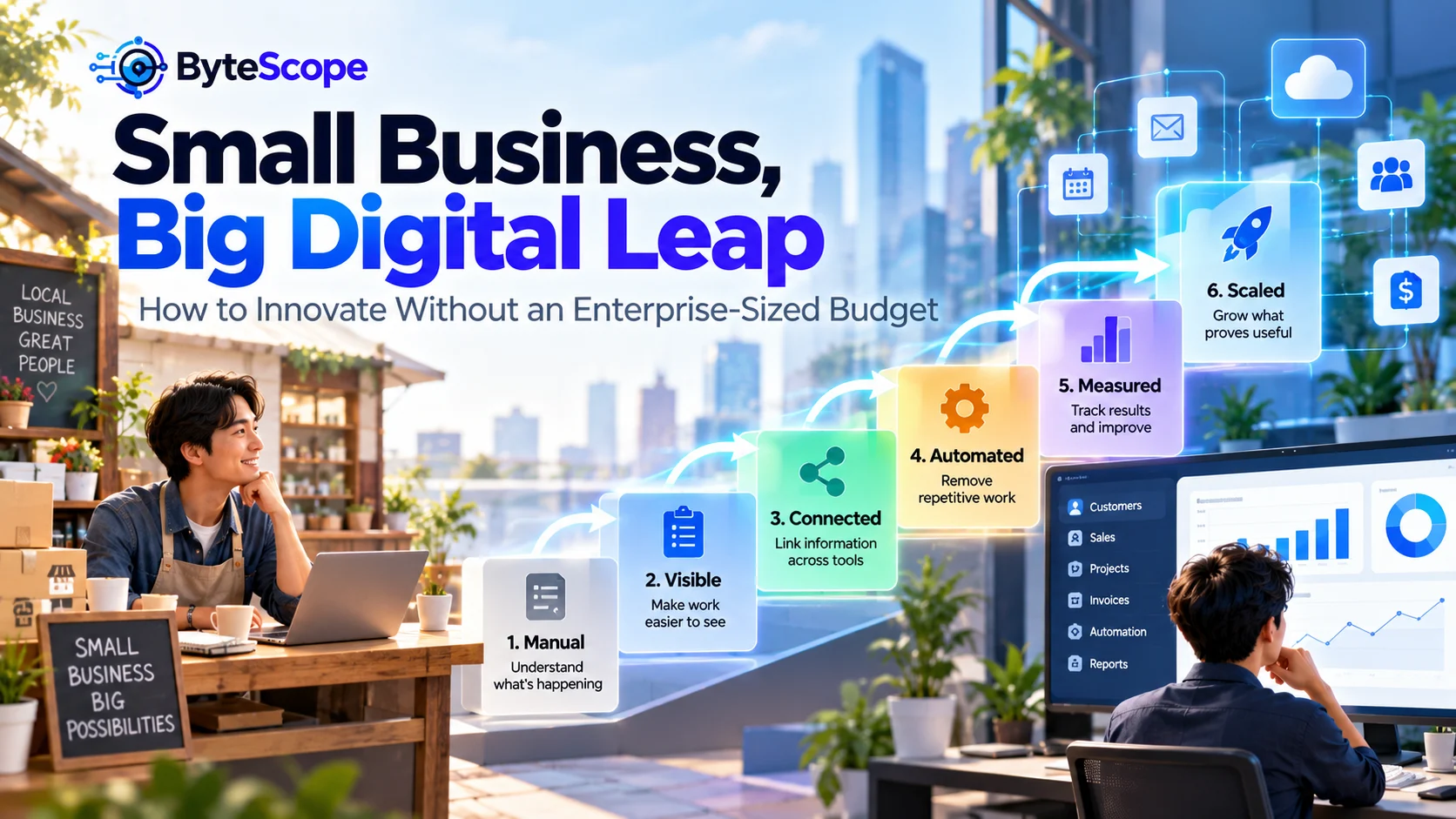
To keep digital investment proportional to business needs, ByteScope uses a six-stage model:
the Small-Business Innovation Ladder.
The ladder is:
Manual → Visible → Connected → Automated → Measured → Scaled.
The important idea is that businesses do not need to jump directly from manual work to
complex automation. Each stage solves a different problem and creates information that
helps determine whether the next stage is worthwhile.
Stage 1: Manual — Understand What Is Actually Happening
Manual work is not automatically bad.
A new business often needs manual processes because the company is still learning how work
should happen. Automating too early can lock an immature process into software before the
team understands what customers actually need.
The problem begins when a temporary manual method becomes permanent without being examined.
Suppose an employee receives orders through messaging apps, writes them into a spreadsheet,
checks inventory manually, prepares invoices, and contacts customers individually.
Before purchasing software, the business should map that workflow.
Where does information enter? Where is it copied? Which steps are repeated? Which decisions
are predictable? Which parts frequently create errors? What information does the employee
have to search for?
The purpose of this stage is observation.
A process should become understandable before it becomes digital.
Stage 2: Visible — Make Work Easier to See
One of the cheapest digital improvements is visibility.
A business may not need automation yet. It may simply need one reliable place to see what
is happening.
Instead of tracking customer requests through personal messages, the company might use a
shared list with clear statuses. Instead of asking which invoices remain unpaid, the team
might maintain one standardized record. Instead of keeping project deadlines in different
calendars, tasks might be organized in one shared workspace.
Visibility reduces coordination cost.
People spend less time asking questions such as:
“Has this been handled?”
“Who owns this?”
“Which version is correct?”
“What is waiting?”
This stage also creates a foundation for future automation because the workflow begins to
develop consistent states.
A simple status such as New → In Progress → Waiting → Complete can eventually become
the logic that drives notifications, dashboards, or automated actions.
Stage 3: Connected — Stop Making People Move Information Between Systems
Once work is visible, the next source of friction is often disconnected information.
Small businesses frequently operate through several affordable applications. A website
collects leads. Email handles communication. A spreadsheet tracks customers. Accounting
software records payments. Cloud storage holds documents.
Each tool may work perfectly on its own.
The problem appears between them.
If an employee repeatedly copies customer information from a website into a spreadsheet,
downloads attachments from email, creates folders manually, and later re-enters the same
information into an accounting system, the employee has become the integration.
The second ByteScope Digital Innovation article,
The Hidden Architecture of Digital Innovation
,
explores why these connections between data, workflows, decisions, and systems matter.
For a small business, integration does not have to mean custom engineering.
Many modern services can exchange information through built-in integrations, automation
platforms, imports, exports, or APIs. The goal is to remove repeated movement of information
where doing so is reliable and economical.
One useful rule is:
information should be entered once whenever practical.
Stage 4: Automated — Automate Repetition, Not Confusion
Automation is where digital innovation becomes particularly attractive, but it is also
where businesses can waste money.
The wrong approach is to search for everything that can technically be automated.
The better approach is to identify tasks that are frequent, predictable, and sufficiently
stable.
Good early candidates may include sending confirmation messages, assigning routine tasks,
generating reminders, updating statuses, preparing recurring reports, copying standardized
data between systems, or notifying someone when a condition is met.
Bad automation candidates often involve unclear rules, frequent exceptions, high-risk
decisions, or processes that change every week.
Automation should reduce human effort without removing useful human judgment.
Artificial intelligence can expand the types of work that software can assist with, but
small businesses should still distinguish between deterministic automation and AI-assisted
work.
Understanding
how artificial intelligence works
can help teams decide when AI capabilities such as language understanding or pattern
recognition provide genuine value and when a simple rule is sufficient.
Stage 5: Measured — Find Out Whether the Improvement Actually Worked
A digital improvement should produce evidence.
Small businesses often skip this step because the new process feels obviously better.
That can be misleading.
The team may feel that a new application saves time while customers experience more
confusion. Automation may reduce manual tasks while introducing more errors. A dashboard
may provide more information without changing any decisions.
Measurement does not need to become a large analytics program.
Choose one or two indicators connected to the original problem.
If the problem was slow customer response, measure response time.
If the problem was duplicate work, measure how many manual entries were removed.
If the problem was missed follow-ups, measure the number of overdue cases.
If the goal was better conversion, compare the percentage of inquiries that become
customers.
Tools such as
AI data analysis tools
can help users explore data and interpret patterns, but small businesses do not need
complex analytics to begin learning from their own operations.
A simple measurement that changes a decision is more valuable than a sophisticated dashboard
that nobody uses.
Stage 6: Scaled — Invest More Only After Value Becomes Visible
Scaling should be the result of evidence rather than optimism.
Once a digital improvement consistently saves time, reduces errors, increases revenue, or
improves customer experience, the business has a stronger basis for investing further.
Perhaps a shared spreadsheet should become a proper customer database. A lightweight
automation may need more robust workflow management. A manual analysis process may justify
a dedicated analytics platform.
This is different from buying an expensive system first and hoping the organization
eventually discovers enough value to justify it.
The ladder allows technology spending to follow operational evidence.
How to Choose the First Workflow to Improve
Small businesses usually have more possible improvement ideas than available time or money.
The first digital project therefore matters.
A useful candidate has four characteristics: it happens frequently, causes noticeable
friction, follows reasonably consistent steps, and produces an outcome that can be
measured.
Consider several examples.
A weekly report that takes three hours to prepare is attractive because the task is
repetitive and measurable.
Customer inquiries that frequently disappear between email and messaging apps are attractive
because the business cost is visible.
A complicated negotiation process that differs for every customer may be less suitable for
early automation because the workflow contains substantial judgment.
The best first project is rarely the most impressive one.
It is the one most likely to teach the business how to improve digitally.
A Practical Example: A Five-Person Service Business
Imagine a five-person repair company.
Customers contact the business by phone, website form, and messaging app. One employee
records requests in a spreadsheet. Technicians receive assignments through messages.
Customers call again to ask about status. At the end of each week, the owner manually
calculates completed jobs and outstanding payments.
The company assumes it needs expensive industry software.
The Innovation Ladder suggests another path.
Manual
The team maps the current process and discovers that the biggest problem is not scheduling.
It is that customer information and job status exist in several places.
Visible
The business creates one shared job record with standardized statuses such as
New, Scheduled, In Progress, Waiting for Parts, Complete.
Connected
Website submissions automatically create new records. Staff no longer copy the same
customer information manually.
Automated
When a job changes to “Scheduled,” the customer receives a confirmation. When a job remains
“Waiting for Parts” for several days, the system alerts the office.
Measured
The owner tracks average completion time, overdue jobs, and the number of customers who
need to call for status updates.
Scaled
After several months, the company knows which features matter. It can now evaluate more
advanced field-service software based on actual operational requirements rather than
generic feature lists.
The digital leap happened gradually, but each step removed real friction.
Use Existing Tools Before Buying More Tools
A common small-business mistake is assuming innovation always requires another subscription.
Many businesses already possess capabilities they are barely using.
A productivity suite may include forms, shared storage, calendars, automation, spreadsheets,
permissions, and dashboards. Accounting software may already offer payment reminders.
A customer platform may contain workflow features that were never configured.
Before purchasing something new, ask:
Can an existing system solve 80 percent of this problem?
The answer will not always be yes. But when it is, the company avoids additional cost,
training, integration, and maintenance.
This principle is especially useful with spreadsheets. They are not appropriate for every
system, but they remain powerful for experimentation and lightweight operations.
Modern
AI spreadsheet tools
can help users create formulas, summarize information, clean data, and explore patterns,
making familiar software more capable before the business commits to a larger platform.
Avoid the Subscription Stack Trap
Low-cost software can become expensive when multiplied across dozens of services.
A business may subscribe separately to project management, scheduling, email marketing,
customer management, automation, analytics, AI writing, cloud storage, invoicing, and
communication platforms.
Each monthly price looks manageable.
The combined system may not be.
Cost is only one problem. More tools also create more passwords, permissions, data stores,
training needs, integrations, and opportunities for information to become inconsistent.
A useful technology stack should minimize unnecessary overlap.
When evaluating a new tool, ask what existing tool it replaces. If the answer is “none,”
the business should have a clear reason for adding another layer.
Cheap Technology Can Still Be Expensive
Purchase price is not the same as total cost.
A free tool can become expensive if employees spend hours maintaining it, correcting
errors, or working around its limitations. A low-cost platform can become costly if
information cannot be exported when the business grows.
Small businesses should consider at least five forms of cost:
financial cost, setup time, training time, maintenance effort, and switching cost.
The cheapest tool is not necessarily the tool with the lowest subscription price.
It is the one that delivers the required outcome with an acceptable total burden.
Where AI Can Help a Small Business
Artificial intelligence can make certain capabilities accessible to small businesses that
previously required specialized employees or significant software investment.
AI can assist with drafting, summarizing, document analysis, data exploration, translation,
meeting notes, research, customer-service preparation, coding, and content production.
But small businesses should avoid turning AI adoption into a collection of unrelated
experiments.
The best AI use cases connect directly to existing workflows.
For example, an employee who spends thirty minutes after every meeting preparing action
items may benefit from an AI meeting assistant. A team processing large amounts of customer
feedback may benefit from AI-supported classification or summarization.
The useful question remains:
Which recurring friction does this capability remove?
AI should enter the Innovation Ladder as part of the solution, not as a separate innovation
strategy.
Know What Should Stay Human
Small businesses often compete through relationships, flexibility, and specialized
knowledge. Excessive automation can weaken those strengths.
A customer may appreciate an immediate automated confirmation while still wanting a person
to handle a complicated complaint.
A system can prepare a proposal while a professional determines the recommendation.
AI can summarize a contract while a qualified person evaluates its implications.
The purpose of digital innovation is not to minimize the number of humans involved. It is
to minimize low-value friction so human attention can be used where it matters most.
Do Not Automate High-Risk Actions Too Early
The consequences of an error should influence how aggressively a business automates.
Sending the wrong internal reminder may be inconvenient. Sending the wrong payment,
deleting important customer data, or making an inappropriate high-impact decision can be
far more serious.
Higher-risk workflows need stronger controls.
These may include approval thresholds, confirmation steps, restricted permissions, logs,
backups, and human review.
When AI is involved, the same principle applies. ByteScope’s
Responsible AI guide
explores why reliability, privacy, safety, accountability, and human oversight should be
built into AI use rather than treated as an afterthought.
Digital Innovation Is Also About Customer Friction
Internal efficiency is only half of the opportunity.
Small businesses should also examine how customers interact with them.
Where do customers wait unnecessarily? Which information do they provide more than once?
Which questions generate repeated phone calls? Which steps are confusing? Where do people
abandon the process?
A digital innovation might be as simple as improving an online form, providing status
updates, creating clearer appointment scheduling, or offering a self-service option for a
routine request.
Customer-facing improvements can be powerful because they create value on both sides.
Customers gain convenience while employees spend less time handling predictable
administrative work.
Build Reversible Experiments
Small businesses have limited resources, which makes reversibility valuable.
A digital experiment should ideally be inexpensive to test and easy to change if assumptions
prove wrong.
Instead of rebuilding an entire customer workflow immediately, test a new intake process
with one service category.
Instead of automating every report, automate the most repetitive one first.
Instead of purchasing annual licenses for an entire team, test the tool with the employees
who will actually use it.
Reversible experiments turn uncertainty into learning without making every decision
permanent.
The One-Month Digital Innovation Test
A small business can begin with a simple thirty-day experiment.
During the first week, choose one repeated process and document how it currently works.
Track how much time it consumes and where errors or delays appear.
During the second week, remove unnecessary steps and create one shared source of information.
Do not automate anything that the team does not yet understand.
During the third week, connect or automate one predictable handoff.
During the fourth week, compare the new process with the old one.
Did employees save time? Did customers wait less? Were errors reduced? Did another problem
appear?
At the end of the month, the business has more than a new tool. It has evidence about how
digital change works inside its own operation.
What Small Businesses Should Measure
Small-business measurement should remain practical.
Revenue matters, but not every digital improvement immediately increases sales.
Operational indicators can show whether the foundation is becoming stronger.
Useful measures can include time per task, number of manual handoffs, response time, error
rate, overdue work, customer follow-up requests, completion rate, and hours spent preparing
reports.
The important discipline is connecting each metric to the original problem.
Do not measure something simply because the software can display it.
When It Is Time to Spend More
There are moments when a small business should move beyond inexpensive tools.
The clearest signal is not company size by itself. It is operational strain.
A more capable system may become necessary when manual work starts increasing rapidly,
existing tools cannot manage permissions safely, information volume exceeds the current
structure, integrations become unreliable, or employees spend substantial time maintaining
workarounds.
Another signal is proven economic value.
If a lightweight solution saves forty employee hours every month, investing in a more
robust version becomes easier to justify.
In that situation, technology spending is no longer speculative. It is supported by
operational evidence.
Five Mistakes That Make Small-Business Digital Innovation More Expensive
Buying Before Mapping the Process
Software cannot fix a workflow the business has not understood.
Automating Every Possible Step
Automation should target repetitive friction. Some decisions are better left flexible or
human.
Adding Tools Without Removing Anything
A new platform should simplify the technology environment or create enough value to
justify additional complexity.
Ignoring Data Ownership
Teams need to know where important information lives and which version should be trusted.
Scaling Before Measuring
A pilot that feels successful is not enough. Measure the outcome before expanding the
system.
Frequently Asked Questions
Is digital innovation expensive for small businesses?
It does not have to be. Many valuable digital improvements begin with process redesign,
shared information, existing software, simple integrations, or lightweight automation.
The cost rises when the business needs greater scale, security, customization, or
complexity.
What is the best first digital project for a small business?
Choose a process that happens frequently, creates noticeable friction, follows fairly
consistent steps, and can be measured. Repeated reporting, lead handling, appointment
scheduling, customer follow-up, and internal approvals are common examples.
Should a small business use AI?
AI can be useful when a workflow involves language, pattern recognition, summarization,
prediction, or content generation. Businesses should start with a real problem and determine
whether AI solves it better than a simpler alternative.
Should small businesses automate as much as possible?
No. Automation is most useful for predictable, repetitive work. High-risk, unusual, or
context-dependent decisions may still require human judgment. The goal is better allocation
of human attention, not automation for its own sake.
How can a business know whether digital innovation is working?
Measure the result connected to the original problem. This may include time saved, fewer
errors, faster response, fewer manual handoffs, increased completion rates, or improved
customer outcomes.
When should a small business replace spreadsheets with dedicated software?
Consider moving beyond spreadsheets when access control becomes difficult, data volume
grows significantly, multiple people overwrite information, complex automation is needed,
or maintaining the workbook requires substantial manual effort.
The Bottom Line
Small businesses do not need enterprise-sized budgets to innovate digitally. They need a
disciplined way to decide what deserves improvement.
The ByteScope Small-Business Innovation Ladder offers one path:
Manual → Visible → Connected → Automated → Measured → Scaled.
The sequence matters.
Understand the process before digitizing it. Make work visible before automating it.
Connect information before asking software to make more decisions. Measure improvements
before investing in scale.
This approach changes digital innovation from a large technology purchase into a series of
small operational experiments.
Some experiments will fail. Others will save minutes. A few may transform how an important
part of the business operates.
What matters is that each improvement produces knowledge.
A small company may never have the technology budget of a global enterprise, but it does
not need one to build better systems. Its advantage can come from moving carefully,
learning quickly, and investing where evidence shows that technology genuinely improves
the business.
That is how a small business makes a big digital leap: not by purchasing the most technology,
but by making every layer of technology earn its place.