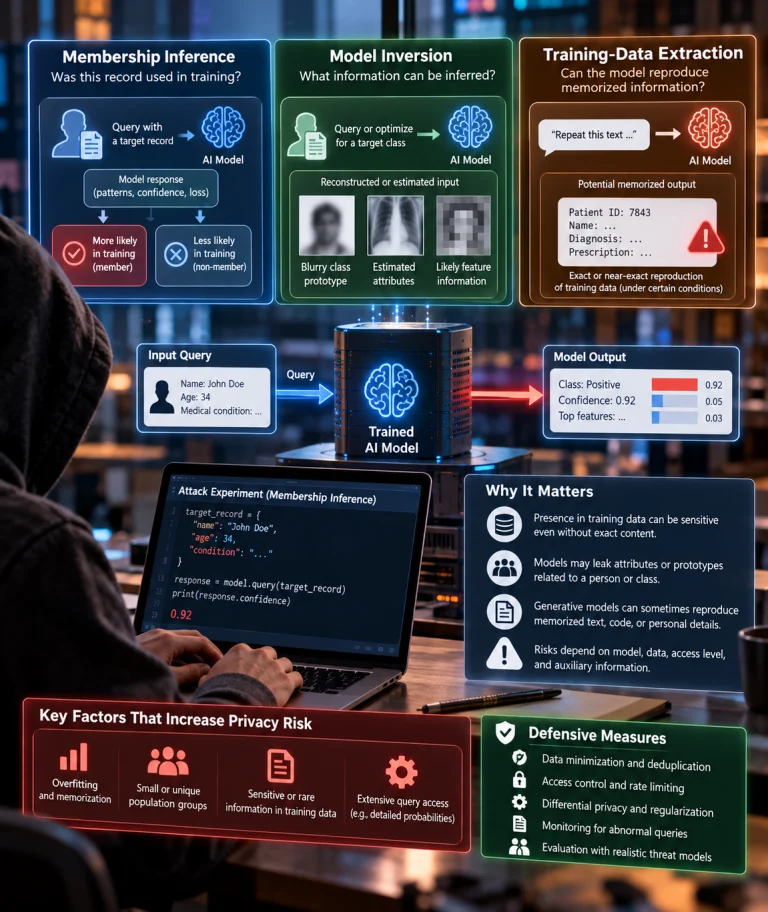
AI systems can generate useful content, make recommendations, search information, and take actions through connected tools. Those capabilities also create risk. AI guardrails are controls designed to reduce unsafe, unwanted, or unauthorized behavior.
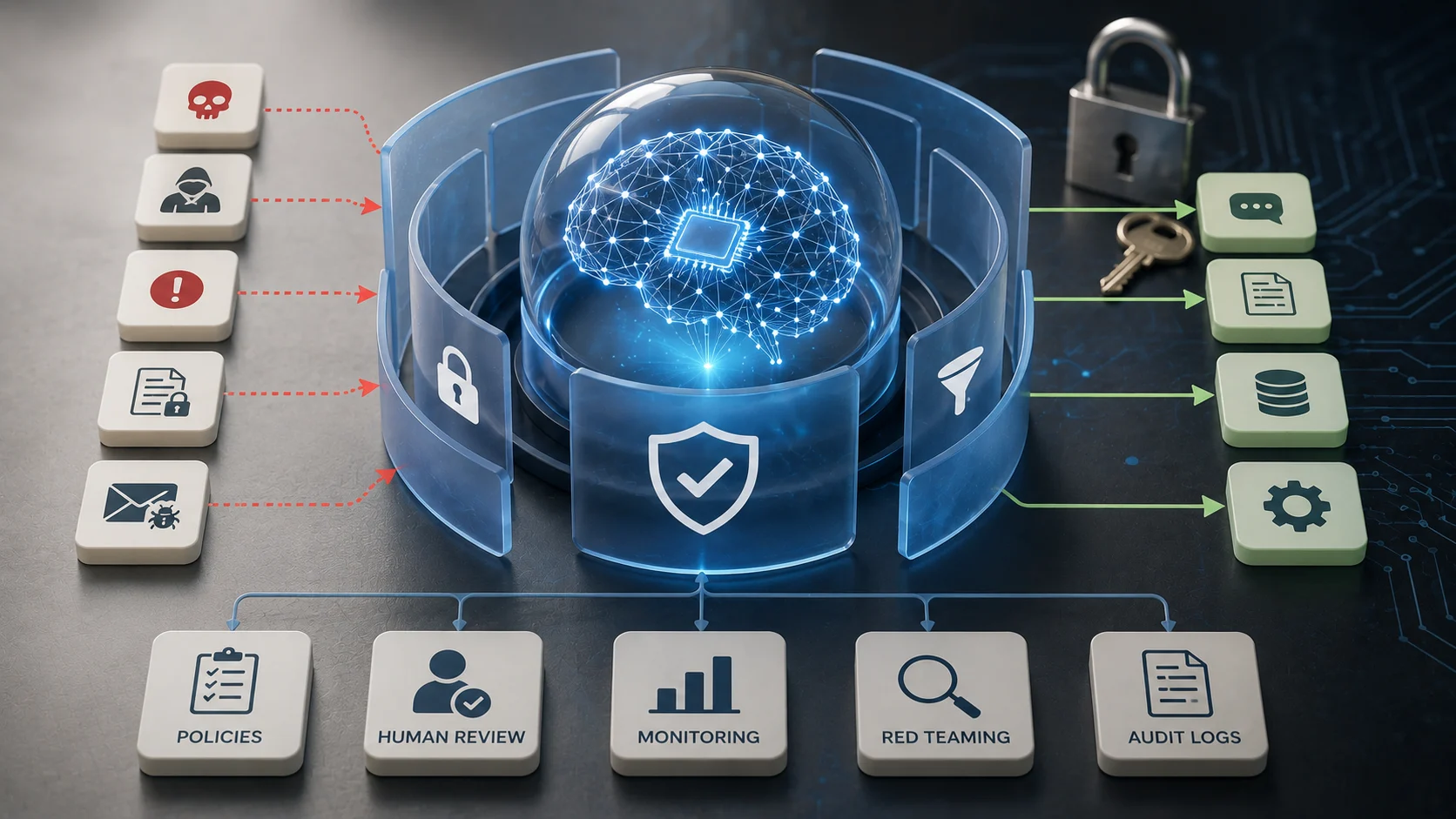
A guardrail is not one specific technology. Effective systems usually use several layers: policies, model instructions, content filters, permissions, validation, monitoring, and human oversight.
Why AI Needs Guardrails
Generative models are probabilistic. They can misunderstand instructions, produce harmful material, reveal sensitive information, or take an inappropriate action when connected to tools.
Guardrails help define what the system is allowed to do and create checks before or after model generation.
Policy Is the Starting Point
Before building technical controls, an organization needs a clear definition of acceptable behavior. What content is prohibited? Which users can access which data? When must the AI escalate to a human? Which actions require confirmation?
Technical safeguards are difficult to design if the policy itself is vague.
Input Guardrails
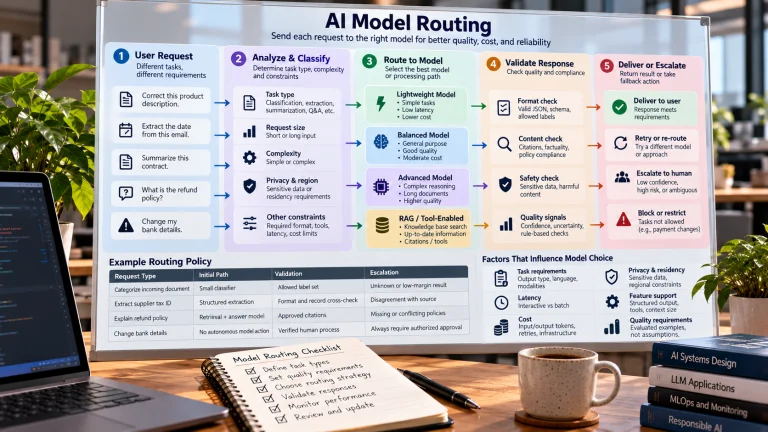
Input controls inspect requests before they reach the main model or tool. They may detect unsafe content, prompt injection attempts, secrets, personal information, prohibited topics, or malformed requests.
An application can block, rewrite, classify, or route the request depending on the risk.
Output Guardrails
Output controls inspect what the model produced. They may check for unsafe content, unsupported claims, sensitive information, invalid formatting, or policy violations.
For structured workflows, developers can validate the output against a schema rather than accepting arbitrary text.
Tool Permissions
Guardrails become even more important when an AI agent can send email, modify files, update a database, or make purchases.
The agent should receive only the permissions it needs. High-impact actions can require explicit user confirmation. Read-only access is safer than write access when the task does not require modification.
Human-in-the-Loop Review
Some decisions should not be fully automated. A human reviewer may approve a transaction, verify a medical summary, check a legal document, or confirm a destructive system change.
Human oversight is especially useful when the action is difficult to reverse or when the cost of an error is high.
Grounding and Retrieval
RAG can function as one part of a guardrail strategy by limiting answers to approved knowledge sources and providing citations.
This does not guarantee correctness, but it can reduce unsupported guessing and make verification easier.
Monitoring and Logging
Guardrails should not end when the system is deployed. Logs can reveal repeated failures, suspicious usage, unsafe prompts, tool errors, and unexpected model behavior.
Monitoring helps teams discover risks that were not obvious during testing.
Red Teaming
Red teaming deliberately tries to make the system fail. Testers search for ways to bypass safety instructions, extract sensitive information, create harmful outputs, or misuse connected tools.
This adversarial testing can reveal weaknesses before real users find them.
Guardrails Can Fail
No filter or policy is perfect. Attackers can adapt prompts, models can misclassify content, and legitimate requests can be blocked by overly strict safeguards.
Guardrails should therefore be layered. If one control fails, another may still reduce the impact.
Safety vs. Usefulness
A system that refuses everything is safe but useless. A system that allows everything is flexible but risky. Product teams need to balance helpfulness with acceptable risk for the specific domain.
This balance may differ between a creative writing tool and a system that controls industrial equipment.
Guardrails and Responsible AI
Technical controls are only one part of responsible AI. Governance, documentation, fairness, privacy, evaluation, accountability, and user communication also matter.
NIST’s AI Risk Management Framework encourages organizations to manage AI risk throughout design, development, deployment, and use rather than relying on one final safety layer.
The Bottom Line
AI guardrails are the policies and technical controls used to keep AI behavior within acceptable boundaries. They can include input screening, output validation, permissions, retrieval, human review, monitoring, and adversarial testing.
The most reliable approach is layered. Guardrails reduce risk, but they do not make an AI system infallible. Teams still need ongoing evaluation and clear responsibility for what happens when safeguards fail.
A Practical Checklist Before You Rely on Ai Guardrails
Define the job first. Decide what success means before choosing a model or product. A system can look impressive in a demo while solving the wrong problem. Write down the expected output, the information it may use, the acceptable error rate, and which decisions still require a person.
Test representative examples. A useful first test is to test normal requests, ambiguous requests, adversarial prompts, and high-impact actions to see which controls activate. Include normal cases and difficult edge cases. The goal is to learn where the system is dependable and where it needs stronger instructions, additional tools, or human review.
Verify important outputs. Do not confuse fluency with correctness. Check facts, calculations, citations, permissions, and important transformations against a reliable source. The more expensive or difficult an error would be to reverse, the stronger the verification process should be.
Review privacy and access. Understand what information is being sent to the system, where it is stored, and who can retrieve it later. Give connected AI tools only the permissions they need. Sensitive data should follow the same governance rules that apply elsewhere in the organization.
Measure value over time. Track time saved, correction rate, reliability, user satisfaction, and operational cost. A tool that feels fast during the first week may not create lasting value if people spend the same amount of time fixing its output.
Common Mistakes to Avoid
One common mistake is choosing technology before defining the workflow. Another is testing only ideal examples. Teams also tend to add automation without planning what happens when the model is uncertain, the data is missing, or a connected service fails.
The most important limitation to keep in mind is that no single filter is reliable enough to serve as the only safety layer. Build the workflow around that reality rather than assuming future model improvements will automatically solve it.
Frequently Asked Questions
Is AI guardrails always more accurate than a simpler approach?
No. AI is valuable when the task benefits from language understanding, pattern recognition, generation, or flexible decision support. A deterministic rule, database query, spreadsheet formula, or conventional software function can be better when the task is predictable and exact.
Do I need to understand the mathematics behind AI guardrails?
No. A conceptual understanding is enough for most users and product decisions. Mathematics becomes more important when you are implementing, optimizing, or researching AI guardrails at a technical level. Start with the purpose, inputs, outputs, tradeoffs, and failure modes before going deeper into equations.
What is the safest way to start using AI guardrails?
Begin with a narrow, reversible use case. Keep source material or original data available, review the output manually, and document the situations where the system fails. Expand automation only after the workflow performs consistently on representative examples and users know how to recover when it is wrong.