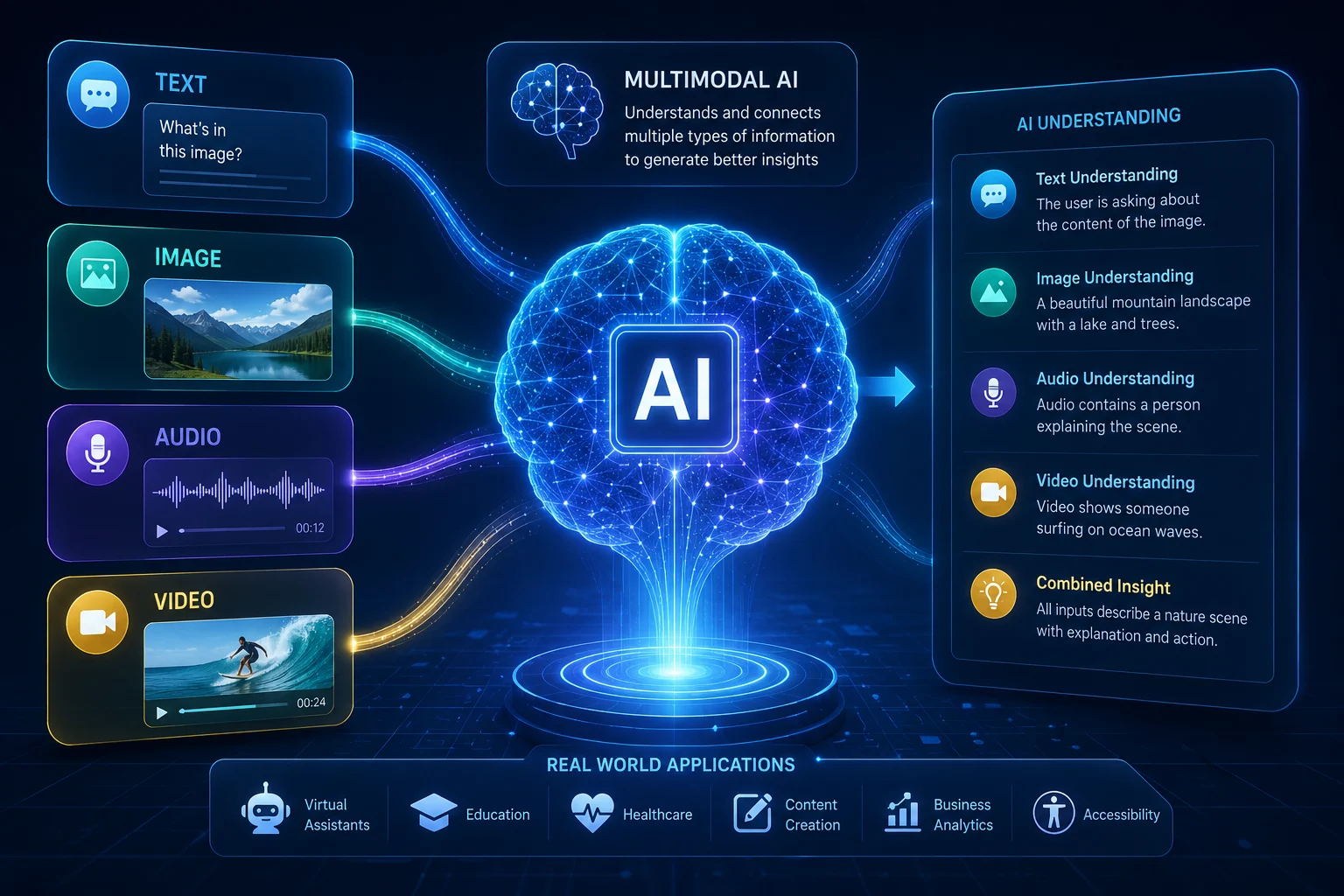
Artificial intelligence used to be discussed as if every system handled one kind of information at a time. A text model processed words, an image model analyzed pictures, and a speech system worked with audio. Multimodal AI changes that picture by allowing a model or a connected AI system to work across several types of input.
A multimodal system might read a written question, inspect a photo, listen to an audio clip, and use all of those signals to produce one response. This makes AI feel more natural because people also understand the world through several forms of information at once.
What Does Multimodal Mean?
In AI, a modality is a type of information. Common modalities include text, images, audio, video, sensor data, and structured numerical data. A multimodal model is designed to accept or reason across more than one of these forms.
The important idea is not simply that one application has several tools. The deeper goal is to connect information from different formats so the system can interpret relationships between them. For example, a model may need to understand that a sentence refers to an object visible in an image or that a spoken instruction describes an action occurring in a video.
This is a natural extension of the concepts covered in large language models, but multimodal systems expand beyond language alone.
How Multimodal AI Represents Different Inputs
Text, pixels, and audio samples look very different to a computer. Before a model can work with them together, each type of input must be converted into numerical representations the model can process.
Text is usually broken into tokens. Images may be divided into patches or encoded by a vision component. Audio can be represented through waveforms, spectrogram-like features, or learned audio representations. Video adds another dimension because the system must interpret both visual content and changes over time.
Modern architectures can map these representations into compatible internal spaces. Once that happens, the model can relate information across modalities rather than treating each input as completely separate.
Why Combining Modalities Is Useful
Many real tasks are naturally multimodal. A user troubleshooting a device may describe a problem in text and attach a photo. A student may ask a question about a diagram. A researcher may want a model to examine a chart while reading the surrounding report.
In these situations, requiring the user to translate everything into text would remove useful information. Multimodal AI can work directly with the source material and preserve visual, acoustic, or spatial context that might otherwise be lost.
This capability is especially useful when combined with AI agents, because an agent may need to interpret screenshots, documents, voice commands, and web content while completing a task.
Text and Image Understanding
Text-and-image systems are among the most common examples of multimodal AI. They can describe images, answer questions about visual content, compare screenshots, explain diagrams, and extract information from photographed documents.
The challenge is that visual understanding requires more than object recognition. A useful system may need to interpret relationships, count elements, read labels, recognize layout, and connect what it sees with the user’s written request.
Quality can vary depending on image resolution, clutter, unusual visual styles, and whether the task requires precise spatial reasoning. A confident visual answer should therefore still be checked when accuracy matters.
Audio and Speech as AI Inputs
Audio adds information that text alone may not preserve. Speech includes words, but it can also contain timing, pauses, emphasis, and speaker differences. Multimodal systems may use audio for transcription, translation, meeting analysis, voice interfaces, or media understanding.
Some models can work with speech directly, while other systems first convert audio to text and then send the transcript to a language model. The first approach may preserve more information; the second can be simpler to build and easier to inspect.
Video Adds Time and Motion
Video is more demanding because the model must understand many frames and how they relate over time. A single frame may not reveal what happened before or after it. Meaning can depend on motion, sequence, and changes across a scene.
Useful video applications include summarizing recordings, finding moments in long footage, answering questions about demonstrations, and supporting creative workflows. However, processing long videos can require substantial computation and careful context management.
Multimodal Generation
Multimodal AI is not limited to understanding. Some systems can also generate several kinds of output. A user might provide text and an image, then ask for a redesigned visual. Another workflow may turn text into speech or generate video from a written description and reference image.
This connects multimodal AI with generative AI. The distinction is that multimodality describes the types of information a system can accept or produce, while generative AI describes the ability to create new content.
Where Multimodal AI Can Go Wrong
More input types create more opportunities for misunderstanding. A model may misread small text in an image, confuse speakers in an audio recording, overlook a critical frame in a video, or connect two pieces of information incorrectly.
Multimodal models can also produce the same kind of confident errors described in our guide to AI hallucinations. Visual or audio evidence does not automatically make an answer correct.
Privacy matters too. Photos, recordings, and videos can contain sensitive personal information that is not obvious at first glance. Users should understand what they are uploading and how the service handles that data.
Why Multimodal AI Matters
Multimodal AI moves computing closer to the way real-world tasks are presented. People do not communicate only through typed sentences, and useful information is often spread across documents, images, conversations, charts, and recordings.
As models become better at combining these sources, AI applications can become more flexible and less dependent on users manually converting information into a single format.
The Bottom Line
Multimodal AI is artificial intelligence that can work across multiple forms of information such as text, images, audio, and video. It does this by turning different inputs into numerical representations that can be connected inside one model or system.
The capability opens the door to richer assistants, more useful document and media analysis, and more natural human-computer interaction. At the same time, users should continue to verify important results because multimodal systems can still misinterpret what they see, hear, or read.