
Artificial intelligence is moving beyond systems that simply answer questions. A growing class of AI products can now break a goal into steps, choose tools, act on information, check what happened, and continue working until the task is finished. These systems are commonly called AI agents.
The idea can sound more futuristic than it really is. An AI agent is not a digital person with unlimited independence. In practical terms, it is usually an AI model connected to instructions, tools, data, and a loop that lets it decide what to do next. That combination can make the system far more useful than a basic chatbot, especially for tasks that require several actions rather than one response.
What Is an AI Agent?
An AI agent is a system that uses an AI model to pursue a goal through a sequence of decisions and actions. Instead of receiving one prompt and returning one final answer, an agent can repeatedly evaluate the situation, choose a next step, use a tool, observe the result, and adjust its plan.
This is the main difference between an agent and a conventional chatbot. A chatbot usually waits for the user to ask something, generates a response, and stops. An agent may continue operating after the first instruction because the task itself requires multiple stages. For example, an agent asked to prepare a market brief might search for current information, compare sources, organize findings, draft a summary, and revise the result before returning it.
Not every multi-step AI system is fully autonomous. Some are tightly controlled workflows in which the path is predefined by software. Others allow the model to decide dynamically which tools and steps are needed. In practice, many useful systems sit somewhere between those two extremes.
How AI Agents Work
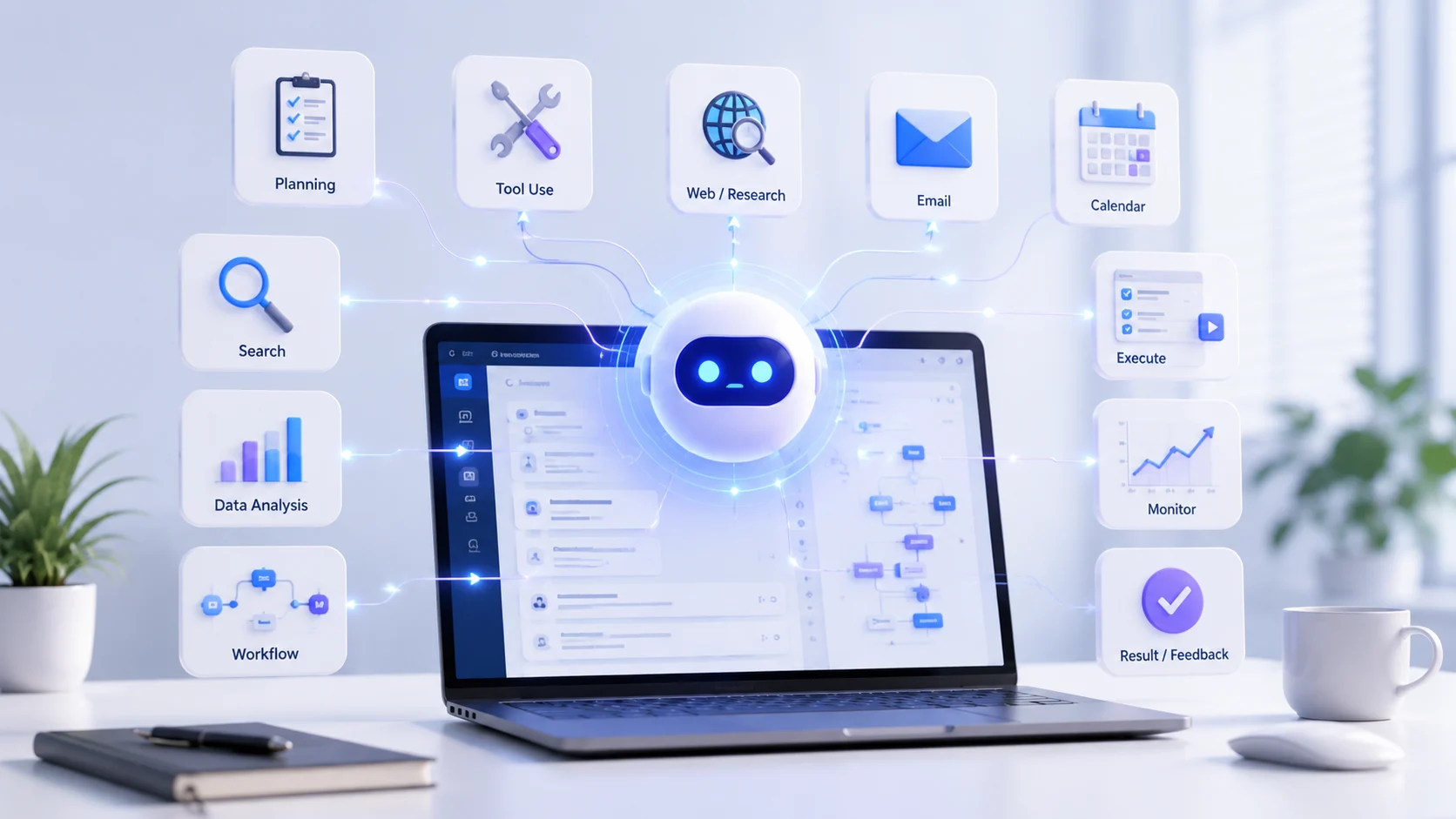
Most agents are built from several familiar AI components rather than one mysterious technology. The central component is usually a large language model that interprets the goal and decides what to do next. The model may then be connected to tools such as web search, databases, file systems, code execution, email, calendars, or business software.
A simple agent loop often looks like this: understand the task, plan a useful next action, perform that action, observe the result, and decide whether the goal has been reached. If not, the system continues. This cycle can be described as plan, act, observe, adjust.
Memory and context can also matter. An agent may need to remember earlier steps, user preferences, intermediate results, or constraints. However, more memory is not always better. Irrelevant context can make decisions less reliable, so good agent design involves deciding what information the model truly needs at each stage.
Tools Make Agents Action-Oriented
A language model by itself mainly produces outputs such as text, structured data, or code. Tools allow an agent to interact with the outside world. A research agent might use web search and document retrieval. A coding agent might inspect files, run tests, and modify a repository. A support agent might look up an order, update a ticket, or draft a response for a human reviewer.
This connection between reasoning and tools is what makes agents feel more capable than ordinary chat. The model is not only describing what someone could do; it may be able to perform parts of the workflow directly. Modern AI platforms increasingly provide built-in tool calling and agent frameworks for this reason.
Tool access also creates risk. An agent that can only summarize a document has a small potential impact. An agent that can send messages, modify files, purchase services, or change production systems has a much larger potential impact. The more authority an agent receives, the more carefully permissions and safeguards should be designed.
AI Agents vs. Traditional Automation
Traditional automation works best when the rules are predictable. A script can move a file every evening, send a notification when a form is submitted, or copy data between two systems. These workflows are efficient because the steps are known in advance.
Agents become useful when the path cannot be completely specified ahead of time. A task such as “research the main reasons customers are canceling and prepare recommendations” may require different searches, documents, or follow-up questions depending on what the system finds. An agent can adapt its process as new information appears.
This flexibility is also why agents should not replace simple automation unnecessarily. If a deterministic rule can solve a task reliably, a conventional workflow may be faster, cheaper, and easier to test. Agentic systems make the most sense when flexibility and model-driven decision-making are genuinely useful.
Where AI Agents Are Useful
AI agents are already being explored for research, software development, customer support, operations, data analysis, and personal productivity. A research agent can gather and compare information from multiple sources. A coding agent can inspect a project, propose changes, run tests, and iterate after failures. A productivity agent can organize information across documents, calendars, and task systems.
These capabilities build on concepts already familiar from large language models and how artificial intelligence works. The difference is that an agent adds an action loop around the model, giving it a way to interact with tools and continue working toward a defined outcome.
Why Human Oversight Still Matters
Autonomy does not eliminate the weaknesses of generative AI. Agents can misunderstand a request, choose an inappropriate tool, rely on incorrect information, or continue down a bad path for several steps. Because one mistake can influence later actions, errors may compound rather than remain isolated.
Good systems therefore use boundaries such as restricted permissions, confirmation before sensitive actions, clear stopping conditions, logging, monitoring, and human review. A useful principle is to give an agent only the access it needs for the task. High-impact decisions involving money, security, legal obligations, health, or irreversible changes should receive stronger human oversight.
Security is another concern. Agents that read webpages, documents, or messages can encounter malicious instructions designed to manipulate their behavior. This is one reason trustworthy agent design increasingly focuses on permission controls, input handling, transparency, and limiting the possible impact of a failure.
Are AI Agents Truly Autonomous?
The word autonomous is relative. Some agents can work for long periods with little intervention, while others pause frequently for confirmation. In most real deployments, autonomy is deliberately bounded by software rules, permissions, budgets, available tools, and human approval steps.
It is more accurate to think of autonomy as a spectrum. A simple assistant may suggest an action. A workflow may execute predefined steps. An agent may choose its own sequence of actions. A more advanced system may coordinate multiple specialized agents. Each level adds flexibility but also increases the need for evaluation and control.
What AI Agents Mean for Everyday Users
For everyday users, the most important change is that AI is becoming less about asking one question at a time and more about delegating a goal. Instead of requesting a list of travel ideas, a user may ask an agent to research options within a budget, compare schedules, organize an itinerary, and prepare a checklist. Instead of asking for code advice, a developer may ask an agent to inspect a bug, make a change, and test the result.
That shift can save time, but it also makes it more important to define goals clearly, review important outputs, and understand what permissions a system has. An agent should be treated as a powerful assistant, not an unquestionable authority.
The Bottom Line
AI agents combine language models with tools, context, and repeated decision-making so they can complete multi-step tasks with less direct instruction. Their value comes from adaptability: they can respond to intermediate results instead of following only a fixed script. At the same time, that flexibility introduces new challenges around accuracy, permissions, security, and oversight.
As agentic systems become more common, the best question is not whether an AI agent sounds advanced. It is whether the added autonomy actually improves the task while keeping users in control. In many cases, the most effective system will be the simplest one that can reliably achieve the goal.