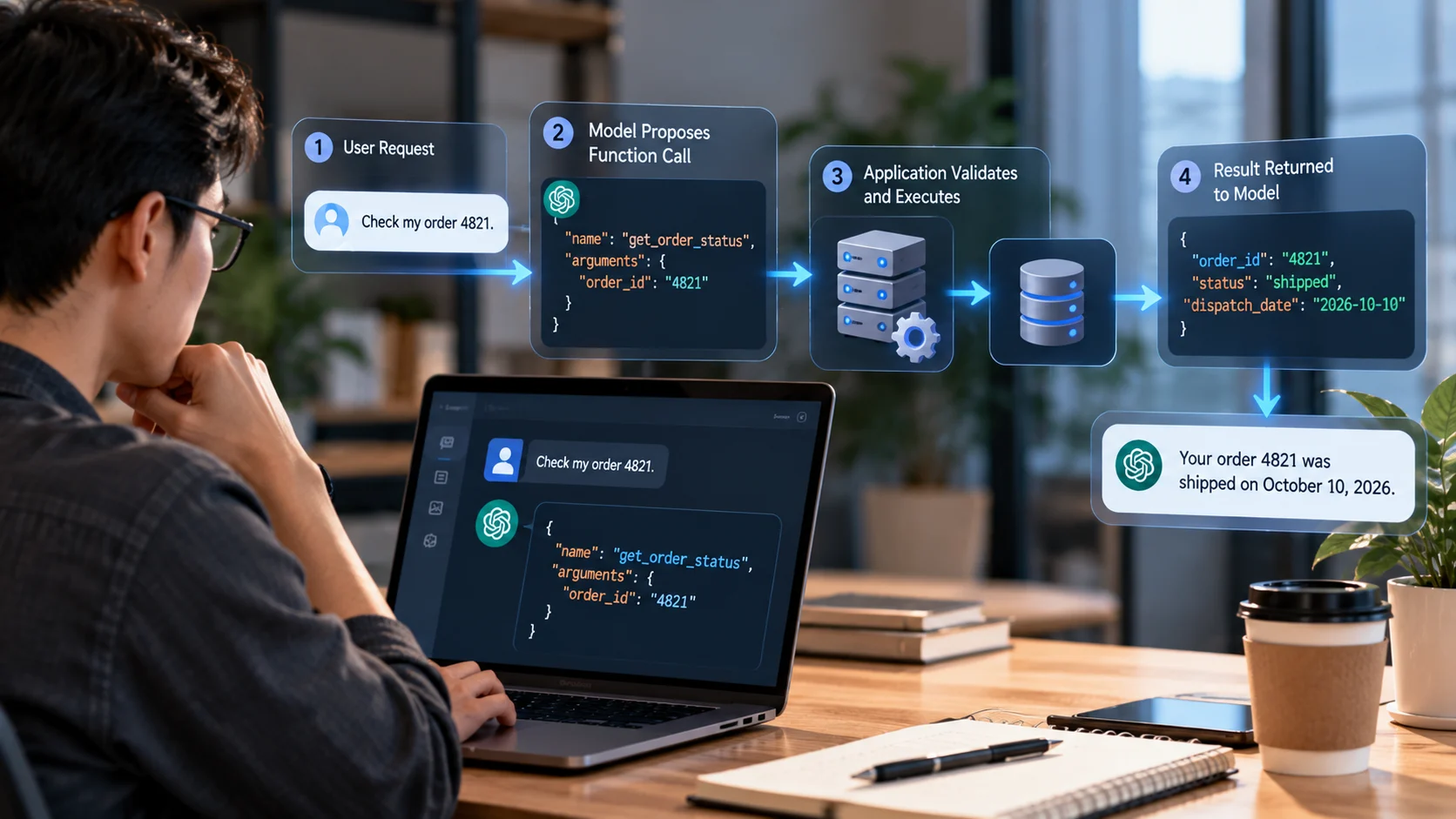
A chatbot can explain how to check an order, but explaining a process is not the same as actually checking a live order database. A language model can also write a sentence saying it has booked a meeting without any calendar event having been created. AI function calling provides a controlled way for a model to request approved operations from software that can perform them.
The distinction matters. A model typically proposes the name of a function and structured arguments. The application hosting the model then decides whether the request is allowed, validates the arguments, executes the operation when appropriate, and sends the result back. The model is not automatically trusted with a server’s credentials or unlimited authority simply because its text looks convincing.
This guide explains the components of function calling, walks through a realistic expense-policy example, and describes the boundaries that make connected AI applications safer and more reliable.
Key Takeaways
A function call is a structured request from a model; application software performs the actual operation.
Tool definitions describe available actions and the argument fields they accept.
JSON validity does not establish user authorization, correct business semantics, or a successful side effect.
Sensitive operations need server-side permission checks, confirmations, idempotency controls, and error handling.
A final answer should reflect the tool’s observed result, not what the model hoped would happen.
What Is Function Calling in AI?
Function calling is an interface for coordinating language-model reasoning with external capabilities. A developer registers a set of functions or tools with a model-accessible description. When the user asks for something requiring outside information or action, the model may produce a structured request identifying the appropriate tool and proposed inputs.
The host application receives that request. It can reject the call, ask a user for confirmation, return an authorization failure, or invoke a service such as a database, weather provider, inventory API, or internal business system. The result is returned to the model or directly to the application, depending on the architecture.
Function calling is related to AI agents, but the terms are not interchangeable. An agent may decide what to do across several steps, maintain state, call tools repeatedly, and evaluate outcomes. Function calling is one mechanism that can support an agent. It is not, by itself, a complete planning or security system.
The Four Parts of a Tool-Calling Workflow
1. A clear tool declaration
A developer defines a function’s name, purpose, parameters, and required fields. Good descriptions narrow the choice a model must make. get_order_status is more explicit than do_customer_task, and a restricted list of supported order-status operations is safer than a vague command that might perform unrelated database changes.
A schema also documents which values are expected. An order lookup might require a string order ID; a stock query might require a product SKU and warehouse identifier. The schema is useful for parsing and validation, but it cannot prove that a caller is entitled to the requested information.
2. The model proposes arguments
When a user says “Check my order 4821,” the model may choose the order-status tool and construct arguments such as {“order_id”:”4821″}. The model is transforming language into a structured proposal. It has not yet fetched any record, verified that the order exists, or confirmed that the customer owns it.
A robust application distinguishes valid syntax from trustworthy intent. Even well-formed arguments can refer to someone else’s order, a nonexistent identifier, or an operation the current user should not be allowed to perform.
3. The application validates and executes
This is the security boundary. The application authenticates the caller, checks that the requested function is permitted, validates all arguments, and applies its business rules. Only then should it call the backend service. The service may return useful data, a not-found error, a permission denial, or a timeout.
Successful argument parsing never replaces this authorization step. A model cannot grant itself additional rights by suggesting a different employee ID or describing an urgent business need.
4. The observed result informs the response
After execution, the application can pass a structured result back to the model. The assistant might then say, “Your order was dispatched yesterday,” but only when a legitimate lookup returned that information. If the service was unavailable, the correct response is to say the lookup failed, not to invent a reassuring order status.
This separation between proposal, execution, and reporting is the foundation of a dependable tool-connected assistant.
Worked Example: Checking a Company Expense Policy
Imagine an employee asking a travel assistant whether an $780 hotel booking complies with company policy. The application has a read-only service for checking permitted expenses. A simplified function declaration could look like this:
{
“name”: “check_expense_policy”,
“description”: “Check a proposed expense against the employee’s policy”,
“parameters”: {
“type”: “object”,
“properties”: {
“employee_id”: {“type”: “string”},
“amount_usd”: {“type”: “number”, “minimum”: 0}
},
“required”: [“employee_id”, “amount_usd”],
“additionalProperties”: false
}
}
For illustration, the model proposes the arguments:
{“employee_id”:”E102″,”amount_usd”:780}
The application must verify that the authenticated employee may request a policy check for E102. A user should not be able to submit another person’s ID and receive confidential policy details merely because the JSON is valid. After authorization, the application checks the amount and calls the expense-policy service.
Suppose the service responds:
{“allowed”:false,”reason”:”Manager review required”}
The assistant can now explain that the booking requires manager review. It should not rephrase the result as “approved” or say the reservation has been made. The function named check_expense_policy only evaluated policy; it did not book a hotel, transfer money, or change a travel record.
If the policy service times out, the assistant should report that approval could not be checked. A timeout is not a denial or an approval. Clear failure states help prevent people from acting on invented certainty.
Why Tool Schemas Are Helpful but Not Sufficient
Schemas reduce formatting errors. They can require an employee_id, restrict amount_usd to a number, and disallow unexpected properties. Some APIs support additional structured-output features, but supported JSON Schema subsets and behavior vary by platform and model.
Several important checks still belong in application logic. An amount of 780 may have a valid type while representing the wrong currency or missing taxes. An employee ID may follow the right format while referring to a person the requester cannot inspect. A supplier result may be incomplete, stale, or internally inconsistent.
For this reason, a strong system validates in layers: syntax, parameter constraints, authenticated identity, business permissions, source-data consistency, and confirmation for consequential actions. When a proposed call fails a layer, the application should refuse or correct the request explicitly rather than sending it to the backend and hoping for the best.
Read-Only Tools and Write Tools Carry Different Risks
Looking up a delivery status generally has fewer consequences than canceling an order or issuing a refund. A read-only tool can still disclose private information, so permissions remain necessary. But tools that modify records require stronger controls because mistakes may be difficult to reverse.
A write operation should define what confirmation is required and how duplicate calls are prevented. For example, a payment request retried after a timeout could charge a customer twice if the application lacks idempotency protection. An idempotency key allows a supported backend to recognize repeated attempts to perform the same logical operation.
The application should also consider whether a tool needs the authority it requests. A customer-service assistant answering delivery questions rarely needs broad database write access. Start with the smallest supported set of actions and expand only when a clear task demands it.
A Practical Implementation Process
Define the allowed job
Write a narrow statement of what the assistant may accomplish. For an order-status assistant, that might be “look up the current status of an order belonging to the signed-in customer.” Exclude refunds, address changes, and cancellations until those actions have been designed and tested separately.
Design precise names and arguments
Give every function a purpose that a developer and reviewer can understand. Use typed fields, required properties, bounded choices, and descriptive errors. Avoid using one generic “execute” tool that can take arbitrary commands. Such a design makes it harder to establish which actions were intended and authorized.
Enforce permissions on the server
Never rely on the model’s willingness to obey instructions as the only safeguard. The backend should derive the caller’s identity from the authenticated session where possible. It must reject attempts to access other users’ records, even when the model generates persuasive arguments.
Handle failures as normal outcomes
Test an unknown ID, missing parameter, denied permission, service timeout, malformed response, and unavailable integration. Define how each situation is reported. Do not present a generic success message when a tool never returned a successful result.
Test with realistic requests
Include ordinary phrasing, incomplete instructions, ambiguous identifiers, and deliberately misleading documents or tool responses. Record whether the assistant selected an appropriate tool, supplied valid arguments, stopped unauthorized calls, and accurately described returned results.
Log the minimum useful evidence
Audit records can include the function name, request identifier, outcome status, service version, and error category. Protect sensitive arguments and returned data; logging everything indiscriminately can create a privacy problem even when the tool execution itself is properly authorized.
How to Measure a Function-Calling System
A successful demonstration is not the same as a reliable deployment. A useful evaluation includes several distinct metrics.
Metric What it reveals
Correct tool-selection rate Did the model request an appropriate operation?
Argument validation pass rate Were required inputs structurally valid?
Unauthorized request rejection Did the application enforce permissions when challenged?
Tool error and retry rate Did connected services behave reliably?
Verified task-completion rate Did the intended operation actually occur?
Final-answer accuracy Did the assistant report the observed outcome correctly?
Each metric needs a clear denominator and representative test cases. A high validation pass rate does not compensate for unauthorized access. A high tool-call completion rate does not prove that the assistant accurately informed the user. Review failures by category instead of combining everything into one attractive percentage.
Common Mistakes in AI Function Calling
Confusing tool selection with execution. The model may name a tool without the application running anything. A final answer must not claim completed actions that were only proposed.
Giving excessively broad access. One assistant with unrestricted write permissions creates unnecessary risk. Separate tools by task, identity, and consequence, and require stronger confirmation for sensitive changes.
Trusting model-generated identifiers. An order number or employee ID in the model’s arguments does not prove ownership. Validate against the authenticated account and the backend’s permission rules.
Retrying side effects carelessly. Timeouts and network failures are normal. Retries should distinguish safe reads from non-idempotent actions, and use supported deduplication controls for payment, cancellation, and similar operations.
Treating tool text as trusted instructions. A retrieved page or API field may contain malicious or irrelevant instructions. Tool responses provide task data, not permission to override application controls. This is one reason prompt-injection defenses matter even when function schemas are well designed.
A Safer Test Plan for Tool-Connected Assistants
Create a small test suite before connecting the assistant to production records. Start with a valid request from an authorized user, then change one condition at a time. The same order ID requested by the wrong user should fail authorization. An unknown ID should produce a not-found result. A missing required field should trigger clarification or a structured validation error, not an invented value.
Next, test service conditions that models cannot solve through wording alone. Simulate a slow response, a backend timeout, an empty service result, and a malformed payload. The assistant’s final message must reflect the actual status. A timeout should not become “the expense is approved,” and an empty result should not be transformed into a fabricated policy rule. Capture both the tool-layer outcome and the user-facing statement for comparison.
For tools that modify information, add a separate confirmation test. Ask whether the assistant can distinguish drafting a refund request from issuing the refund itself. Verify that retries do not create duplicate side effects. If a destructive operation lacks a safe retry mechanism, use a more conservative recovery path and require explicit approval where appropriate.
Finally, review every test with three questions: Did the application enforce its own rules? Did the action actually occur? Did the assistant describe the observed outcome accurately? These are independent checks. A fluent response cannot compensate for a permission bypass, and a successful backend update does not justify a misleading explanation to the user.
Frequently Asked Questions
Does an AI model actually execute the function?
Ordinarily, the host application executes the function or calls the external service after evaluating the structured request. Specific platforms may abstract away some steps, but authorization and accountability are still essential.
Is function calling the same as an AI agent?
No. An agent may combine multiple tool calls with planning and state. Function calling is the controlled request-and-response mechanism used for an individual supported operation.
Does valid JSON make a tool call safe?
No. JSON validity addresses formatting, not permission, correctness, or the consequences of an action. Server-side identity checks and business rules remain necessary.
What should an assistant say when a tool fails?
It should describe the observed failure accurately, avoid fabricating a successful result, and offer an appropriate retry or human escalation if the application supports one.
Conclusion
AI function calling connects a language model’s ability to interpret requests with software that can obtain information or take approved actions. The crucial boundary is that the model proposes and the application validates, authorizes, executes, and checks. Begin with narrow read-only tools, keep permissions explicit, test failures as carefully as successes, and ensure final responses describe what really happened. That approach turns function calling from an impressive demo into a dependable application feature.
Further Reading on ByteScope
AI Agents Explained
AI Guardrails Explained
When Automation Helps—and When It Hurts
Sources and Further Reading
OpenAI: Function Calling
OWASP: LLM Prompt Injection Prevention
JSON objects in the example are illustrative; actual API envelopes and supported schema features depend on the platform.