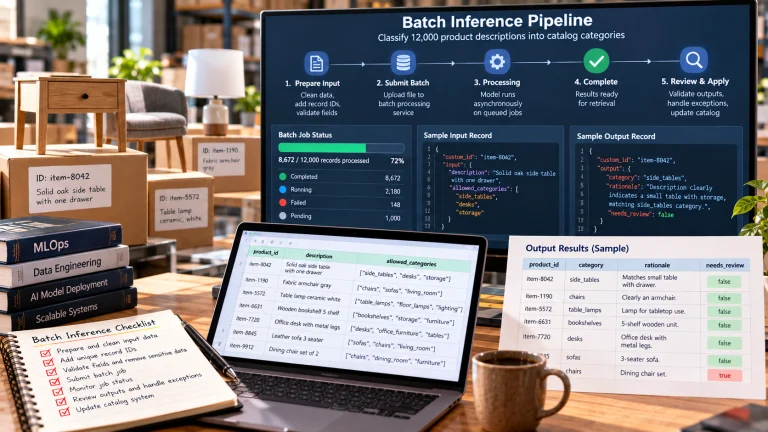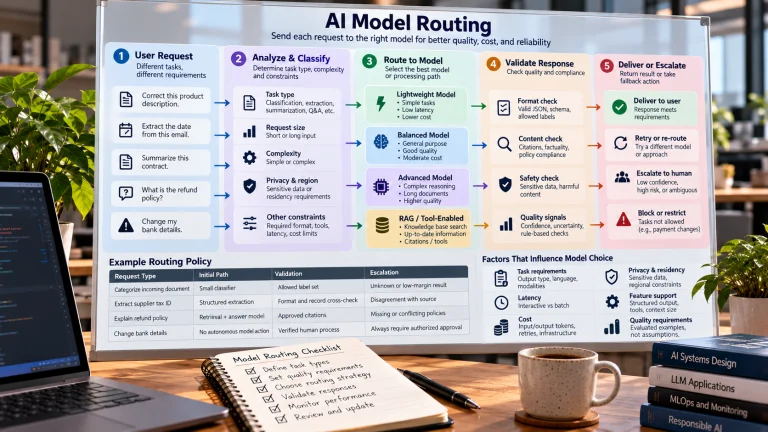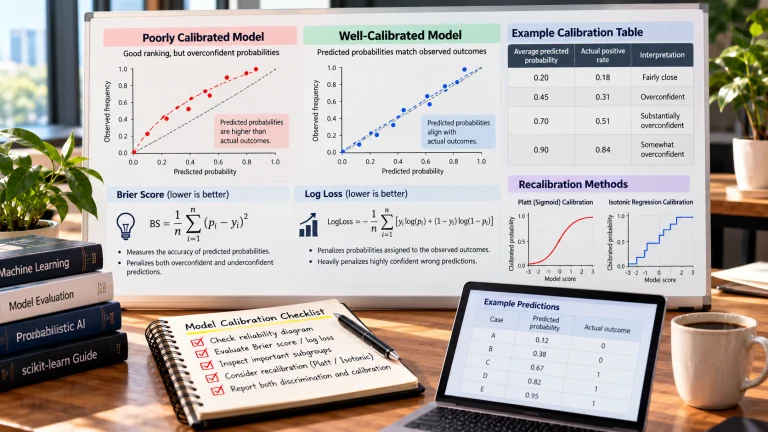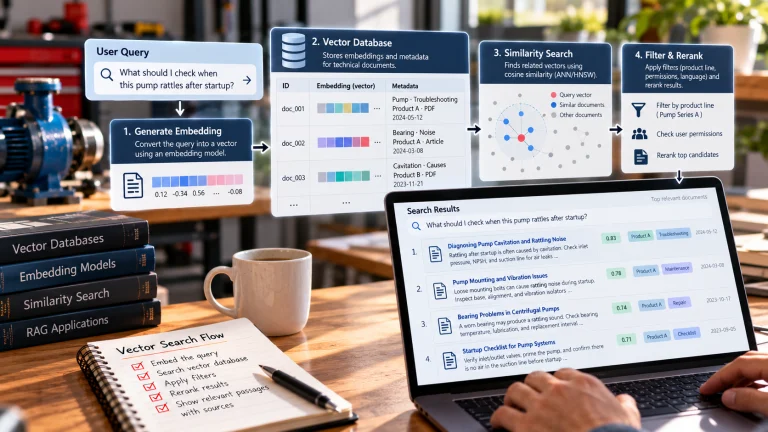
An AI assistant may summarize an invoice correctly for a human while returning a format that breaks an accounting workflow. Perhaps the total appears as free-form text instead of a number, a currency field is missing, or a supplier name is included under an unexpected key. Structured AI outputs address this problem by asking a model to return information in a shape that software can read predictably.
The idea is simple: define the data contract before generating the response. In many systems the contract is expressed using JSON and a JSON Schema. However, a crucial distinction remains. An object can satisfy its schema while containing incorrect facts. Reliable automation requires structural checks, business rules, and source verification—not simply well-formatted text.
This guide explains the pieces of a structured-output workflow, shows a small schema example, and provides a practical path from an AI-generated object to a record another application can safely use.
Key Takeaways
JSON defines a way to represent data; JSON Schema can describe which fields, types, and constraints are expected.
A syntactically valid JSON object may still violate the required schema or business rules.
Provider-supported constrained output can improve format consistency, but feature support varies across models and APIs.
Missing evidence should produce an explicit unknown or review state rather than an invented value.
Downstream applications must validate the data independently before acting on it.
Why Free-Form AI Responses Create Integration Problems
People can usually understand several ways of describing the same fact. Software cannot safely rely on that flexibility. A human might accept “eight units remain,” “stock: 8,” or a sentence saying the warehouse has eight books. A program expecting an integer under a key named quantity needs a much narrower representation.
When developers extract values by searching for words inside free-form prose, small changes in punctuation or wording can break the parser. A model may also insert a helpful disclaimer or reorder information. These behaviors are not inherently wrong for conversation, but they are poor substitutes for a defined interface when the output feeds another system.
Structured output introduces an explicit contract. Instead of telling a model to “write a report,” the application specifies the information required and a machine-readable shape for that information. This makes automatic checks easier, exposes certain errors earlier, and lets the next process reject incomplete records rather than silently guessing.
JSON, JSON Schema, and Constrained Generation
JSON represents values such as strings, numbers, booleans, arrays, objects, and nulls. It does not automatically specify what an application expects. The following object is valid JSON:
{“sku”:”BK-14″,”quantity”:8}
But so is {“sku”:”BK-14″,”quantity”:”eight”}. Both are syntactically valid; the second may be unusable if software requires an integer.
JSON Schema describes additional requirements, including property names, types, required fields, allowed values, and some numerical or textual constraints. A simple inventory record might use:
{
“type”: “object”,
“properties”: {
“sku”: {“type”: “string”},
“quantity”: {“type”: “integer”, “minimum”: 0}
},
“required”: [“sku”, “quantity”],
“additionalProperties”: false
}
Under this schema, the first object passes basic structural validation. The version with “quantity”:”eight” fails because the field is a string. A negative quantity also fails because the minimum is zero. Unexpected keys are disallowed.
Some AI APIs support constrained generation that is designed to produce outputs conforming to supported schemas. Others offer JSON-specific modes or only conventional prompting. These modes are not interchangeable, and not every JSON Schema feature is supported by every provider. Read the documentation for the model and endpoint actually being used rather than assuming that a generally valid schema is universally accepted.
A Schema Can Be Valid and the Answer Still Be Wrong
Imagine a warehouse really has eight books of a particular SKU, but the model returns:
{“sku”:”BK-14″,”quantity”:8000}
This object passes the simple schema: the value is an integer and is not negative. Yet it may be wildly incorrect. The schema knows nothing about the warehouse’s real stock count. That factual check needs an authoritative source such as a database, an inventory ledger, or a validated extraction from a trusted document.
This is the difference between schema validity and semantic validity. Schema validity asks whether the structure conforms to the agreed contract. Semantic validity asks whether the record makes sense and accurately represents the world. A third check may be necessary: authorization. Even a correct record should not be released to someone who lacks permission to access it.
A reliable workflow treats these checks as separate gates. Passing one does not imply passing the others.
Designing a Contract for Invoice Extraction
Suppose a procurement team receives invoices in several layouts. The downstream system needs a supplier name, invoice ID, total amount, currency, and processing status. A sensible design starts with those business requirements, not with an instruction to return as many fields as possible.
For example, define supplier_name as a string, invoice_total as a nonnegative number or an explicitly permitted null value, currency as a supported currency code, and review_required as a boolean. The exact shape depends on whether the system must distinguish missing fields from failed extraction or invalid source documents.
If the invoice image is unreadable, the model must not invent a total merely to keep the object complete. One design is to allow null for uncertain fields and set a review status with a reason. Another uses an envelope with status, data, and errors, where each status maps to a documented handling path. The important property is that uncertainty survives the handoff.
The team should also decide what to do with conflicting fields. An invoice may show a subtotal, tax, discount, and final amount. A model can extract each value while still selecting the wrong one as the payable total. Business validation should compare relevant arithmetic and escalate inconsistencies instead of treating a formatted object as final approval.
A Step-by-Step Structured Output Workflow
1. Define the downstream decision
Begin with the consumer of the information. Does another application create a customer record, approve a transaction, display a table, or issue an alert? Each use has a different tolerance for missing fields. A dashboard may display an unknown supplier category; a payment workflow cannot safely invent a bank account number.
Write down which fields are required, how they will be used, and what happens when a value is absent.
2. Choose minimal, stable field names
Names should reflect one meaning consistently. Avoid a field such as date when the system needs to distinguish invoice date, due date, and processing date. Use stable types and document units. An amount should not sometimes mean dollars and sometimes mean cents without an explicit unit convention.
A smaller schema is easier to test than a sprawling object containing dozens of fields that nobody uses.
3. Specify unknown and error states
A field that could not be established is not the same as a value of zero or an empty string. Design an explicit representation for unknown values and identify which conditions require human review. The contract should also handle a model refusal, interrupted generation, service timeout, and invalid output.
Do not rely on a fallback parser that quietly extracts whichever number happens to appear first in a response.
4. Generate with the supported model interface
Use the provider’s documented structured-output method when available. Provide only the source material necessary for the task and explain relevant extraction boundaries. If the interface does not guarantee schema conformity, run a separate parser and validator rather than assuming that a prompt mentioning JSON will always work.
The surrounding application must remain prepared for failures even when constrained generation is enabled.
5. Validate structure and business meaning separately
First run schema validation. Reject type mismatches, missing required keys, unexpected properties, and prohibited values. Then check business rules: known supplier IDs, permitted currencies, reconciliation of totals, and authorization where applicable. Finally compare important claims with the actual source document or trusted system.
When a check fails, record the specific reason. A useful error message might say “invoice total conflicts with line-item sum” rather than the unhelpful “AI failed.”
6. Route exceptions to the correct reviewer
Not every problem needs the same response. A formatting error may be retried, an illegible document may require re-upload, and a conflict between a purchase order and invoice may need finance approval. Preserve the source and model output for the reviewer according to the organization’s privacy requirements.
A review queue should make uncertainty visible, not bury it beneath a generic success status.
7. Version the contract and retest integrations
Field names, allowed categories, and business rules change as applications evolve. Treat schema updates as interface changes. Version contracts when necessary, test consuming applications, and plan for old records that still use previous definitions. A model change should also trigger regression testing on the same representative documents.
A Useful Validation Scorecard
Do not evaluate structured output solely by how often a JSON parser accepts the response. Combine several checks:
Measure What it tells you
JSON parse success Does the response contain parseable JSON?
Schema conformance Does the object match the declared contract?
Field-level accuracy Are extracted values supported by source data?
Business-rule acceptance Are domain constraints satisfied?
Exception rate How often is clarification or review needed?
Downstream correction time How much repair work is created after acceptance?
A system can have a very high schema pass rate and still produce incorrect supplier totals. Conversely, a conservative system that flags uncertain invoices may require more review while protecting the organization from expensive errors. Quality depends on the consequence of a mistake, not one headline percentage.
How to Test a Schema Against Real Documents
Build a small regression set that reflects the documents the application will actually receive. Include one clean invoice, one that uses an unfamiliar layout, one with a missing currency, one with a handwritten note, and one in which two totals appear on the same page. Record a trusted answer for each case, including which fields are genuinely unknowable. This set is much more useful than testing the same simple invoice repeatedly.
For every test, keep three observations separate. The first is whether the model returned a well-formed response matching the supported schema. The second is whether individual field values matched the trusted answers. The third is whether the resulting object could safely pass the business rules of the destination system. A solution that passes the first test but fails the second should not be accepted simply because its JSON looks clean.
Revisit the regression set when a model version changes, a document supplier changes its layout, or a downstream application adds a new requirement. Note the date and revision of each change. Otherwise, a team may spend considerable effort tuning generation settings when the actual problem is an altered invoice template or a new accounting rule.
The same method applies beyond invoices. A content-classification service can test ambiguous category labels; a product catalog can test unknown materials; and a support system can test missing customer identifiers. In each case, explicitly describing what should happen when information is absent is as important as describing the successful case.
Common Mistakes to Avoid
Confusing structure with truth. JSON Schema cannot verify a historical fact, current price, or identity on its own. Add source-grounded checks.
Inventing required values. If a field is mandatory but the input lacks evidence, the workflow needs an explicit failure or review state. Forcing the model to fill every field can make an uncertain answer look authoritative.
Using vague field names. A field called value gives downstream software little information. Specify whether it represents currency, quantity, confidence, score, or another concept.
Changing schemas without coordinating consumers. A renamed field can break working integrations. Version contracts and run tests before deploying changes.
Assuming strict formatting prevents prompt injection. An attacker-controlled document can still attempt to manipulate what a model extracts or which tool it calls. Permission checks and security boundaries must remain in application code.
Frequently Asked Questions
Is JSON the same as structured output?
JSON is a common output format. Structured output is the broader idea of enforcing a defined shape and meaning for machine-consumable information. Other formats and typed interfaces can serve similar purposes.
Does valid JSON guarantee correct information?
No. It guarantees only that the text follows JSON syntax. Additional schema, business-rule, and factual checks may be necessary.
What should happen when a field is unknown?
Use a documented representation such as null, an explicit unknown status, or a review flag. Do not substitute a plausible number or invented name merely to complete the object.
How do I know whether my model supports a particular schema?
Consult current documentation for the specific model and endpoint. Supported features, restrictions, and error behavior differ across providers.
Conclusion
Structured AI outputs make language models easier to integrate with software by defining what the response should look like. JSON Schema is useful for type and shape validation, but it is not a substitute for verifying the facts or enforcing business permissions. The safest approach begins with the downstream decision, defines a minimal contract, preserves uncertainty, validates in layers, and treats errors as normal workflow outcomes rather than exceptions to hide. A contract also needs a person who maintains it: someone who understands the source data, can approve definition changes, and can explain what the consuming application expects. That ownership prevents a technically valid interface from quietly becoming a collection of incompatible assumptions.
Further Reading on ByteScope
AI Hallucinations Explained
AI Coding Tools
AI Agents Explained
Sources and Further Reading
JSON Schema: Getting Started
OpenAI: Structured Outputs
Implementation details depend on the model API and the schema features it supports.