Digital innovation is often described through the technologies associated with it:
artificial intelligence, automation, cloud computing, connected devices, data analytics,
and increasingly intelligent software. Those technologies matter, but they are not what
makes an organization innovative.
A company can buy modern software and still operate with slow approvals, duplicated data,
confusing responsibilities, and frustrated customers. Another organization may use relatively
simple technology yet redesign a process so effectively that work becomes faster, clearer,
and easier to improve. The difference is not simply the sophistication of the technology.
It is the quality of the system built around it.
That is why a more useful way to think about digital innovation is not
“Which technology should we adopt?” but “What should work better, and what combination
of people, processes, information, and technology can make that improvement sustainable?”
Technology becomes important after the problem and desired outcome are understood.
Digital Innovation Is a System Change, Not Just a Technology Upgrade
Consider a business that receives customer requests through email. Employees manually copy
each request into a spreadsheet, send messages to different departments, wait for responses,
and then update the customer. Management decides to modernize the process by purchasing a
new customer-service platform.
If employees still need to copy information manually, chase approvals through email, and
re-enter the same data in several systems, the organization has digitized parts of the
existing process without truly improving the process itself. The interface may look newer,
but the underlying friction remains.
Digital innovation would ask a deeper set of questions. Why is the same information entered
more than once? Which decisions actually require human approval? Which requests can be
routed automatically? What information should employees see at the moment they make a
decision? What should customers be able to do without waiting for an employee?
Those questions shift attention from technology to system design.
The result might still involve a customer-service platform, but it may also require better
data structures, simpler responsibilities, automation, dashboards, notification rules, and
clear exceptions for situations that need human judgment.
In other words, digital innovation is not simply the addition of a digital layer. It is
the deliberate redesign of how value moves through a system.
Why Technology-First Innovation Often Disappoints
New technology creates excitement because it is visible. A new dashboard, AI assistant,
automation platform, or mobile application feels like progress. Problems inside workflows
are less exciting because they are usually hidden in ordinary activities: waiting for a
response, copying a number between systems, checking the same document twice, correcting
inconsistent records, or asking someone who owns the next step.
This creates a common innovation trap. Organizations begin with a product demonstration
instead of a problem. They ask where a technology can be inserted rather than whether
the surrounding process deserves to exist in its current form.
The result can be what might be called digital decoration: modern tools
placed on top of old operating habits. A paper form becomes an online form, but five people
still approve it. A spreadsheet moves to the cloud, but teams continue maintaining competing
versions. An AI assistant drafts an answer, but the employee must still search several
systems to find the information needed to verify it.
None of these tools are necessarily bad. The problem is that adoption is being confused
with innovation. Adoption answers, “Are we using the technology?” Innovation asks,
“Is something important now working better?”
The ByteScope Friction-to-Flow Framework
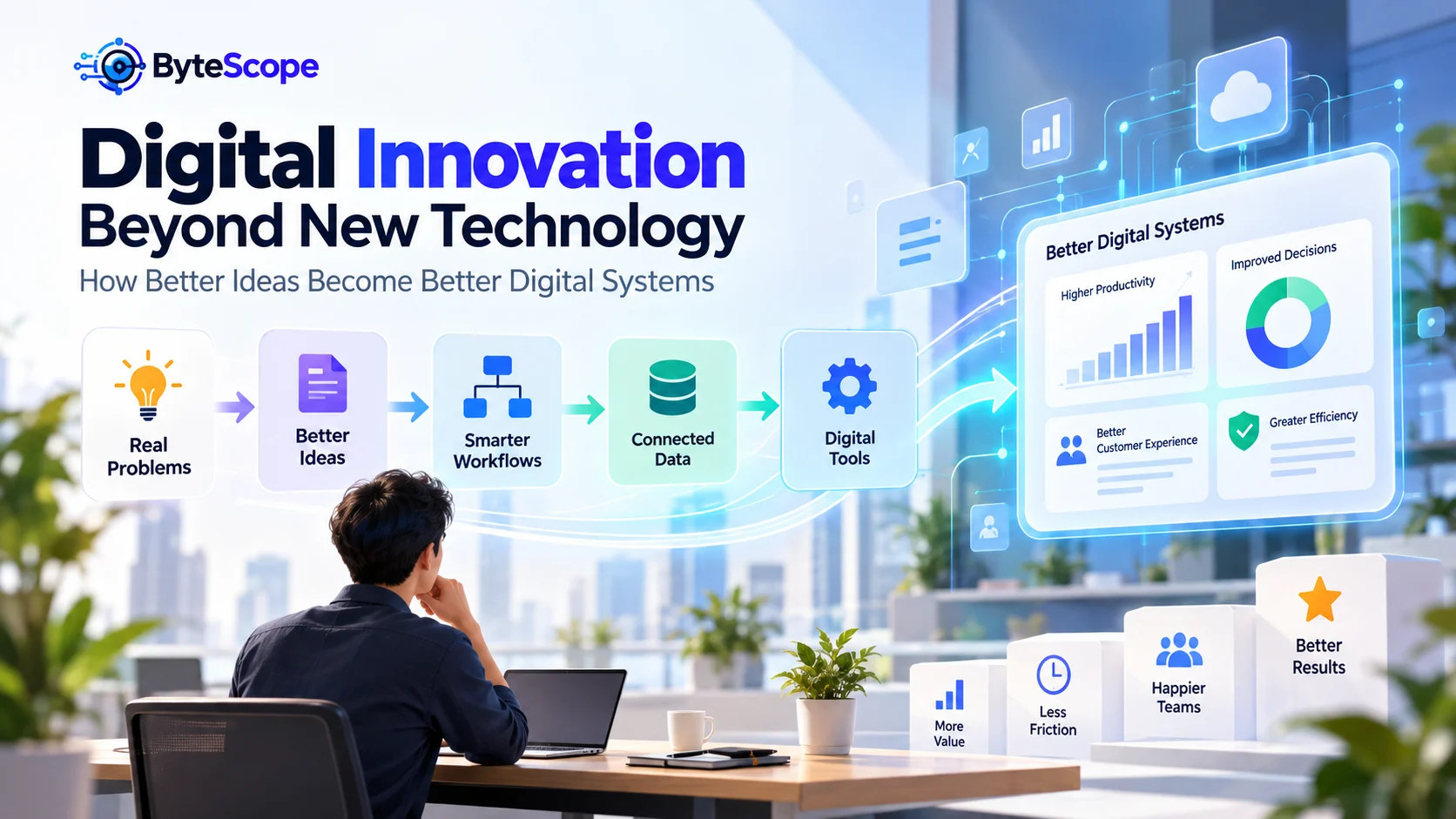
To make that distinction practical, ByteScope uses a simple editorial framework for thinking
about digital innovation: Friction-to-Flow. It begins with a point of
friction and follows the path toward a measurable digital system rather than beginning
with a specific technology.
- Find the friction: identify where time, information, effort, or customer trust is being lost.
- Define the outcome: describe what should become faster, clearer, safer, cheaper, or easier.
- Redesign the workflow: remove unnecessary steps before automating what remains.
- Connect the data: determine what information is needed, where it comes from, and who can use it.
- Select the technology: choose the simplest technology capable of supporting the redesigned workflow.
- Add guardrails: define permissions, human review, privacy boundaries, and failure recovery.
- Measure the flow: evaluate whether the new system produces the intended result and improve it continuously.
1. Find the Friction
Innovation becomes more concrete when it begins with observable friction. Friction may be
a long waiting time, repeated data entry, unclear ownership, frequent errors, abandoned
customer journeys, slow reporting, or employees spending hours on work that contributes
little to the final outcome.
The important point is to describe the problem in operational terms. “We need AI” is not
a problem statement. “Our support team spends two hours each morning categorizing incoming
requests before anyone can answer them” is.
The second statement can be investigated, measured, redesigned, and tested. It also leaves
open the possibility that AI may not be the best solution.
2. Define the Outcome Before the Tool
A useful digital initiative needs a destination. If the support problem is slow request
classification, the desired outcome might be reducing the time between submission and
assignment while maintaining accurate routing.
That outcome is more useful than saying the goal is to “implement automation.” Automation
is a method. Faster, reliable routing is the outcome.
This distinction protects teams from being impressed by features that do not affect the
problem they are trying to solve. It also provides a basis for deciding whether the
innovation worked.
3. Redesign Before You Automate
One of the most valuable questions in digital innovation is surprisingly simple:
Does this step need to exist?
Automating a poor process can make the poor process run faster without making it better.
If three departments approve a routine request because that is how the organization has
always operated, adding automated notifications to all three departments may reduce some
waiting time, but it preserves the underlying complexity.
A stronger approach asks whether the approval rules can be simplified. Perhaps only unusual,
high-value, or high-risk requests need manual approval while ordinary cases can proceed
automatically.
Digital innovation therefore includes subtraction. Removing a step can be as innovative
as adding a feature.
4. Connect the Data to the Decision
Modern digital systems depend on information moving to the right place at the right time.
That does not mean collecting as much data as possible. It means understanding which data
supports the decision being made.
A sales manager may need recent conversion trends, not every historical transaction.
A support agent may need the customer’s recent interactions and account status, not unrestricted
access to the entire customer database. An operations team may need alerts for unusual
conditions rather than a dashboard containing dozens of metrics.
Digital innovation improves when information is designed around action. Tools such as
AI data analysis tools
can help people explore datasets and identify patterns more quickly, but the usefulness
of those insights still depends on asking relevant questions and connecting analysis to
real decisions.
5. Select Technology After the Workflow Is Clear
Once the workflow, outcome, and information requirements are understood, technology selection
becomes easier. The team can compare tools against specific needs instead of collecting
features that sound impressive.
Some problems need nothing more sophisticated than a shared database, an integration,
and a few automation rules. Others may benefit from machine learning, natural-language
interfaces, or AI systems that can adapt to changing information.
Understanding
how artificial intelligence works
helps teams distinguish tasks where pattern recognition and flexible language processing
are useful from tasks where a deterministic rule may be more reliable.
More advanced systems may use
AI agents
to perform multi-step activities involving tools, information, and decisions. But an agent
should not replace a simple automation merely because it sounds more advanced. Complexity
should earn its place by solving a problem that simpler technology cannot solve well.
6. Add Guardrails as Part of the Design
A digital system is not complete merely because it works under ideal conditions. It also
needs a plan for incorrect information, unavailable services, unauthorized access, unusual
cases, and decisions that should not be automated.
This becomes especially important when systems process customer data or use AI to recommend
or take actions. Privacy, reliability, accountability, security, and human oversight are
design requirements rather than tasks to consider only after deployment.
The same principle applies to
responsible AI:
a capable system still needs boundaries appropriate to the consequences of its decisions.
Low-risk automation may require light monitoring, while sensitive or irreversible actions
may require explicit human approval.
7. Measure Whether Friction Actually Became Flow
A successful launch is not the same as successful innovation. The real question is whether
the system improved the experience or result it was created to change.
If the original problem involved slow processing, measure processing time. If it involved
errors, measure error rates. If employees were repeatedly entering the same information,
measure the reduction in manual steps. If customers were abandoning a process, compare
completion rates before and after the change.
Measurement also helps reveal unintended effects. A system may process requests faster
while increasing incorrect routing. An automated response may reduce workload while
creating more follow-up questions. A dashboard may provide more information while making
important signals harder to notice.
Digital innovation is therefore iterative. The first version creates evidence. The evidence
guides the next improvement.
A Practical Example: Turning a Broken Handoff Into a Digital System
Imagine a small professional-services company where new client requests arrive through a
website form. An administrator reads each submission, copies the information into a
spreadsheet, emails the appropriate specialist, and creates a folder for the client.
The specialist then emails the administrator when the request has been reviewed.
The obvious technology-first response might be to purchase a larger customer relationship
management platform. But the Friction-to-Flow approach begins by mapping what is actually
happening.
The main friction is not the absence of a CRM. It is the manual handoff between the form,
spreadsheet, email, specialist, and client record. The desired outcome is a reliable process
where each qualified request is assigned quickly, visible to the right employee, and tracked
without duplicate entry.
The redesigned workflow might send form data directly into a shared record, apply simple
routing rules, notify the assigned specialist, create a status field, and alert the
administrator only when an exception occurs. A dashboard can show how many requests are
waiting and how long they have been open.
The organization may eventually add AI to classify unusual requests or summarize longer
client descriptions. But that capability becomes useful because it serves an already
understood workflow. AI is no longer the project. It is one component of the system.
For an even smaller operation, the first version could be built around tools the company
already knows. For example,
AI spreadsheet tools
may assist with formulas, summaries, and analysis while the team learns which parts of the
process actually deserve deeper automation.
This example illustrates an important principle: the digital maturity of a solution should
match the maturity of the problem understanding. Starting smaller often produces better
evidence for deciding what to build next.
What Makes a Digital System Better?
A better digital system is not necessarily the one with the largest number of features.
It is the one that makes the important path through a process easier to understand and
complete.
Good systems reduce unnecessary decisions while keeping meaningful decisions visible.
They capture information once and reuse it where appropriate. They make ownership clear.
They expose exceptions instead of forcing people to monitor everything. They allow users
to recover when something goes wrong rather than trapping them in an automated process.
They also respect the difference between efficiency and effectiveness. A process can become
faster while producing worse outcomes. A chatbot can respond instantly but frustrate
customers if it cannot recognize when a human is needed. An automated report can arrive
every morning but add no value if nobody knows what decision it should influence.
This is why better digital systems connect technology with context. The system is designed
around what people are trying to accomplish, not around what the technology is capable of
demonstrating.
Digital Innovation Should Reduce Complexity, Not Hide It
Technology sometimes makes complexity less visible without actually removing it. A polished
interface may sit on top of dozens of integrations, duplicated records, unclear rules, and
manual workarounds.
This matters because hidden complexity eventually becomes operational cost. Systems become
harder to change, employees rely on unofficial procedures, and small failures spread across
connected workflows.
A useful innovation project therefore asks not only what the user sees but what the
organization must maintain behind the experience. Can a rule be understood six months
later? Is the source of important data clear? Can permissions be changed safely? Does the
system show why a request failed? Can the organization continue operating if one component
is unavailable?
These questions may sound less exciting than discussing the newest technology, but they are
often what determine whether an innovation remains useful after the launch announcement is
forgotten.
The Role of Human Judgment in Digital Innovation
Digital innovation does not require removing people from every process. In many cases, the
best design changes where human attention is used.
Routine, predictable steps can be automated so people spend less time moving information
between systems. Humans can then focus on exceptions, negotiation, interpretation, creative
work, relationship building, and decisions where context matters.
This creates a more useful question than “Can this task be automated?” The better question
is “Which parts of this task benefit from automation, and which parts benefit from human
judgment?”
A customer complaint might be automatically categorized and routed, while a person decides
how to resolve a complex dispute. A financial report might be assembled automatically while
a manager interprets an unusual trend. An AI system may summarize a long document while a
professional determines what the summary means for a real decision.
Digital innovation becomes stronger when automation and human judgment are designed as
complementary parts of the workflow rather than competing alternatives.
How Small Teams Can Start Without a Large Transformation Program
Digital innovation does not need to begin with a company-wide transformation project.
Smaller teams can often learn more by improving one recurring workflow with a measurable
problem.
A useful starting point is a process that happens frequently enough for improvement to
matter but is contained enough to change safely. Examples include weekly reporting,
customer request routing, meeting follow-up, inventory updates, document approval, or
internal information search.
Document the current process before changing it. Observe where people wait, repeat work,
switch tools, correct errors, or create unofficial workarounds. Then define one outcome
that can be measured.
Build the smallest version capable of testing the idea. Avoid designing the final system
before learning whether the new workflow actually helps. A simple integration that saves
thirty minutes every day can provide more practical insight than months spent planning a
large platform that has never been tested with real users.
Once the improvement is demonstrated, expand carefully. The goal is not to digitize
everything. It is to create a repeatable way of turning useful ideas into better systems.
Digital Innovation vs. Digital Transformation
Digital innovation and digital transformation are related but do not need to mean the same
thing. Digital innovation can happen at the level of a product, workflow, service, or
specific customer experience. It may be relatively small and focused.
Digital transformation usually describes broader organizational change in which digital
capabilities reshape multiple areas of how an organization operates, competes, serves
customers, or makes decisions.
A single improved onboarding workflow can be digital innovation. A company redesigning its
operating model around integrated digital services, shared data, new skills, and different
customer channels is closer to digital transformation.
The distinction is useful because not every valuable innovation needs to become a
transformation program. Small improvements can create value on their own and can also
become building blocks for larger change.
Questions to Ask Before Calling a Project “Digital Innovation”
Before describing a new system as innovative, ask what problem it removes, what behavior
changes, and what evidence will show improvement. If the main achievement is simply that
a new tool was purchased or deployed, the project may be digitization rather than meaningful
innovation.
Also ask what became simpler. If employees now use an additional platform without eliminating
any previous work, the organization may have created another layer of complexity. If
customers gain a new digital channel but still need to repeat information when they switch
channels, the experience is not truly connected.
Finally, ask what happens when the system is wrong. Mature digital systems include recovery,
escalation, ownership, and human intervention where appropriate. Innovation should improve
control as well as convenience.
Frequently Asked Questions About Digital Innovation
What is digital innovation in simple terms?
Digital innovation is the use of digital capabilities to create a meaningful improvement
in a product, service, workflow, experience, or decision process. The important part is
the improvement, not simply the presence of new technology.
Does digital innovation always require artificial intelligence?
No. AI can be useful when a problem involves language, pattern recognition, prediction,
generation, or flexible decision support, but many successful digital improvements rely
on simpler technologies such as databases, integrations, workflow automation, cloud
services, or better interfaces.
What is an example of digital innovation?
A company that replaces a fragmented customer-request process with a connected system that
captures information once, automatically routes ordinary cases, alerts staff about
exceptions, and provides real-time status information is practicing digital innovation.
The innovation is the redesigned experience and workflow, not any single application.
Why do some digital innovation projects fail?
Projects often struggle when organizations start with technology rather than a clearly
defined problem, automate inefficient processes, ignore user behavior, use poor-quality
data, or fail to define how success will be measured. Complexity can also increase when
new tools are added without removing outdated processes.
How should a small business approach digital innovation?
Start with one repeated problem that has visible cost or friction. Map the current workflow,
define a measurable improvement, simplify unnecessary steps, and test the smallest digital
solution that can improve the process. Expand only after the first version produces useful
evidence.
Is digital innovation a one-time project?
Usually not. Digital systems operate in changing environments. Customer expectations,
business rules, technology, security risks, and available data change over time. Effective
innovation therefore includes measurement, feedback, maintenance, and repeated improvement.
The Bottom Line
Digital innovation is easy to associate with whatever technology is receiving the most
attention. But new technology alone does not create a better organization, product, or
customer experience.
The more useful path starts with friction. Identify where work or value is being lost,
define the outcome that should improve, redesign the workflow, connect the necessary data,
and only then choose the technology capable of supporting the new system. Add appropriate
guardrails, measure what changes, and use real evidence to guide the next iteration.
That is the idea behind the ByteScope Friction-to-Flow Framework. Digital
innovation moves from a real problem toward a better flow of information, decisions, and
actions. AI, automation, cloud platforms, and analytics can all contribute, but they are
components rather than the destination.
The most useful digital systems are often not the ones that display the most technology.
They are the ones where the technology almost disappears into the experience because the
process has become clearer, faster, safer, and easier to improve.
When better ideas become better systems, technology stops being the headline and starts
doing what digital innovation is supposed to do: make something important work better.