Technology is usually introduced with a promise of speed.
Artificial intelligence can produce drafts in seconds.
Automation can process repetitive transactions without waiting for employees.
Cloud platforms can scale computing resources rapidly.
Digital forms can replace paper.
Analytics can produce answers that previously required hours of manual calculation.
Each improvement can be real.
Yet organizations sometimes experience a surprising result.
One part of the process becomes dramatically faster while the complete process barely
improves.
Sometimes it becomes worse.
An AI writing system generates twenty documents in the time employees previously created
three.
But the legal team can still review only five documents per day.
The organization has not eliminated waiting.
It has created a larger review queue.
A customer-service automation categorizes requests instantly.
But the specialist team receiving those requests has limited capacity.
Classification becomes faster while resolution time increases.
A factory machine produces components faster.
The packaging station cannot handle the increased output.
Inventory accumulates between the two stages.
This is the digital bottleneck paradox.
Technology accelerates one part of a system, but the overall system does not become faster
because the constraint simply moves somewhere else.
Local Speed Is Not System Speed
This distinction is the foundation of the bottleneck problem.
A workflow consists of connected stages.
Consider:
Request → Analysis → Draft → Review → Approval → Delivery
If the drafting stage takes two hours, replacing it with AI that produces a draft in two
minutes appears transformational.
But what if review takes two days?
The customer’s total waiting time may barely change.
The organization improved a local metric.
The system-level metric remained almost unchanged.
This is why digital innovation should be evaluated across the complete workflow rather
than isolated components.
ByteScope’s article
Digital Innovation That Pays Off
emphasized measuring actual outcomes rather than feature launches or technology activity.
The bottleneck paradox is one reason that distinction matters.
The Fastest Step Does Not Control Throughput
Imagine a process with four stages.
- Stage A can process 100 requests per hour.
- Stage B can process 80.
- Stage C can process 30.
- Stage D can process 90.
The overall workflow cannot sustainably produce 100 completed requests per hour.
Stage C limits the system to approximately 30.
Now imagine AI doubles Stage A’s speed.
It can process 200 requests per hour.
Total throughput is still constrained around Stage C.
The additional speed may simply create more work waiting in front of the bottleneck.
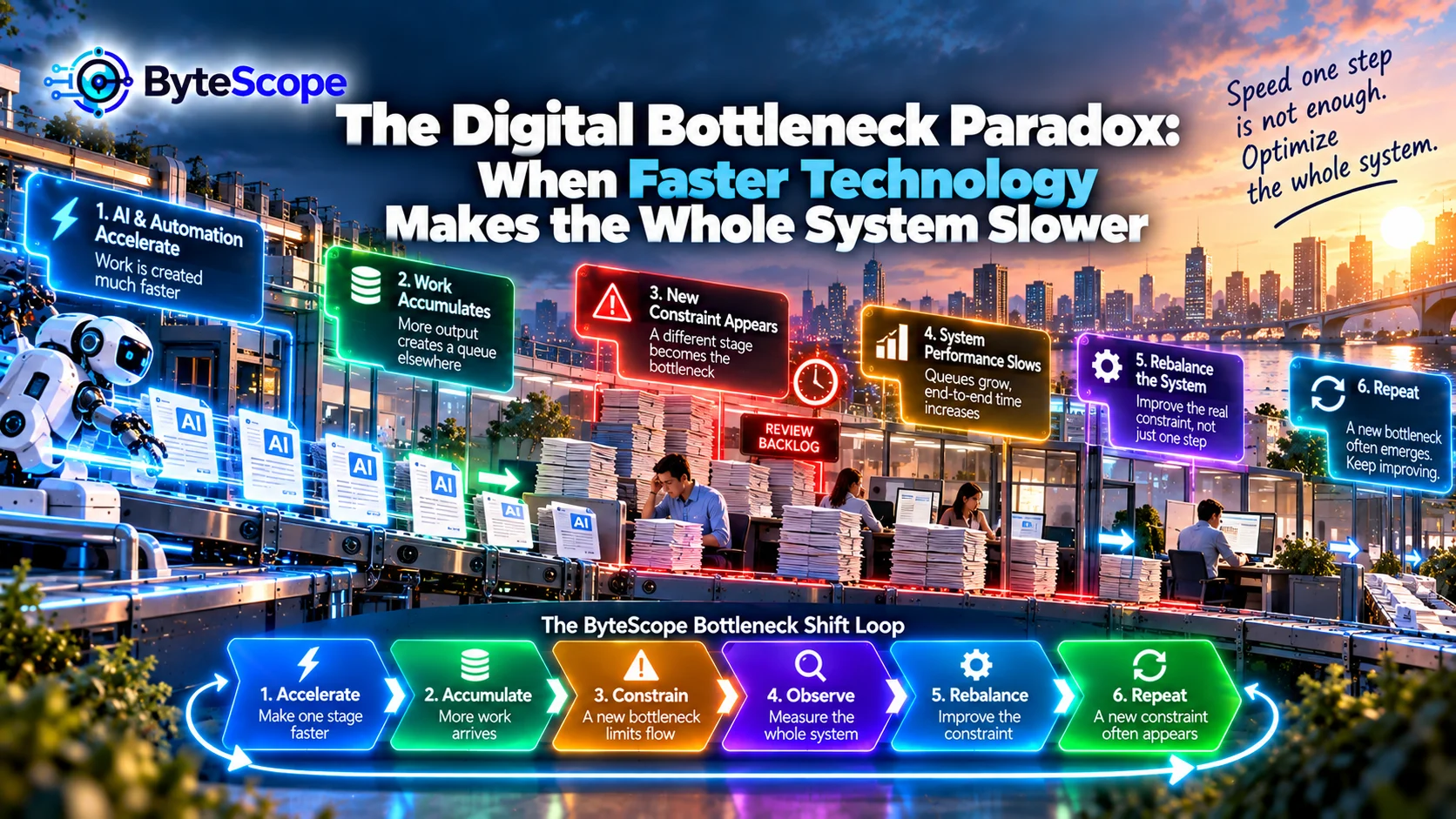
The ByteScope Bottleneck Shift Loop
To understand how this happens, ByteScope uses a six-stage framework:
Accelerate → Accumulate → Constrain → Observe → Rebalance → Repeat.
The loop recognizes an important truth:
when one bottleneck is removed, another often becomes visible.
Improvement is therefore not a one-time event.
It is a continuous process of identifying where the system is currently constrained.
1. Accelerate: Technology Makes One Stage Faster
Most digital improvement begins here.
A tool reduces the time required for a task.
Examples include:
- AI generating content;
- automation entering data;
- software classifying requests;
- cloud infrastructure increasing processing capacity;
- digital forms replacing manual paperwork;
- APIs transferring information between systems;
- analytics generating reports automatically.
This is genuine productivity improvement.
The mistake is assuming that local improvement automatically produces equivalent
end-to-end improvement.
AI Makes the Paradox Easier to See
Generative AI dramatically reduces the time needed to create certain kinds of output.
A marketing team may previously create five campaign concepts in a day.
With AI, it can create fifty.
That appears to be a tenfold productivity increase.
But someone still needs to evaluate the ideas.
Someone may need to verify factual claims.
Someone needs to choose which concepts fit the brand.
Someone may need to approve publication.
The generation bottleneck disappeared.
Evaluation became the new bottleneck.
Faster Creation Can Increase Review Work
This pattern occurs across many AI workflows.
AI can quickly generate:
- reports;
- code;
- design variations;
- summaries;
- customer responses;
- research notes;
- documents.
But greater output volume can increase the amount of material requiring human verification.
If quality assurance capacity remains unchanged, the queue moves downstream.
2. Accumulate: Faster Output Creates a Queue Somewhere Else
Once upstream capacity increases, work begins arriving faster at the next constrained
stage.
At first, the result may look positive.
More tasks are completed.
More documents are generated.
More leads are processed.
More customer requests are classified.
Then waiting begins increasing.
The queue is the visible symptom of imbalance.
Queues Are Information
Organizations often view queues only as problems.
They are also diagnostic signals.
A growing queue tells you that work is arriving faster than the next stage can process it.
The question is:
Why?
Possible explanations include:
- insufficient capacity;
- manual review requirements;
- limited specialist availability;
- too many approvals;
- poor-quality upstream output;
- system integration delays;
- unclear ownership.
The article
From Data Exhaust to Decision Signals
explored how operational information becomes valuable when it reveals something that
deserves action.
Queue growth is one of those signals.
The Review Queue Problem
AI makes review queues particularly important.
Suppose a financial team traditionally prepares ten analyses each week.
Managers review all ten.
An AI-assisted workflow now allows analysts to produce thirty.
Management review capacity remains ten.
Twenty analyses wait.
The organization can now create more analysis.
It cannot necessarily use more analysis.
Production capacity and decision capacity are different things.
3. Constrain: The Next Bottleneck Becomes the System Limit
Once work accumulates, the next constraint becomes visible.
This constraint may be technological.
A database cannot handle increased transaction volume.
An API has rate limits.
A network becomes saturated.
It may also be human.
Only three specialists can approve unusual cases.
One manager must sign every contract.
One employee understands how to resolve integration failures.
Or it may be procedural.
Every request requires multiple approvals regardless of risk.
The bottleneck does not care whether it is digital or human.
It simply limits flow.
Digital Transformation Often Reveals Old Organizational Constraints
Technology can expose inefficient rules that were previously hidden by slower work.
When document preparation took three days, a one-day approval did not seem significant.
When AI reduces preparation to ten minutes, that same approval suddenly dominates the
workflow.
The approval process did not become slower.
Everything around it became faster.
This changes where improvement should focus.
The Approval Bottleneck
Approvals are particularly common constraints.
Organizations often add approval steps to reduce risk.
Over time, every case may follow the same path regardless of consequence.
Digital systems then accelerate preparation while requests pile up waiting for approval.
A better design may distinguish:
- low-risk routine cases;
- moderate exceptions;
- high-consequence decisions.
Not every case necessarily requires the same level of review.
4. Observe: Measure the Whole Flow
The bottleneck paradox becomes difficult to detect when every team measures only its own
performance.
Marketing says lead generation increased 60 percent.
Sales says the number of uncontacted leads doubled.
Marketing looks successful.
The overall revenue system may not have improved.
Operations reports faster order processing.
Shipping reports a growing backlog.
Operations improved its local metric.
Customers may still wait longer.
System measurement therefore needs end-to-end metrics.
Measure Flow Time
Flow time is the total time required for something to travel from the beginning of a
workflow to the intended outcome.
For example:
customer request → final resolution.
Not:
customer request → initial automated response.
ByteScope’s
The Invisible Customer Journey
made a similar distinction between fast visible interactions and the hidden waiting that
occurs afterward.
A process can appear instant at the interface while remaining slow end to end.
Measure Waiting, Not Just Working
Most workflows spend surprisingly little time being actively processed.
They spend substantial time waiting.
A document may require:
- 20 minutes to prepare;
- 12 hours waiting for review;
- 10 minutes of review;
- 24 hours waiting for approval;
- 5 minutes to publish.
Automating the 20-minute preparation step creates limited improvement if 36 hours of
waiting remain.
This is why queue time often deserves more attention than task time.
Useful Bottleneck Metrics
Depending on the workflow, useful measurements may include:
- end-to-end completion time;
- queue size;
- time spent waiting at each stage;
- throughput per stage;
- rework rate;
- exception volume;
- utilization of constrained resources;
- work-in-progress volume.
These measurements reveal flow rather than isolated productivity.
Utilization Can Be Misleading
Organizations often try to keep every employee or machine fully utilized.
This sounds efficient.
But a system where every resource operates near maximum capacity can become extremely
sensitive to variation.
One unexpected task can create a queue.
One employee absence can cause delay.
One unusual customer case can push work into the next day.
Some spare capacity can improve resilience and flow.
5. Rebalance: Improve the Constraint Instead of Everything Else
Once the actual bottleneck is visible, improvement should focus there.
Suppose AI makes document creation nearly instant but human review remains slow.
Possible responses include:
- reducing unnecessary review;
- prioritizing high-risk documents;
- improving draft quality;
- giving reviewers better decision support;
- adding review capacity;
- automatically approving low-risk cases.
The correct response depends on why the bottleneck exists.
Do Not Automate Around a Bottleneck Without Understanding It
A slow stage may exist for a legitimate reason.
Perhaps the employee is making a high-consequence judgment.
Perhaps an approval protects against financial loss.
Perhaps a human inspection catches defects automation cannot reliably detect.
The objective is not:
remove every slow step.
It is:
understand why the step constrains the system and determine whether that constraint
is justified.
Automation Can Help the Bottleneck Instead of Replacing It
Sometimes the best use of automation is to assist the constrained resource.
For example, instead of automatically approving every application, AI may summarize the
relevant information and prioritize higher-risk cases for human review.
The reviewer remains responsible for the decision.
But the surrounding work becomes easier.
The principles discussed in
When Automation Helps—and When It Hurts
are useful here.
Automation should match predictability, consequence, reversibility, and the need for human
judgment.
6. Repeat: Every Improvement Creates a New System
After the bottleneck is improved, the workflow changes.
A different stage may now become the constraint.
This is normal.
Suppose:
- generation was the original bottleneck;
- AI accelerates generation;
- review becomes the bottleneck;
- review is redesigned;
- approval becomes the bottleneck;
- approval is streamlined;
- delivery capacity becomes the bottleneck.
The bottleneck moves because the system improved.
This is why optimization is continuous.
A Moving Bottleneck Is Not Failure
Finding another constraint after improving the first one can feel frustrating.
In reality, it can be evidence of progress.
The previous constraint no longer controls the system.
The next limit has become visible.
A mature organization expects this movement instead of assuming one technology project will
permanently solve throughput.
Example: AI Content Production
Consider a media team publishing articles.
The original process is:
Research → Draft → Edit → Fact-check → Publish
AI dramatically speeds up drafting.
The team can now create ten times more drafts.
But editors cannot review ten times more articles.
Fact-checkers cannot verify ten times more claims.
The publishing calendar may not need ten times more content.
The organization therefore needs to decide whether faster generation should create more
output or simply reduce the time required to produce the same amount at higher quality.
Faster generation does not automatically mean more production is desirable.
Example: AI Software Development
AI coding tools can accelerate code generation.
Developers may produce features more quickly.
But downstream constraints can include:
- code review;
- testing;
- security review;
- deployment;
- product approval;
- maintenance.
Generating more code can increase pressure on all of these stages.
The correct metric therefore should not simply be:
lines of code produced.
A more useful question is:
how quickly can a valuable, reliable change move from idea to production?
Example: Customer Support Automation
Imagine an AI system that instantly categorizes and summarizes customer tickets.
Previously, support agents spent ten minutes preparing each case.
That work disappears.
Now specialists receive requests much faster.
If specialist capacity does not increase, their queue grows.
The organization may report:
“AI reduced ticket-processing time by 70 percent.”
Customers may simultaneously experience longer resolution times.
Both statements can be true.
Example: Sales Lead Generation
Automation can generate and qualify more leads than a sales team previously handled.
This appears valuable.
But if sales representatives cannot contact the additional leads quickly, lead quality may
decline by the time follow-up occurs.
The bottleneck shifted from lead generation to sales capacity.
Generating more upstream work did not necessarily create more revenue.
Example: Manufacturing Automation
A factory automates one production station.
Output increases by 40 percent.
The downstream inspection station remains unchanged.
Products begin accumulating before inspection.
The automated machine looks highly productive.
The factory’s total output barely changes.
This is the physical version of the same digital principle.
Example: Automated Reporting
A business introduces analytics software that generates reports automatically.
Managers previously received five reports each week.
They now receive thirty.
The reporting bottleneck disappeared.
Human attention became the constraint.
This connects directly to
From Data Exhaust to Decision Signals
.
Faster information production creates little value if decision-makers cannot identify which
information deserves attention.
The Human Attention Bottleneck
This may become one of the defining constraints of AI-enabled organizations.
Machines can increasingly generate:
- text;
- analysis;
- code;
- images;
- recommendations;
- alerts;
- summaries;
- predictions.
Human attention does not scale at the same rate.
A manager still has a limited number of hours.
A reviewer can inspect only a certain amount of output carefully.
A customer can evaluate only a limited number of choices.
The future bottleneck may therefore be less about producing information and more about
deciding what deserves human attention.
AI Should Compress Work, Not Merely Multiply Output
A weak AI implementation asks:
“How can we produce more?”
A stronger question is:
“How can we reduce the amount of work required to reach the outcome?”
That distinction is critical.
If AI creates five times more content that humans must manually review, total work may
increase.
If AI summarizes ten documents into the three issues requiring attention, total work may
decrease.
Interoperability Can Remove Hidden Bottlenecks
Some bottlenecks are not caused by processing capacity.
They are caused by handoffs.
An employee finishes one task, then manually copies information into another system.
A second team waits for an email.
A report cannot begin until someone exports a file.
ByteScope’s
Interoperability Is the Real Superpower
explored how better-connected systems can remove these manual bridges.
A workflow can often become significantly faster without making any individual application
faster.
The improvement comes from eliminating waiting between applications.
The Last Mile Can Become the New Bottleneck
The article
The Last-Mile Problem of Digital Transformation
explored the gap between technology deployment and real-world use.
Bottlenecks can emerge at exactly this point.
An upstream system creates work quickly.
Frontline employees cannot use the output efficiently.
They need to reformat it.
Verify it.
Copy it.
Or manually adapt it to the real workflow.
The technology looks fast.
The point of use becomes slow.
Resilience Can Also Affect Bottlenecks
A system designed only for maximum speed may become fragile.
When something fails, throughput collapses entirely.
A more resilient design may sacrifice a small amount of peak efficiency in exchange for
continuity.
ByteScope’s
Designing for Failure
explored why spare capacity, graceful degradation, containment, and recovery can create
long-term value.
Maximum speed and maximum resilience are not always the same design goal.
Innovation Debt Can Become a Bottleneck
A workflow may also slow because years of digital shortcuts have created complexity.
One change requires updating several integrations.
Employees wait for information from legacy systems.
Nobody understands an old automation well enough to modify it safely.
The constraint is no longer computing capacity.
It is architectural complexity.
This is where
innovation debt
begins acting as a system bottleneck.
The Bottleneck Audit
Choose one important workflow.
Do not begin by asking which technology seems slow.
Map the complete process from trigger to outcome.
For every stage, record:
- processing time;
- waiting time;
- queue size;
- capacity;
- rework;
- exceptions;
- dependencies;
- ownership.
Then look for the point where work consistently accumulates.
That is likely closer to the true constraint than the component employees complain about
most loudly.
The “Where Is the Work Waiting?” Test
If you want an even simpler method, ask:
Where is unfinished work waiting right now?
Perhaps it is:
- in an approval queue;
- inside a support backlog;
- waiting for specialist review;
- waiting for information from another system;
- waiting for a customer response;
- waiting for an integration;
- waiting for management attention.
The location of waiting often reveals the constraint.
The One-Step Faster Test
For any proposed digital improvement, ask:
“If this step becomes ten times faster tomorrow, what happens next?”
If the answer is:
“The next team will receive ten times more work,”
you may be preparing to move the bottleneck rather than remove it.
Do Not Optimize Every Stage Equally
Suppose one stage is the true constraint.
Improving non-constrained stages may create little system-level benefit.
If a workflow can process only 30 requests per hour because of one specialist review,
making an upstream database 20 percent faster may not improve throughput.
Digital investment should therefore consider where additional capacity actually changes the
outcome.
Sometimes the Best Optimization Is Less Input
An overlooked way to improve a bottleneck is reducing the amount of work entering it.
For example:
Instead of giving a manager every AI-generated recommendation, filter low-confidence or
low-impact suggestions.
Instead of sending every transaction through manual approval, route only exceptions.
Instead of asking specialists to review every customer issue, resolve predictable cases
through self-service or automation.
Reducing unnecessary demand can be more effective than increasing capacity.
Seven Warning Signs of a Digital Bottleneck
- One team is consistently surrounded by growing queues.
- Upstream productivity rises while customer completion time stays unchanged.
- AI generates more output than employees can review.
- Employees spend substantial time waiting for approvals.
- More automation creates more exception handling.
- A single specialist, system, or integration limits several workflows.
- Every department reports better productivity while end-to-end performance barely improves.
Six Questions for Finding the Real Constraint
Apply the ByteScope Bottleneck Shift Loop:
- Accelerate: Which stage did technology make faster?
- Accumulate: Where did additional work begin piling up?
- Constrain: Which resource now limits completion?
- Observe: What happens to end-to-end time, queues, and throughput?
- Rebalance: Can capacity, workflow, prioritization, or demand be changed?
- Repeat: After improvement, where did the constraint move?
Frequently Asked Questions
What is the digital bottleneck paradox?
The digital bottleneck paradox occurs when technology makes one stage of a process much
faster without increasing the capacity of surrounding stages. Work then accumulates at the
next constraint, limiting overall improvement.
Can AI make a workflow slower?
Indirectly, yes. AI may accelerate generation, classification, or analysis while creating
more output for humans or downstream systems to review and process. If those stages lack
capacity, queues and total completion time can increase.
How do you identify a bottleneck?
Look for persistent queues, long waiting times, high utilization, repeated handoffs, and
stages where unfinished work accumulates. Measuring the complete workflow is more useful
than examining individual task speeds in isolation.
Should every bottleneck be automated?
No. Some bottlenecks involve judgment, safety, risk, or specialist expertise. The best
solution may be better prioritization, reduced demand, decision support, additional capacity,
workflow redesign, or selective automation.
Why does faster technology sometimes create more work?
Technology can dramatically increase the amount of output produced upstream. If that output
still requires human review, correction, approval, or downstream processing, the total
volume of work entering those stages may increase.
What is the difference between productivity and throughput?
Productivity can describe how efficiently a particular worker, machine, or process stage
produces output. Throughput describes how much completed output the entire system produces
over time. Local productivity can improve without increasing system throughput.
How does interoperability reduce bottlenecks?
Interoperability can eliminate manual transfers, duplicate data entry, synchronization
delays, and waiting between applications. This can improve flow even when the individual
systems themselves do not become faster.
The Bottom Line
Digital technology makes many things faster.
That does not automatically make the system faster.
AI can generate more documents.
Automation can process more transactions.
Cloud infrastructure can handle more requests.
Analytics can create more information.
But every workflow contains constraints.
When one constraint disappears, another becomes visible.
The ByteScope Bottleneck Shift Loop captures that movement:
Accelerate → Accumulate → Constrain → Observe → Rebalance → Repeat.
Technology accelerates one stage.
Additional work accumulates downstream.
A new resource becomes the constraint.
End-to-end measurements reveal where flow is being limited.
The system is rebalanced around the real bottleneck.
Then the process repeats as the constraint moves somewhere else.
This changes the question organizations should ask about technology.
Instead of:
“How much faster is this tool?”
ask:
“How much faster does the entire outcome become?”
That is a much harder question.
It is also much more useful.
Because customers do not care how fast one database processed a request.
They care how long it took to get the result.
Managers do not ultimately need more AI-generated analysis.
They need better decisions.
Organizations do not benefit simply because one employee can produce ten times more
material.
They benefit when the complete workflow creates more useful output with less unnecessary
waiting and effort.
The future of digital innovation may therefore require a different definition of speed.
Not the speed of the model.
Not the speed of the application.
Not the speed of the automation.
But the speed at which a real need moves through the entire system and becomes a useful
outcome.
That is the speed that matters.