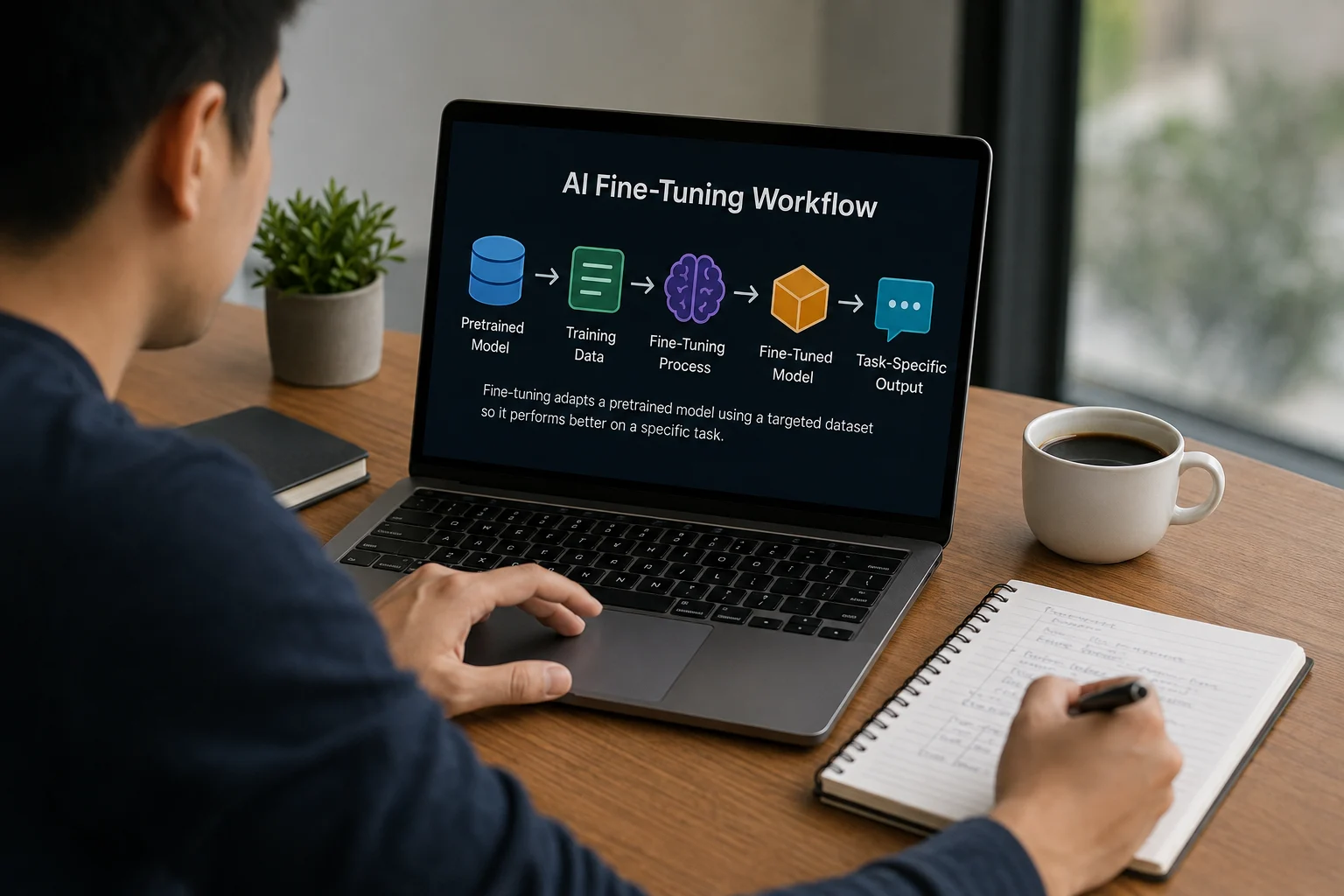
Modern AI applications often begin with a general-purpose model that can perform many tasks. Sometimes that is enough. In other cases, developers want the model to follow a particular style, produce a consistent format, or perform a specialized task more reliably. Fine-tuning is one way to adapt a pretrained model for that purpose.
Fine-tuning does not mean teaching a model everything from the beginning. It starts with a model that has already been trained and continues training it on a smaller, targeted dataset.
What Is Fine-Tuning?
Fine-tuning is additional training performed on an existing model. The developer provides examples that demonstrate the desired behavior, and the model’s parameters are adjusted so it becomes more likely to reproduce that pattern.
A dataset might contain examples of user requests paired with ideal responses, classification labels, preferred outputs, or other task-specific signals depending on the fine-tuning method.
The goal is usually behavior adaptation rather than general knowledge acquisition.
Why Start With a Pretrained Model?
Training a capable language model from scratch requires enormous datasets, computation, engineering, and evaluation. A pretrained model already contains broad language and reasoning capabilities.
Fine-tuning reuses that foundation. Developers can focus their resources on the behavior that matters for the application rather than recreating general language ability.
This is similar to specializing an experienced generalist rather than training a beginner from zero.
What Fine-Tuning Can Improve
Fine-tuning can help a model follow a consistent output structure, classify text in a domain-specific way, imitate a particular communication style, apply specialized terminology, or perform a repeated task with fewer instructions in every prompt.
It can also reduce prompt length because some patterns that previously needed long examples can become part of the tuned model’s behavior.
However, improvement depends heavily on the quality and consistency of the training data.
Fine-Tuning Is Not the Same as RAG
Fine-tuning changes the model’s behavior by updating its parameters. Retrieval-Augmented Generation leaves the model unchanged and supplies external information at answer time.
If the problem is “the model needs access to our latest policy documents,” RAG is often the better fit. If the problem is “the model must always produce this exact structured format,” fine-tuning may be useful.
Knowledge that changes frequently is usually difficult to manage through fine-tuning alone because the model would need new training whenever that information changes.
Fine-Tuning vs. Prompt Engineering
Before fine-tuning, developers should test whether better prompts can solve the problem. Clear instructions, examples, and structured outputs are much easier to change than model weights.
Prompt engineering is flexible and inexpensive to iterate. Fine-tuning becomes more attractive when the same behavior is needed repeatedly at scale or when prompt-only performance remains inconsistent.
Training Data Quality Matters
A fine-tuned model learns from the examples it receives. If those examples are inconsistent, incorrect, biased, or poorly formatted, the model can learn the same problems.
Datasets should represent the real range of tasks the model will encounter. They should include difficult cases rather than only perfect examples. Duplicates, contradictions, and accidental private information should be removed.
A smaller high-quality dataset can be more valuable than a much larger collection of noisy examples.
Overfitting and Narrow Behavior
A model can become too closely adapted to its fine-tuning data. This is known as overfitting. The system may perform well on familiar examples but struggle with new variations.
Evaluation should therefore use examples that were not part of the training set. Developers need to know whether the improvement generalizes rather than simply memorizing patterns.
Safety Can Change After Fine-Tuning
Fine-tuning may alter more than the intended behavior. A model that is modified for a specialized task should be reevaluated for safety, accuracy, and undesirable side effects.
This is especially important when training data contains risky instructions, sensitive content, or biased decision patterns. Fine-tuning should be part of a broader responsible AI process.
Parameter-Efficient Fine-Tuning
Not every fine-tuning method needs to update every parameter in the model. Parameter-efficient approaches can modify or add a smaller set of weights, reducing memory and compute requirements.
This is particularly useful with open models that developers want to customize on their own infrastructure.
When Fine-Tuning Is Worth Considering
Fine-tuning makes sense when a task is stable, repeated frequently, and clearly represented by examples. It is also useful when consistency matters enough to justify a training and evaluation pipeline.
For one-off tasks, constantly changing knowledge, or problems that can be solved with a better prompt, fine-tuning may add unnecessary complexity.
The Bottom Line
Fine-tuning adapts a pretrained AI model using a targeted dataset. It can improve consistency, task specialization, and formatting while reducing the amount of instruction needed in each prompt.
It is not a universal upgrade. Strong prompting, retrieval, and workflow design should usually be tested first. When fine-tuning is used, the quality of training data and evaluation matters more than simply creating a custom model.
A Practical Checklist Before You Rely on Fine-Tuning
Define the job first. Decide what success means before choosing a model or product. A system can look impressive in a demo while solving the wrong problem. Write down the expected output, the information it may use, the acceptable error rate, and which decisions still require a person.
Test representative examples. A useful first test is to start with a repeated task that has clear examples of ideal outputs and compare a tuned model against a strong prompt-only baseline. Include normal cases and difficult edge cases. The goal is to learn where the system is dependable and where it needs stronger instructions, additional tools, or human review.
Verify important outputs. Do not confuse fluency with correctness. Check facts, calculations, citations, permissions, and important transformations against a reliable source. The more expensive or difficult an error would be to reverse, the stronger the verification process should be.
Review privacy and access. Understand what information is being sent to the system, where it is stored, and who can retrieve it later. Give connected AI tools only the permissions they need. Sensitive data should follow the same governance rules that apply elsewhere in the organization.
Measure value over time. Track time saved, correction rate, reliability, user satisfaction, and operational cost. A tool that feels fast during the first week may not create lasting value if people spend the same amount of time fixing its output.
Common Mistakes to Avoid
One common mistake is choosing technology before defining the workflow. Another is testing only ideal examples. Teams also tend to add automation without planning what happens when the model is uncertain, the data is missing, or a connected service fails.
The most important limitation to keep in mind is that fine-tuning can encode inconsistent examples and may need retraining when the desired behavior changes. Build the workflow around that reality rather than assuming future model improvements will automatically solve it.
Frequently Asked Questions
Is fine-tuning always more accurate than a simpler approach?
No. AI is valuable when the task benefits from language understanding, pattern recognition, generation, or flexible decision support. A deterministic rule, database query, spreadsheet formula, or conventional software function can be better when the task is predictable and exact.
Do I need to understand the mathematics behind fine-tuning?
No. A conceptual understanding is enough for most users and product decisions. Mathematics becomes more important when you are implementing, optimizing, or researching fine-tuning at a technical level. Start with the purpose, inputs, outputs, tradeoffs, and failure modes before going deeper into equations.
What is the safest way to start using fine-tuning?
Begin with a narrow, reversible use case. Keep source material or original data available, review the output manually, and document the situations where the system fails. Expand automation only after the workflow performs consistently on representative examples and users know how to recover when it is wrong.